Wayground logo

Free Printable Worksheets

Font size

S
M
L
XL
Worksheets

Viruses and Bacteria Test

Total questions: 45

Worksheet time: 42mins

Name
Class
Date
1.

Which of the following is true for both bacteria and viruses?

a)

both contain genetic material

b)

can be killed using antibiotics

c)

have a cell membrane

d)

have a protein coat

2.

Which statement is true about viruses?

a)

Viruses can eat and metabolize food.

b)

Viruses can reproduce only using a host cell.

c)

Viruses can reproduce on their own at any time.

d)

Viruses contain DNA, so they are alive.

3.

One important way to control the spread of viruses in through

a)

the use of vaccines

b)

drinking a lot of tea

c)

the use of other types of bacteria

d)

the use of antibiotics

4.
Antibiotics can cure infections caused by
a)
viruses
b)
bacteria
c)
viruses or bacteria
d)
anything
5.
Where do bacteria live?
a)
only in water
b)
only inside living organisms
c)
only in the soil
d)
almost everywhere
6.
Different bacteria do different things, including
a)
helping people digest their food
b)
breaking down dead organisms
c)
turning milk into cheese
d)
all of the above
7.
A virus becomes active when it
a)
is in the open air
b)
enters water
c)
enters a living cell
d)
wakes up in the morning
8.

A bacterium reproduces asexually by dividing to form two new bacterial cells. What is the name of the process by which bacteria reproduce?

a)

meiosis

b)

mitosis

c)

budding

d)

binary fission

9.

Which of the following is a risk of overusing antibiotics to treat infections>

a)

Bacteria may become resistant to antibiotics.

b)

Antibiotics increase the rate of infection.

c)

Antibiotics cause other diseases to develop.

d)

Antibiotics only work once.

10.

Bacteria come in which of the following shapes?

a)

rod, cone, spiral

b)

rod, sphere, spiral

c)

rod, sphere, cone

d)

sphere, cone, spiral

11.

What do viruses need to reproduce?

a)

Genetic material

b)

A host cell

c)

Bacteria

d)

Insulin

12.
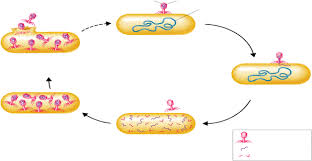
What process is this?
a)
phagocytosis
b)
lytic cycle
c)
lysogenic cycle
d)
formation of antibodies
13.

Which viral life cycle kills its host cell by lysing (bursting)?

a)

Lysogenic Cycle

b)

Lytic Cycle

c)

Binary Fission

d)

Conjugation

14.

Can a virus be cured with antibiotics?

a)

yes

b)

no

15.

Which is most often used to destroy bacteria?

a)

vaccine

b)

antibiotics

c)

vitamins

d)

water

16.
A(n) _____ is a virus that enters a bacterial cell.
a)
endospore
b)
decomposer
c)
plasmid
d)
bacteriophage
17.
Unlike the cells of eukaryotes, the cells of bacteria do not have
a)
a nucleus
b)
cell walls
c)
flagellum
d)
cells
18.
Some bacteria move by using a long, whip-like structure called a(n) ____________________
a)
tail
b)
cillia
c)
organs
d)
flagellum
19.

Reasons that viruses are considered to be nonliving is because

a)

They are not cellular

b)

They cannot reproduce on their own

c)

They cannot make proteins

d)

They cannot respond to stimuli.

20.

Which of the following is not a bacterial shape?

a)

bacilli

b)

spirilla

c)

maxilli

d)

cocci

21.
All bacteria are harmful.
a)
True
b)
False
22.
You have a cold, but your doctor will not give you an antibiotic, because
a)
antibiotics do not kill viruses.
b)
colds are not infectious.
c)
antibiotics make colds worse.
d)
antibiotics provide bacteria with food.
23.
When should you get a vaccine?
a)
Before you get sick
b)
After you get sick
c)
Only when you are a baby
d)
Only when you are old
24.
What does invading the host cell enable the virus to do?
a)
increase its size
b)
synthesize needed oxygen
c)
obtain nutrients
d)
reproduce
25.
The substance being transferred into the bacterial cell in B is
a)
a nucleic acid
b)
a protein
c)
an enzyme
d)
a hormone
26.
Nitrogen-fixing bacteria live on the roots of leguminous plants in swellings called nodules. The bacteria synthesize nitrogen compounds that are used by the plants, and the plants provide moisture and nutrients for the bacteria. The interaction between the nitrogen-fixing bacteria and the leguminous plants is known as
a)
parasitism
b)
mutualism
c)
saprophytism
d)
commensalism
27.

Which type of bacteria performs the first step in recycling nitrogen compounds from the bodies of plants and animals?

a)

nitrogen-fixing bacteria

b)

decomposing bacteria

c)

nitrifying bacteria

d)

denitrifying bacteria

28.
A piece of refrigerated, cooked meat will remain safe to eat for a longer period of time than a refrigerated piece of raw meat of similar size. Which statement is a valid inference based on this information?
a)
Cooking meat kills many bacteria and fungi.
b)
Cool temperatures stimulate the growth of microbes on raw meat.
c)
Raw meat cannot be preserved.
d)
Cooked meat contains antibodies that destroy decomposers.
29.
The graph represents the results of an investigation of the growth of three identical bacterial cultures incubated at different temperatures. Which inference can be made from this graph?
a)
Temperature is unrelated to the reproductive rate of bacteria
b)
Bacteria cannot grow at a temperature of 5°C.
c)
Life activities in bacteria slow down at high temperatures.
d)
Refrigeration will most likely slow the growth of these bacteria.
30.
When penicillin was first introduced, it was very effective in destroying most of the bacteria that cause gonorrhea. Today, certain varieties of this bacterium are resistant to penicillin. Which statement best explains the appearance of these resistant varieties?
a)
Penicillin stimulated the bacteria to become resistant, and this resistance was passed to the offspring.
b)
Penicillin killed the susceptible bacteria, while naturally resistant varieties survived and reproduced.
c)
Penicillin used today is not as strong as the penicillin used when it was first introduced.
d)
Penicillin stimulated the production of antigens in the resistant bacteria.
31.
A student investigated the effectiveness of four different mouthwashes in destroying bacteria. He inoculated the nutrient agar in four petri dishes with bacteria. Each of four paper disks, 1 centimeter in diameter, was soaked in a different mouthwash sample and placed on a different agar surface. Sterile procedures were used throughout the experiment. Each petri dish was placed in an incubator at a temperature of 37ºC for a 24-hour period. The diagram below represents the sequence of events in this investigation. The shaded areas in the petri dishes represent regions of bacterial growth. Which petri dish contains the most effective mouthwash?
a)
A
b)
B
c)
C
d)
D
32.
Enzymes are used in moving sections of DNA that code for insulin from the pancreas cells of humans into a certain type of bacterial cell. What will this bacterial cell's offspring be able to produce?
a)
human insulin
b)
antibodies against insulin
c)
enzymes that digest insulin
d)
a new type of insulin
33.

Where did the Corona Virus start?

a)

China

b)

Australia

c)

America

d)

Europe

34.

What is a novel virus?

a)

A virus that hasn't been seen before

b)

A virus that has been seen before

35.

Hand washing is an effective was to stop the spread of a virus.

a)

True

b)

False

36.

How can we reduce the risk of Coronavirus (COVID-19)? [Select all that apply]

a)

Washing our hands often for 20 seconds.

b)

Using our cellphones and sharing hot cheetos. Sharing is caring.

c)

Covering our mouth while coughing, specifically with tissue or the inside of our elbow.

d)

If we feel ill with fever, visit the doctor and stay home.

37.

Which of the following terms describes bacteria that occur in clusters?

a)

Strepto

b)

Staphlo

c)

Diplo

d)

Marxo

38.

Which type of bacteria is shown in this picture?

a)

Gram Positive Streptobacilli

b)

Gram Negative Streptobacilli

c)

Gram Negative Staphlobacilli

d)

Gram Positive Stphlococcus

39.

Which type of bacteria is shown in this picture?

a)

Gram Positive Streptococcus

b)

Gram Negative Staphlococcus

c)

Gram Positive Staphlobacilli

d)

Gram Positive Staphlococcus

40.

Which of the following is involved in forms of reproduction in bacteria? Select all that apply.

a)

Binnary Fission

b)

Conjugation

c)

Endospore Formation

d)

Sexual Reproduction

41.

Which structure(s) in bacterium allows the cell to communicate and sometimes conjugate?

a)

Pili

b)

Flagellum

c)

Plasmid

d)

Nucleoid

42.

What shape of bacterium is this?

a)

Bacillus

b)

Coccus

c)

Spirillus

d)

Maxius

43.

HIV is a "retrovirus". This means what?

a)

It has a really cool 70's theme happening.

b)

It has to use reverse transcriptase to infect host

c)

It infects host's RNA instead of it's DNA

d)

It's effects cannot be reversed

44.

What structures are visible on this bacterium? Choose all that apply.

a)

Flagellum

b)

Pili

c)

Capsule

d)

Plasmid

45.

Which protein, if present, is used to separate Archaebacteria from Eubacteria and Gram Positive bacteria from Gram Negative bacteria?

a)

Isoleucine

b)

Phenylalanine

c)

Peptidoglycan

d)

Tryptophan