
 Worksheets
Gerrymandering
Total questions: 13
Worksheet time: 7mins
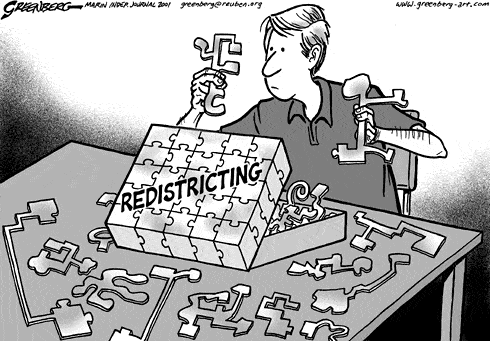

How many districts must be created across the United States for the House of Representative? Hint: it is obviously equal to the total number of seats in the House of Representatives.
643
435
200
100
Reapportionment is:
When district boundaries are drawn in order to benefit the party in power and help it stay in power
When seats in the House of Representatives are redistributed among states because of changes in population
When district boundaries are redrawn to reflect changes in population.
A measurement of the US population that occurs every ten years
In most states (but not all), who usually draws district boundaries?
The House of Representatives
The Senate
The Supreme Court
State legislatures
What do we call the official count of the population?
Reapportionment
Census
Century
Redistricting
How often does the census occur?
Every 4 years
Every 8 years
Every 10 years
Every 25 years
Only the ____ is reapportioned based on population changes.
Senate
House of Representatives
Which of the following are rules of redistricting after a census? Choose all that apply.
Districts must be compact.
Districts must be drawn every 5 years.
Districts must be contiguous.
Districts must be equal or almost equal in population.
Each Representative represents roughly about how many people?
2
100
700,000
1 billion
Packing is when:
District boundaries are drawn in order to benefit the party in power and help it stay in power
District lines are drawn in order to concentrate the opposing party in a few districts
District lines are drawn in order to spread the opposing party out across districts
When district lines are redrawn to reflect changes in population
Cracking is when:
District boundaries are drawn in order to benefit the party in power and help it stay in power
District lines are drawn in order to concentrate the opposing party in a few districts
District lines are drawn in order to spread the opposing party out across districts
When district lines are redrawn to reflect changes in population
Which of these is an accurate order of events?
Census --> reapportionment --> redistricting
Reapportionment --> redistricting --> census
Reapportionment --> census --> redistricting
Redistricting --> reapportionment --> census
How have some states attempted to stop the problem of political gerrymandering? Choose both that apply.
Continue having state legislatures create the lines to support their own political parties.
Have independent commissions create the lines.
Ignore the problem and hope it goes away.
Create computer algorithms to draw neat lines that do not take into account political data.

