wayground logo

Free Printable Worksheets

NEW

Font size

S
M
L
XL
Worksheets

Sound

Total questions: 40

Worksheet time: 49mins

Name
Class
Date
1.
travels through solids fastest because the molecules are closer together
a)
speed of sound
b)
wavelength
c)
frequency
d)
amplitude
2.
The number of wavelengths that pass a point each second
a)
frequency
b)
wavelength
c)
pitch
d)
amplitude
3.
Material (matter) through which a wave travels
a)
medium
b)
Doppler Effect
c)
sound
d)
pitch
4.
A wave in which the vibration is in the same direction as that in which the wave is traveling; sound waves
a)
longitudinal wave
b)
ocean wave
c)
transverse wave
d)
mechanical wave
5.
The part of a longitudinal wave where the particles of the medium are close together.
a)
rarefaction
b)
compression
c)
crest
d)
trough
6.
The number of wavelengths that pass a point each second
a)
crest
b)
amplitude
c)
frequency
d)
pitch
7.
A reflected sound wave
a)
frequency
b)
pitch
c)
echo
d)
rarefaction
8.
Highest point of a wave
a)
crest
b)
trough
c)
wavelength
d)
frequency
9.

What is transported by a wave?

a)

air

b)

energy

c)

matter

d)

particles

10.

A transverse wave is traveling through an unknown medium as shown in the diagram. How are the particles of the medium vibrating?

a)

parallel to the y-axis

b)

parallel to region R

c)

Parallel to the x-axis

d)

Parallel to Region Q

11.

A student listed some properties of waves.


Which properties did the student list incorrectly?

a)

3 and 2

b)

4 and 1

c)

2 and 4

d)

1 and 3

12.

The diagram shows a cartoon of a sound wave produced while a student is speaking.


What happens to the sound wave when the student speaks louder?

a)

The amplitude increases

b)

the wavelength will double

c)

the speed will increase

d)

the amplitude will decrease

13.

Two sound waves of different frequencies interfere and produce a resulting waveform shown with four points (W, X, Y, and Z) marked on the new wave.


At which point will the sound be the loudest ?

a)

W

b)

X

c)

Y

d)

Z

14.
When comparing the two waves that are shown, how would Wave A (green wave) differ than Wave B (black wave)?
a)
Wave A and B have the same amplitude, but wave B (black) has a lower pitch.
b)
Wave A and B have the same amplitude, but Wave A has a lower pitch. 
c)
Wave A and B have the same pitch, but Wave A is a softer sound. 
d)
Wave A and B have the same pitch, but Wave B is a softer sound. 
15.
What does pitch depend on?
a)
amplitude 
b)
frequency
c)
intensity 
d)
volume of sound
16.
Sound travels FASTEST through which of these materials?
a)
Air
b)
Empty space
c)
Metal
d)
Water
17.
What is vibration?
a)
how loud a sound is
b)
the back and forth movement of matter
c)
how high or low a sound is
d)
the loudness or softness of a sound
18.
Sound is a form of? 
a)
energy
b)
pitch
c)
volume
19.
A longer string makes a _______ pitch than a short string.
a)
louder
b)
softer
c)
higher
d)
lower
20.
To make a sound from a stringed instrument louder you must
a)
hit it
b)
pluck it harder
c)
hold it higher
d)
pluck it softer
21.
What is volume?
a)
how high or low a sound is
b)
the loudness or softness of a sound
c)
the number of vibrations per second
d)
vibrations
22.
What medium does sound travel through slowest?
a)
gas
b)
solid
c)
liquid
d)
trees
23.
Sound does not travel in space because
a)
Space is too far away.
b)
There is no matter in space.
c)
Space is the final frontier
d)
Space has planets.
24.
What is frequency?
a)
the number of vibrations per second
b)
how high or low a sound is
c)
the loudness or softness of a sound
d)
the back and forth movement of matter
25.

Which of these sound waves has the highest frequency?

a)
b)
c)
26.

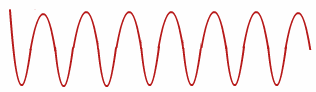
Which sound wave has the lowest pitch?
a)
b)
c)
27.

What part of the wave are the arrows pointing to?

a)

Crest

b)

Trough

c)

Amplitude

d)

Origin

28.

4. What do we hear thunder after we see a flash of lightning , usually some time later?

a)

Sound travels at a speed of 300,000,000 m/s. while light travels at a speed of 330 m/s.

b)

Sound travels at a speed of 330 m/s while light travels at a speed of 3,000,000 m/s.

c)

Sound travels at a speed of 330 m/s while light travels at a speed of 300,000,000 m/s.

d)

Because imagine dragons thunder, feel the thunder.

29.
When sound waves cause the eardrum to vibrate, these vibrations are immediately passed on to the_________.
a)
outer ear and ear canal
b)
inner ear
c)
tiny hairs
d)
three small bones in the middle ear
30.
What happens in the inner ear? 
a)
Sound waves are captured.
b)
Sound waves move deeper into the ear. 
c)
Sound waves are reflected.
d)
Sound waves are converted into nerve impulses.
31.
Where does HEARING (interpreting the nerve impulses) take place?
a)
outer ear
b)
middle ear
c)
inner ear
d)
brain
32.
What is #13?
a)
Eardrum
b)
Anvil
c)
Hammer
d)
Cochlea
33.
What is #19?
a)
Semicircular Canals
b)
Ear Canal
c)
Auditory Nerve
d)
Cochlea
34.
What is #2?
a)
Ear Canal
b)
Pinna
c)
Hammer
d)
Anvil
35.
Identify the order in which sound travels through the ear 
a)
hammer, stirrup, anvil, eardrum, ear canal
b)
ear canal, eardrum, hammer, stirrup, anvil 
c)
ear canal, eardrum, hammer, anvil, stirrup
d)
eardrum, ear canal, hammer, anvil, stirrup
36.

What is the unit of sound volume?

a)

joules

b)

hertz

c)

decibel

d)

amplitude

37.

What is the unit of sound frequency?

a)

joule

b)

hertz

c)

decibel

d)

pitch

38.

To calculate the speed of sound, you must?

a)

divide the distance by time

b)

divide time by distance

c)

multiply distance x time

d)

add distance and time

39.

What s the speed of sound in air?

a)

30m/s

b)

300m/s

c)

3,000m/s

d)

3 million M/s

40.

If a car is travelled 60km in 60 minutes, its speed is?

a)

60km /min

b)

600Km/min

c)

60Km/hour

d)

600Km/hour