wayground logo

Free Printable Worksheets

NEW

Font size

S
M
L
XL
Worksheets

COORDINATION

Total questions: 20

Worksheet time: 15mins

Name
Class
Date
1.
Which type of neuron transmits a signal from the central nervous system to an effector such as a muscle?
a)
sensory
b)
motor
c)
relay
d)
dendrite
2.
Which part of the nervous system is not involved in producing reflex actions?
a)
brain
b)
spinal cord
c)
receptors
d)
sensory
3.
What is the eye an example of?
a)
a stimulus
b)
a sense organ
c)
a relay neuron
d)
a part of nerve cell
4.
Which ions are involved in an action potential?
a)
Na; Cl
b)
Na; K
c)
K; Cl
d)
Na; Ca
5.
What is the normal resting potential of a neuron cell membrane?
a)
+40mV
b)
-30mV
c)
+55mV
d)
-70mV
6.
Which is the correct order of events in depolarisation then repolarisation? 
a)
Sodium channels close, potassium channels open
b)
Sodium channels open, potassium channels open, 
c)
Sodium channels open, potassium channels close
d)
Potassium channels open, sodium channels open
7.
When a neuron is not engaged in an impulse.
a)
Resting potential
b)
Action potential
c)
Neural potential
d)
Synaptic potential
8.
In resting potential, neurons have more _________ on the outside of the cell membrane.
a)
K+
b)
NaCl
c)
Na+
d)
Cl-
9.
What is the insulating membrane that surrounds parts of the axon that helps to protect & propagate action potential?
a)
Axon
b)
Dendrites
c)
Node of Ranvier
d)
Myelin Sheath
10.

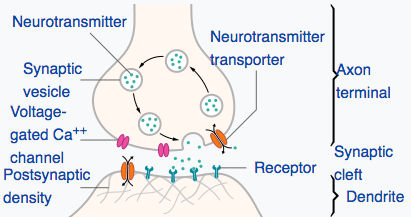
Chemicals released into a cleft when an action potential reaches the terminal are called.....

a)

ligand gated ion channels

b)

synaptic vesicles

c)

neurotransmitters

d)

voltage gated ion channels

11.

Which pattern shows how signals are transmitted from the presynaptic neuron to the post synaptic neuron

a)

electrical --> electrical

b)

electrical --> chemical

c)

chemical --> electrical --> chemical

d)

electrical --> chemical --> electrical

12.

What causes the release of neurotransmitters into the cleft?

a)

an action potential reaches the terminal

b)

ligand gated ion channels open

c)

excititory neurotransmitters bind to ligand gated ion channels

d)

an action potential on the post synaptic neuron triggers nearby voltage gated ion channels

13.
What generates a nerve impulse on the post-synaptic membrane? 
a)
Calcium binding with a receptor site
b)
Potassium leaking into the post-synaptic membrane 
c)
Neurotransmitter binding with receptor sites
d)
Neurotransmitter being removed from the synapse
14.

What chemical is activated by the action potential in the presynaptic neuron that causes the vesicles containing neurotranmitters to move toward the synaptic cleft?

a)

calcium

b)

potassium

c)

sodium

d)

phosphorus

15.

The action potential arrives at the ____ and depolarizes the ____ membrane.

a)

Axon terminal, pre-synaptic

b)

Axon terminal, post synaptic

c)

pre-synaptic, axon terminal

d)

post synaptic, axon terminal

16.

What is the response in the postsynaptic cell once the acetylcholine has bound to it?

a)

In opens the Na+ gated channels and Na+ rush in

b)

It opens the Ca2+ gated channels and Ca2+ rush in

c)

It closes the K+ channels creating a resting potential

d)

It releases its own neurotransmitter into the synaptic cleft

17.

Produces the hormone insulin and glucagon, which controls the level of glucose in the blood.

a)

Thyroid Gland

b)

Pancreas

c)

Thymus Gland

d)

Pituitary Gland

18.

These release testosterone, which controls changes in a male's body and regulates sperm production.

a)

Ovaries

b)

Target Cells

c)

Parathyroids

d)

Testes

19.
Where are the adrenal glands located?
a)
One on each side of the larynx
b)
On top of the kidneys
c)
Behind the orbital bone
d)
The inner ear
20.

What type of product is secreted by endocrine glands?

a)

Sweat

b)

Hormones

c)

Saliva

d)

Tears