
 Worksheets
Term 4 - Term 2 Quizizz Review
Total questions: 45
Worksheet time: 2hrs 53mins


Which makes a good index fossil?
a fossil not commonly found in rocks
a fossil that lived throughout geologic time
a fossil that lived during three geologic time periods
a fossil that lived during only one geologic time period and commonly found on many continents


this type of fossil provides evidence of the activities of ancient organisms; examples include marks left by footprints or tails
Index
carbon film
trace
cast
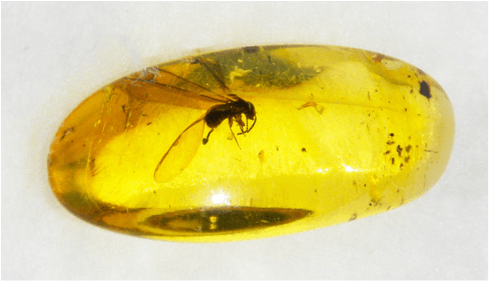

A crater in the Yucatan peninsula was believed by scientists to be the asteroid that struck Earth 65 million years ago. How did this catastrophic event affect the environment at that time?
Cause a mass extinction
Caused a massive tsunami
Caused an earthquake
Caused a volcanic eruption
What causes the water table to rise?
Evaporation
Condensation
Precipitation
Runoff
Sea-floor spreading in the Atlantic Ocean is causing North American and the Europe to move farther apart. At which type of boundary does sea-floor spreading occur?
transform boundary
convergent boundary
divergent boundary
subduction zone
Which type of crust forms mountains?
continental crust and oceanic crust converging
continental crust and continental crust converging
oceanic crust and oceanic crust diverging
oceanic crust and continental crust diverging
When the continental crust and the oceanic crust converge, why does the oceanic crust subduct beneath the continental crust?
The oceanic crust is lighter than the continental crust
The continental crust is much thinner than the oceanic crust
The continental crust has a greater density than the oceanic crust
The oceanic crust has a greater density than the continental crust
Rock layers on the East Coast of South America and rock layers on the West Coast of Africa are made of similar rock and are of the same age. What sort of evidence does this support?
The climates of both regions are the same
South America and Africa were once connected but drifted apart around 200 million years ago
Africa and South America formed at different times
Erosion caused the continents to separate
Which layer of the Earth lies immediately below the lithosphere?
hydrosphere
inner core
outer core
asthenosphere
After Alfred Wegener died, scientists believe that Earth's plates are moved by
earthquakes
the gravitational pull of the moon
convection currents in the mantle
ocean currents
What is formed when two oceanic plates converge?
a trench and volcanic islands
folded mountains
transform boundary
seafloor spreading
What is the name that Alfred Wegener gave to the large supercontinent?
Pantene
Gondwanaland
Pangaea
Laurasia
Caves are typically formed by
mechanical weathering and runoff
mechanical weathering and groundwater flow
chemical weathering and groundwater flow
chemical weathering and runoff
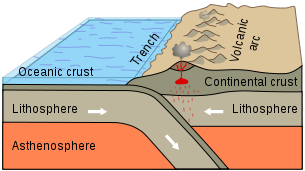
Subduction zones occur on Earth where dense oceanic crust dives under more buoyant continental crust. These boundaries are characterized by a deep ocean trench next to a high continental mountain range, large numbers of earthquakes and volcanoes. All of this is further evidence for the
big bang theory.
theory of plate tectonics.
origin of the species.
theory of natural selection.
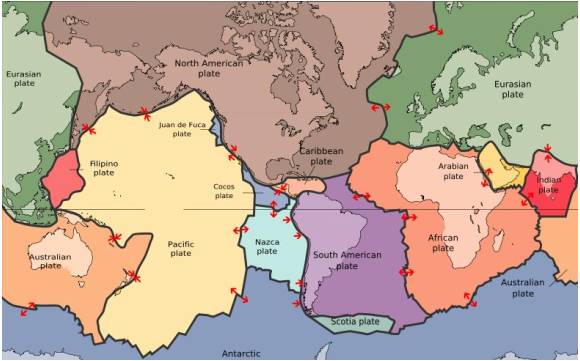
The map in the picture shows tectonic plate boundaries. This map would be useful in predicting the location of future
droughts
hurricanes
earthquakes
tornadoes
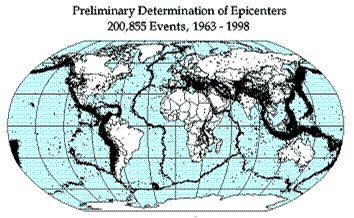
Earthquake epicenters (center of where the earthquakes started) were mapped for a 35 year period in the diagram above. The black dots indicate these epicenters. The black dots appear along what feature on Earth?
hot spots
plate boundaries
rift zones
sea floor spreading


What do you call melted rock once it hardens on the Earth's surface?
Intrusive Igneous Rock
Magma
Extrusive Igneous Rock
Metamorphic Rock
Geologists have classified rocks into three major groups of rocks which are:
inorganic, organic and chemical rocks
igneous, sedimentary and metamorphic rocks
metamorphic, chemical and non chemical rocks
sedimentary, inorganic and igneous rocks
What kind of igneous rock usually contains large crystals?
clastic
extrusive
organic
intrusive
A type of fossil formed when an organism is buried in sediments that changed into rock. The buried organism decays and leaves an impression of its shape, which then filled with sand and mud before hardening into the shape of the buried organism.
Cast Fossil
Mold Fossil
Preserved Fossil
Petrified Wood
Which rock was formed due to extreme heat & pressure?


Based on the rock cycle diagram, which statement would be true?
All rocks come from igneous rock
Weathering and erosion creates metamorphic rocks
The driving forces of the rock cycle are weathering, temperature, and pressure
Temperature alone is responsible for the creation of sedimentary rocks

Which is labeled correctly
1-Igneous Rock 2-Sedimentary Rock 3-Sediments 4-Metamorphic Rock
1-Metamorphic Rock 2-Igneous Rock 3-Sediments 4-Sedimentary Rock
1-Sedimentary Rock 2-Metamorphic Rock 3-Igneous Rock 4-Sediments
1-Sediments 2-Metamorphic Rock 3-Igneous Rock 4-Sedimentary Rock
How is metamorphic rock transformed to sedimentary rock?
Crystallization and cooling
Erosion and deposition
Volcanic eruption and cooling
Faulting and extreme heat
What is the first step in the process of the formation of sedimentary rock?
Compaction
Cementation
Deposition
Erosion

Which layer will be completely filled with groundwater?
O
A
B
C

How does soil properties affect the amount of water drained through each type of soil samples?
Gravel has less permeability than clay
Clay has less permeability than sand
Clay has a greater particle size than fine sand
Sand has a higher pH and more humus than clay
How does the size of the particle affect permeability?
Smaller the particles the higher the permeability
Smaller the particles the lower the permeability
Larger the particles the lower the permeability
Particle size does not affect the permeability

What part of the water cycle does arrow #5 represent in the water cycle diagram?
Precipitation
Evaporation
Infiltration
Run-off

