
 Worksheets
Electrostatics lesson -2 FHSS
Total questions: 25
Worksheet time: 23mins
When a balloon is rubbed on a sweater in what direction do the electrons move? (Pause and try to remember my Funny story Method)
From the sweater to the balloon
From the balloon to the sweater
They do not move
They travel to the groud
An atom of oxygen has 8 protons and 10 electrons, this means the atom is ____________
positively charged because it has excess electrons
negatively charged because it has excess electrons
positively charged because it has a deficiency of electrons
negatively charged because it has a deficiency of electrons
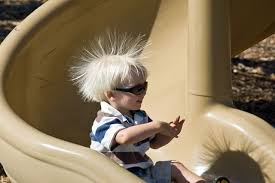
What method of static charging is shown in this picture
Contact
Friction
Grounding
Electron Shifting
When a charged object contacts another object (one is usually a conductor), there is a transfer of electrons. How do you determine which object acquires the transferred electrons?
Always transfer from the bigger to the smaller object, to make it even
Transfer is based on the initial charge of the two objects
Transfer is based on how much electron affinity that each object has
Always transfer from the more negative to the more positive object
A solid non-conducting sphere has a radius R and a charge of +Q uniformly distributed throughout its volume. Which graph below describes the electric field as a function of distance r from the center of the sphere?


A spherical conductor is given a positive charge. Under electrostatic conditions, which of the following is TRUE of the electric field just beneath the surface of the sphere?
The electric field is directed away from the center of the sphere.
The electric field in infinitely large.
The electric field is zero.
The electric field depends on the radius of the sphere.
The electric field is directed tangential to the surface of the sphere.
A billion electrons are added to a body, its charge becomes
1.6 X 10⁻¹⁹ C
1.6 X 10⁻²⁸ C
-1.6 X 10⁻¹⁰ C
-1.6 X 10⁻²⁸ C
Two charges of 20μC and -80μC are placed 80 cm apart. The distance of the point from the smaller charge where the intensity will be zero is:
80 cm
35 cm
30 cm
25 cm
What does the Law of Conservation of Charge state?
like charges repel and opposites attract
positive charge fields point away from a charge; negative points toward
charges cannot be created nor destroyed, only transferred
In an electric field, Point A has more electric field lines moving through it than Point B. Which is true?
Point A and Point B will have the same Force, but A will be farther away
Point A will have a stronger Force, Point B is farther away and has a weaker Force
Point A and Point B will have the same Force, but B will be farther away
Point B will have a stronger Force, Point A is farther away and has a weaker Force

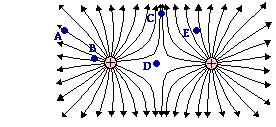
Label the charges respectively:
+; +
+; -
-; -
-; +
A physics instructor in an closed room charges an electrostatic generator to 25 mC, then carries it into the lecture hall. The net electric flux through the lecture hall walls is:
0 N×m2/C
25 x 10–6 N×m2/C
2.2 x 10⁵ N×m2/C
2.8 x 10⁹ N×m2/C

