wayground logo

Free Printable Worksheets

NEW

Font size

S
M
L
XL
Worksheets

Flow of Energy and Cycling of Matter

Total questions: 40

Worksheet time: 20mins

Name
Class
Date
1.

The trophic pyramid is a triangular shape because

a)

90% of energy is lost to heat, movement, and survival, and only 10% of energy goes to the next level

b)

People see the top of the pyramid so it is important to know the keystone species.

c)

10% of energy is lost to heat, movement, and survival, and only 90% of energy goes to the next level

d)

the top of the pyramid is the pinnacle organism of an ecosystem

2.

The job of decomposers in an ecosystem is to

a)

break down once living things from all levels of the ecosystem to recycle nutrients back to producers

b)

break down only top level consumers to recycle nutrients

c)

break down only producers to recycle nutrients

d)

give energy to all levels of the ecosystem

3.

Heterotroph means

a)

the organisms get their energy from eating other organisms

b)

the organisms make their own food from photosynthesis

c)

the organims get energy from breaking down once living things

4.

Autotroph means

a)

the organism can make its own food from photosynthesis

b)

the organsim gets its energy from eating other organisms

c)

the organism gets energy from breaking down once living things

5.

The food web shows

a)

many possible interactions and feeding relationships beween the organsims in the ecosystem

b)

a nice picture of what lives in the ecosystem

c)

the symbiotic relationships

d)

the keystone species

6.
Which consumers gets the most energy from the producers?
a)
Shark
b)
Herring
c)
Phytoplankton
d)
Crustaceans
7.
Which of the following energy pyramid represents the flow of energy in the food web shown starting with producers (bottom) to tertiary consumer (top)?
a)
Grass -> Bird -> Eagle -> Snake
b)
Grass -> Rabbit -> Bird ->  Eagle
c)
Eagle -> Lizard -> Worm -> Grass
d)
Grass -> Worm -> Bird -> Eagle
8.
A willy wagtail is an omnivore. It eats leaves, seeds, and worms, which also eats the leaves. Its predator the snakes and bobcats has to catch it first. Which of the following shows the correct flow of energy?
a)
Snakes -> Willy -> Leaves -> Worms
b)
Willy -> Leaves -> Worms -> Snakes
c)
Leaves -> Worms -> Willy -> Bobcats
d)
Leaves -> Seeds -> Willy -> Worms -> Snakes -> Bobcat
9.
Any organism that CANNOT make its own food internally...it has to eat or ingest other organisms!
a)
scavenger
b)
producer
c)
consumer
d)
decomposer 
10.
An organism that lives by breaking apart dead organic matter into simpler parts is...
a)
scavenger
b)
consumer
c)
decomposer
d)
carnivore
11.
Which organism recieves the least amount of energy from the producer?
a)
Owl
b)
Grasshopper
c)
Lilypad
d)
Mouse
12.
What percentage of energy is passed on to each trophic level?
a)
10%
b)
50%
c)
90%
d)
100%
13.
The arrows in a food chain or web represent ...
a)
They point to the organism that is being eaten.
b)
It shows how sunlight flows within an ecosystem.
c)
They show the direction the energy is flowing between organisms. 
d)
They represent how water is transferred within a habitat.
14.
The owl and weasel compete for which organism?
a)
Hawk
b)
Spider
c)
Grasshopper
d)
Shrew
15.
Which of the following would be the most likely effect, if there were a sudden increase in the cricket population?
a)
There would be a decrease in the small bird population.
b)
There would be a decrease in the grass/flowers population.
c)
There would be a decrease in the mice population.
d)
There would be an increase in the grass/flowers population.
16.
Which of the following best describes the small bird in the food web above?
a)
primary and secondary consumer
b)
secondary and tertiary consumer
c)
primary consumer only
d)
secondary consumer only
17.
The diagram represents a pyramid of energy in an ecosystem.  Which level would most likely contain organisms that can photosynthesize?
a)
A
b)
B
c)
C
d)
D
18.
If there are 100 kcal of energy available in the producers, how much energy would be available to the herbivores?
a)
10 Kcal
b)
1 Kcal
c)
100 Kcal
d)
1000 Kcal
19.
Which organism(s) in the food web above can be described as quaternary consumers?
a)
owl and mosquito
b)
mouse only
c)
small bird and owl
d)
owl only 
20.
Which organisms have the most energy? 
a)
ladybugs
b)
plants
c)
owl
d)
mosquitoes
21.
If these organisms were arranged in an ecological biomass pyramid, which organism would have the least amount of biomass?
a)
coyote
b)
insect
c)
lizard
d)
shrub
22.
If the small bird on trophic level 3 in the pyramid has 50 kcal of energy available, how many kcal of energy were present in the trees?
a)
5
b)
500
c)
5000
d)
0.5
23.
Which organisms would likely have the largest biomass?
a)
mountain lions and eagles
b)
snakes and frogs
c)
squirrels and deer
d)
flowers, trees and fruit
24.

An ecologist notes an increase in algae growth in a river adjacent to a farm that uses fertilizers. What can she infer from this information?

a)

The water contains too much phosphorus.

b)

The water contains too much nitrogen.

c)

The water contains too little phosphorus.

d)

The water could contain too much nitrogen or phosphorus, but there is not enough information to tell which.

25.

Which cycle is shown in this diagram?

a)

Nitrogen

b)

Carbon

c)

Phosphorus

d)

Water

e)

Oxygen

26.

Which cycle is shown in this diagram?

a)

Nitrogen

b)

Carbon

c)

Phosphorus

d)

Water

e)

Oxygen

27.

Which cycle is shown in this diagram?

a)

Nitrogen

b)

Carbon

c)

Phosphorus

d)

Water

e)

Oxygen

28.

What converts nitrogen gas into a usable form for plants and animals?

a)

bacteria

b)

rain

c)

fungi

d)

car exhaust

29.
The process of plants losing water through their leaves is called ____.
a)
condensation
b)
evaporation
c)
transpiration
d)
exhaling
30.

Humans and animals can use nitrogen directly from the atmosphere (N2).

a)

True

b)

False

31.

Earth's atmosphere is made up of how much nitrogen?

a)

60%

b)

28%

c)

98%

d)

78%

32.
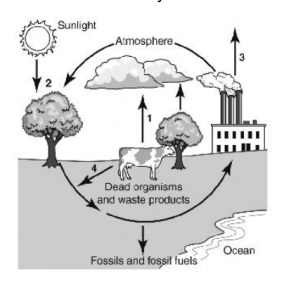
What is happening at 1?
a)
respiration: releasing CO2
b)
decomposing COin the soil
c)
photosynthesis: absorbing CO2
d)
turning CO2 from the atmosphere into organic molecules
33.

What drives the water cycle, by providing the energy for water to evaporate?

a)

The moon

b)

The sun

c)

A car

d)

The earth

34.
In the energy pyramid here, how much of the energy in each level gets lost as heat or used by the organism for survival?
a)
80%
b)
90%
c)
10%
d)
20%
35.
How many primary consumers are there in this food web?
a)
1
b)
2
c)
3
d)
4
36.

Several owls live in a forest. The owls prey on mice. Hawks also prey on mice. Which might happen if several hawks move to the forest where the owls live?

a)

The number of owls will increase, and the number of hawks will decrease.

b)

The number of mice will increase, and the number of owls will decrease.

c)

The number of owls and hawks will increase.

d)

The number of owls and mice will decrease.

37.
Which of the following is a "primary energy source"?
a)
Grass
b)
Sun
c)
Bacteria
d)
Soil
38.
The cycling of matter is important because
a)
Matter can be created and destroyed
b)
Only a limited amount of matter is available so it has to be recycled
c)
Matter can only be found in a solution
d)
Bacteria use matter to convert organisms into solar energy
39.

In the diagram above, where is light energy converted to chemical energy?

a)

Sun

b)

Grass

c)

Grasshopper

d)

Hawk

40.

What is the correct arrangement of these organisms on an energy pyramid?

a)
b)
c)
d)