wayground logo

Free Printable Worksheets

Font size

S
M
L
XL
Worksheets

Chemistry - Chapter 20 -Solubility/Colloid Test

Total questions: 65

Worksheet time: 1hrs 8mins

Name
Class
Date
1.

Polar substances will dissolve other polar substances and ionic substances because:

a)

they have an uneven charge distribution

b)

they have an even charge distribution

c)

they are smaller

d)

they are larger

2.

What is a solvent

a)

A liquid that will dissolve a solid solute

b)

Another word for solution

c)

A thing that make drinks change colour

d)

Usually the solid about to be dissolved

3.

The ___ is the thing being dissolved.

a)

solute

b)

solvent

c)

mixture

d)

solution

4.
Solutions are composed of __________ .
a)
salts and solutes
b)
solvents and salts
c)
solutes and alloys
d)
solutes and solvents
5.

If I dissolve salt in water, what is the solvent?

a)

salt

b)

water

c)

salt & water

d)

none of the above

6.
How does a solution become supersaturated?
a)
dissolve lots of solute in it.
b)
dissolve a little solute in it. 
c)
dissolve more solute than you should be able to. 
d)
dissolve a solvent in it. 
7.
Solution where more solute can still be dissolved at the given temperature. 
a)
Saturated
b)
Unsaturated
c)
Mixture
d)
Homogeneous solution
8.
__________ are made up of solutes and solvents.
a)
Solutions
b)
Suspensions
c)
Heterogeneous Mixtures
d)
Pure Substances
9.
When a solvent contains as much of the solute as it can hold, the solution is said to be
a)
supersaturated
b)
diluted
c)
saturated
d)
unsaturated
10.
You can make a solution more concentrated by adding __________.
a)
solute
b)
solvent
c)
water
11.

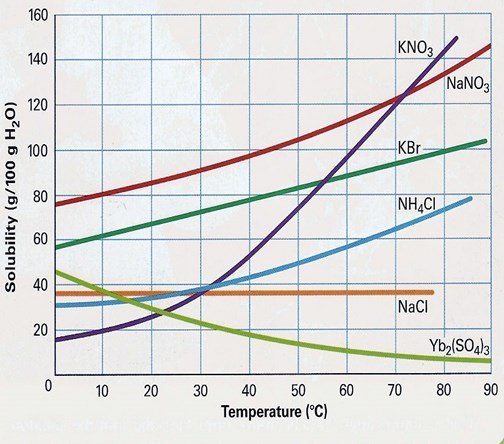
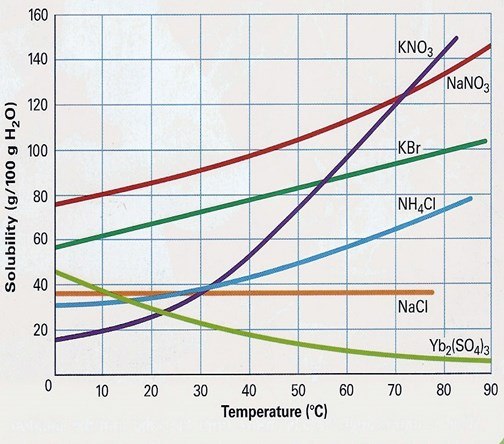
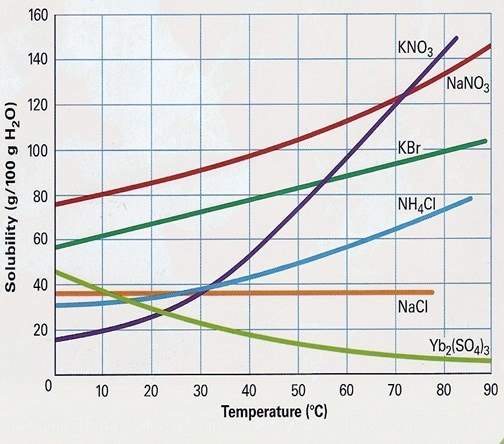
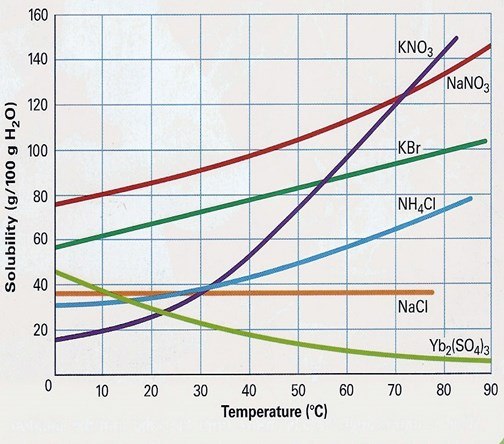
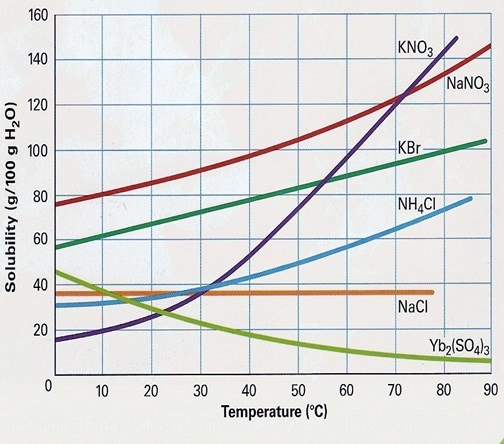
At which temperature do KBr and KNO3 have the same solubility?

a)

60

b)

55

c)

50

d)

Never

12.

At 80'C, KBr's solubility is:

a)

100

b)

90

c)

80

d)

0

13.

Determine the solubility for the substances at 55'C and arrange them in order from lowest to highest solubility.

a)

NaCl, NH4Cl, KBr, NaNO3

b)

NaCl, NH4Cl, NaNO3, KBr

c)

NH4Cl, NaCl, NaNO3, KBr

d)

NaNO3, KBr, NH4Cl, NaCl

14.

Identify if the following solution would be saturated, unsaturated, or supersaturated: 103 g KBr at 70'C.

a)

Unsaturated

b)

Saturated

c)

Supersaturated

15.

Identify how many grams of KNO3 is required to make a saturated solution at 40'C.

a)

50 g

b)

45 g

c)

60 g

d)

33 g

16.

How could you change a saturated solution to an unsaturated solution?

a)

Add solvent

b)

Add solute

17.

What type of mixture separates upon standing and has the largest particles?

a)

Solution

b)

Alloy

c)

Colloid

d)

Suspension

18.

How many grams of NaCl are soluble in 100 g of water at 10 ºC?

a)

35 grams

b)

100 grams

c)

40 grams

d)

10 grams

19.

If you have 0.050 L of 0.500 M potassium bromide. How many moles of potassium bromide are present? (CORRECTLY ROUND TO 2 SIGFIGS)

a)

20.9 mol

b)

0.021 mol

c)

0.025 mol

d)

0.0209 mol

20.

Which one of the terms describes particles of intermediate size and are dispersed in the mixture?

a)

solutions

b)

colloids

c)

suspensions

d)

homogeneous

21.

If water can dissolve a covalent bond, that covalent bond is said to be

a)

polar

b)

nonpolar

c)

highly ionic

d)

none of the choices are correct

22.
Which is the correct net ionic equation for the reaction of AgNO3 and CaCl2?
a)
Ca2+(aq) +  2Cl- (aq) → CaCl(s)
b)
Ag+(aq)  +  Cl- (aq) → AgCl(s)
c)
Ag +  Cl  →  AgCl
d)
Ag+  +  Ca2+   →Ag2Ca (s)
23.
What are the spectator ions in this reaction?
CuCl2(aq) + NaOH(aq) → Cu(OH)2(s) + NaCl(aq)
 
a)
Cu2+ and OH1-
b)
Na2+ and Cl2-
c)
Na1+ and Cl1-
d)
Na1+ and OH1-
24.

What of these is always soluble?

a)

Nitrates

b)

Phosphates

c)

Carbonates

d)

Hydroxides

25.
Is NaCl soluble or insoluble?
a)
Soluble
b)
Insoluble 
c)
Neither
d)
Soluble and Insoluble
26.
Is AgCl soluble or insoluble?
a)
Soluble
b)
Insoluble
c)
Neither 
d)
Both
27.

What is meant by aqueous?

a)

dissolved in water

b)

in powder form

c)

not soluble

d)

a precipitate forms

28.
Which substance is MOST soluble at 0 ºC?
a)
KI
b)
NaNO3
c)
NaCl
d)
Ce2(SO4)3
29.
When 20 grams of potassium chlorate, KClO3, is dissolved in 100 grams of water at 80 ºC, the solution can be correctly described as:
a)
supersaturated
b)
saturated
c)
unsaturated
30.
When two liquids mix, they are said to be....
a)
insoluble
b)
miscible
c)
soluble
d)
immiscible
31.

Molality (m) = moles of solute / _________________________.

a)

kilogram of solvent

b)

kiloliter of solvent

c)

kilometer of solvent

d)

ounces of solvent

32.

What is the molality of a solution made by dissolving 2 moles of NaOH in 400 grams of water?

a)

5 mol/kg. solvent

b)

4 mol/kg solvent

c)

3 mol/kg. solvent

d)

2.5 moles /kg solvent

33.

Molarity is measured in _____.

a)

moles per g.

b)

mols per L.

c)

moles per mm.

d)

moles per mL.

34.

What do molarity and molality have in common?

a)

Both have "moles solute" in the numerator

b)

Both have "kg solvent" in the denominator

c)

Both have "L solution" in the denominator

d)

Both have "moles solution" in the denominator

35.

What are the units of molarity?

a)

M

b)

m

c)

Ml

d)

Mr

36.

What are the units of molality?

a)

M

b)

m

c)

Ml

d)

Mr

37.

What is the molality of a solution in which 3.0 moles of NaCl is dissolved in 1.5 Kg of water?

a)

2.0 M

b)

0.22 m

c)

135 m

d)

2.0m

38.
Sugar water is a 
a)
solution
b)
suspension
c)
colloid
39.
Italian dressing is a
a)
solution
b)
suspension
c)
colloid
40.
Sand floating in water, but most of the sand is settled at the bottom this an example of which type of mixture?
a)
A solution
b)
A colloid
c)
A suspension
d)
A compound
41.
Particles are spread throughout a fluid but are too large to stay mixed w/o being stirred or shaken.
a)
suspension
b)
colloid
c)
solution
42.

Which of the following would leave particles on filter paper?

a)

Solution

b)

Suspension

c)

Colloid

43.

A type of mixture where the particles are larger than those in a solution but not heavy enough to settle out.

a)

Homogeneous mixture

b)

Colloid

c)

Suspension

d)

Compound

44.
Which are different types of mixtures
a)
suspension
b)
solution
c)
colloid
d)
all the above
45.
What are the spectator ions in the reaction of sodium chloride with silver nitrate?
a)
silver and nitrate
b)
sodium and chloride
c)
sodium and nitrate
d)
silver and chloride
46.
Which is the correct net ionic equation for the reaction of AgNO3 and CaCl2?
a)
Ca2+(aq) +  2Cl- (aq) → CaCl(s)
b)
Ag+(aq)  +  Cl- (aq) → AgCl(s)
c)
Ag +  Cl  →  AgCl
d)
Ag+  +  Ca2+   →Ag2Ca (s)
47.
Which is the correct net ionic equation for the reaction of AgNO3 and CaCl2?
a)
Ca2+(aq) +  2Cl- (aq) → CaCl(s)
b)
Ag+(aq)  +  Cl- (aq) → AgCl(s)
c)
Ag +  Cl  →  AgCl
d)
Ag+  +  Ca2+   →Ag2Ca (s)
48.
What precipitate forms when you mix lead (II) nitrate with sodium chloride?
a)
sodium nitrate 
b)
lead (II) chloride 
c)
sodium lead
d)
chloride nitrate 
49.

Which of the following is the correct symbol for a substance in a water solution?

a)

cr

b)

aq

c)

l

d)

s

50.
Which of the following does NOT form a precipitate?
a)
Pb(NO3)2(aq) + 2KI(aq) 
b)
Sr(NO3)2 (aq) + K2SO4(aq) →
c)
AgNO3(aq) + Na2S(aq) →
d)
 Pb(NO3)2(aq) + AgNO3(aq) →
51.
Which is the correct net ionic equation for the reaction of AgNO3 and CaCl2?
a)
Ca2+(aq) +  2Cl- (aq) → CaCl(s)
b)
Ag+(aq)  +  Cl- (aq) → AgCl(s)
c)
Ag +  Cl  →  AgCl
d)
Ag+  +  Ca2+   →Ag2Ca (s)
52.
In this equation,
ZnCl2 + LiOH  → Zn(OH)2 + LiCl
Which product is insoluble?
a)
zinc hydroxide
b)
lithium chloride
c)
lithium hydroxide
d)
zinc chloride
53.
Which of the following is the correct net ionic equation for
3AgNO3 (aq) + Na3PO4(aq) --> Ag3PO4(s) + 3NaNO3 (aq)
a)
Ag+1 (aq) + PO4-3(aq) --> Ag3PO4(s) 
b)
3Ag+1 NO3-1 (aq) + 3Na+1 PO4-3(aq) --> Ag PO4(s) + 3Na+1 NO3-1 (aq)
c)
3Ag+1 (aq) + PO4-3(aq) --> Ag3PO4(s) 
d)
None of the above
54.

What are spectator ions?

a)

ions in solution

b)

unreacted ions that don't take part in the reaction.

c)

solid species formed by low solubility

55.
KBr
a)
Soluble
b)
Insoluble
56.
Zinc Hydroxide
a)
Soluble 
b)
Insoluble
57.
Zinc Carbonate
a)
Soluble 
b)
Insoluble 
58.
KOH
a)
Soluble 
b)
Insoluble
59.
PbI2
a)
Soluble
b)
Insoluble
60.
K2CO3
a)
soluble
b)
insoluble
61.
Ca(OH)2
a)
soluble
b)
insoluble
62.
FeS
a)
soluble
b)
insoluble
63.
K2SO4
a)
soluble
b)
insoluble
64.
NH4NO3
a)
soluble
b)
insoluble
65.
BaCl2
a)
soluble
b)
insoluble