wayground logo

Free Printable Worksheets

Font size

S
M
L
XL
Worksheets

Hydrology Practice

Total questions: 35

Worksheet time: 29mins

Name
Class
Date
1.
 When water vapor changes to liquid water 
a)
evaporation
b)
 condensation
c)
humidity
d)
precipitation
2.
What percent of Earth’s water is freshwater 
a)
1%
b)
2%
c)
3%
d)
5%
3.
What is Salinity? 
a)
how much salt is in any given liquid
b)
salt on the rocks
c)
how much salt is in takis
4.
What causes deep ocean currents?
a)
moon's gravitational pull
b)
temperature, density, salinity
c)
wind
5.
How do clouds form? 
a)
smoke from factories
b)
when condensation near land freezes
c)
when water vapor condenses and cools 
6.
What gives the water cycle its energy 
a)
sun
b)
moon
c)
fire
d)
ice
7.
What percent of Earth’s water is saltwater 
a)
79%
b)
98%
c)
3%
d)
97%
8.
What is it called when plants give off water vapor as a waste product?
a)
condensation
b)
evaporation
c)
sublimation
d)
transpiration
9.
What is an underground layer of rock or soil filled with water called?
a)
Aquifer
b)
Spring
c)
Well
d)
Reservoir
10.
Water stored below the Earth's surface is called:
a)
Groundwater
b)
Bogs
c)
Water in the ground
11.
Snow, sleet, hail, and rain are all examples of  ________________. 
a)
evaporation
b)
condensation
c)
accumulation
d)
precipitation
12.

Name two factors that increase salinity

a)

Evaporation and freezing

b)

Near the mouth of river and freezing

c)

Condensation and Precipitation

d)

Evaporation and melting

13.

Explain how convection currents allow ocean surface currents to flow around the globe.

a)

Warm water rises, cool water sinks

b)

Warm water rises, warm water sinks

c)

Cool water rises, cool water sinks

d)

Cool water rises, cool water sinks

14.

What is the difference between in the movement of both surface and deep ocean currents?

a)

Surface: Wind

Deep Ocean: Temperature and density

b)

Surface: Wind

Deep Ocean: Temperature and salinity

c)

Surface: Wind

Deep Ocean: Temperature and pressure

d)

Surface: Wind

Deep Ocean: Temperature

15.
Where is most water found on the Earth? 
a)
In Glaciers
b)
In Lakes
c)
In Rivers
d)
In the Ocean
16.

Due to the Coriolis Effect, surface currents curve:

a)

clockwise in the northern hemisphere,

counter clockwise in the southern hemisphere

b)

counter clockwise in the northern hemisphere,

clockwise in the southern hemisphere
17.
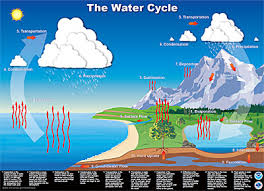
During which stage do clouds form?
a)
condensation
b)
evaporation
c)
precipitation
d)
runoff
18.
Which represents the distribution of water on Earth?
a)
3% freshwater, 97% salt water
b)
97% freshwater, 3% salt water
c)
71% freshwater, 29% salt water
d)
29% freshwater, 71% salt water
19.
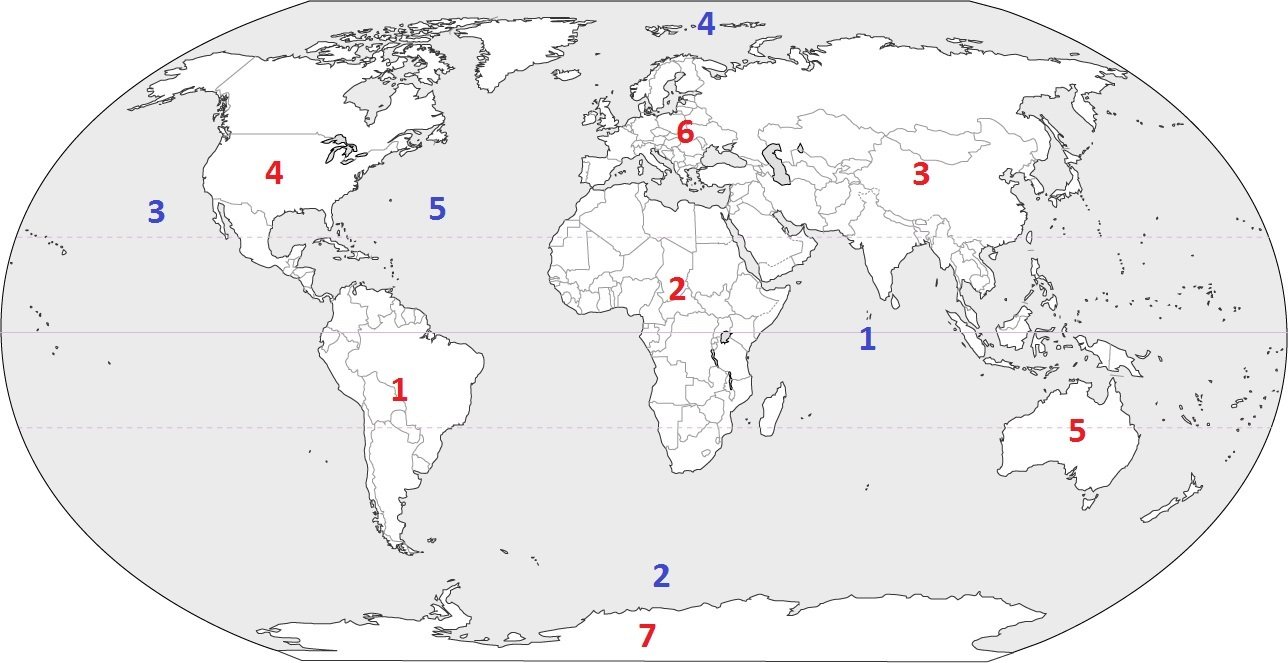
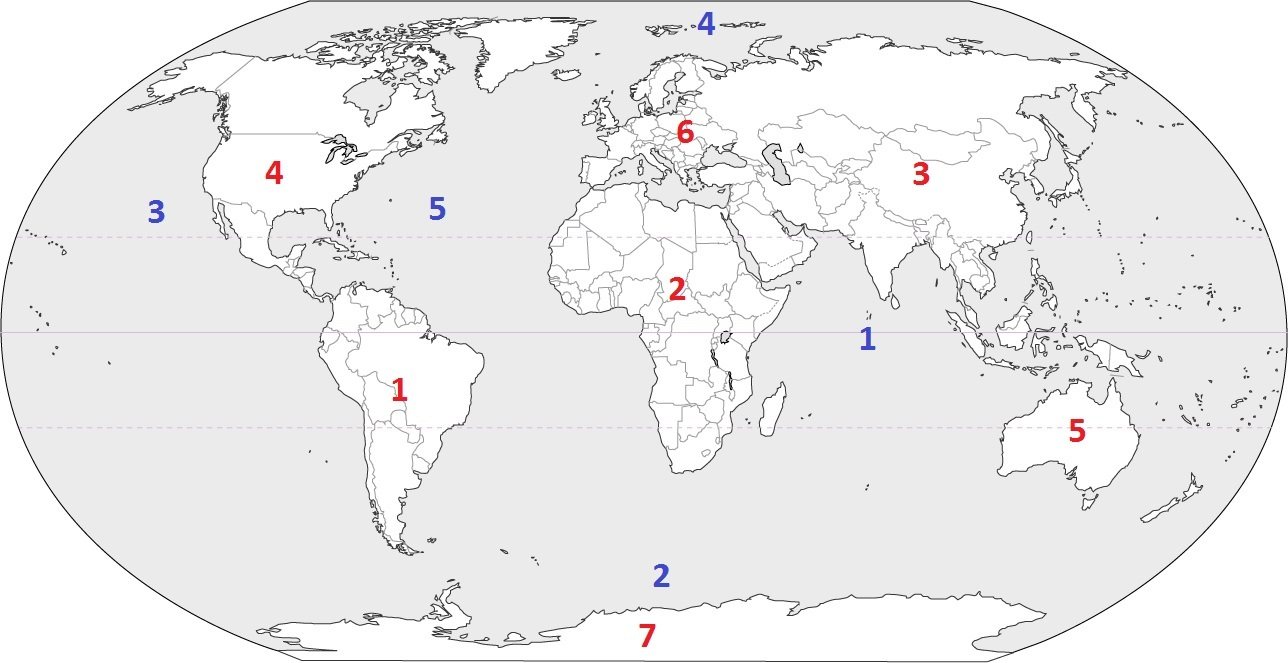
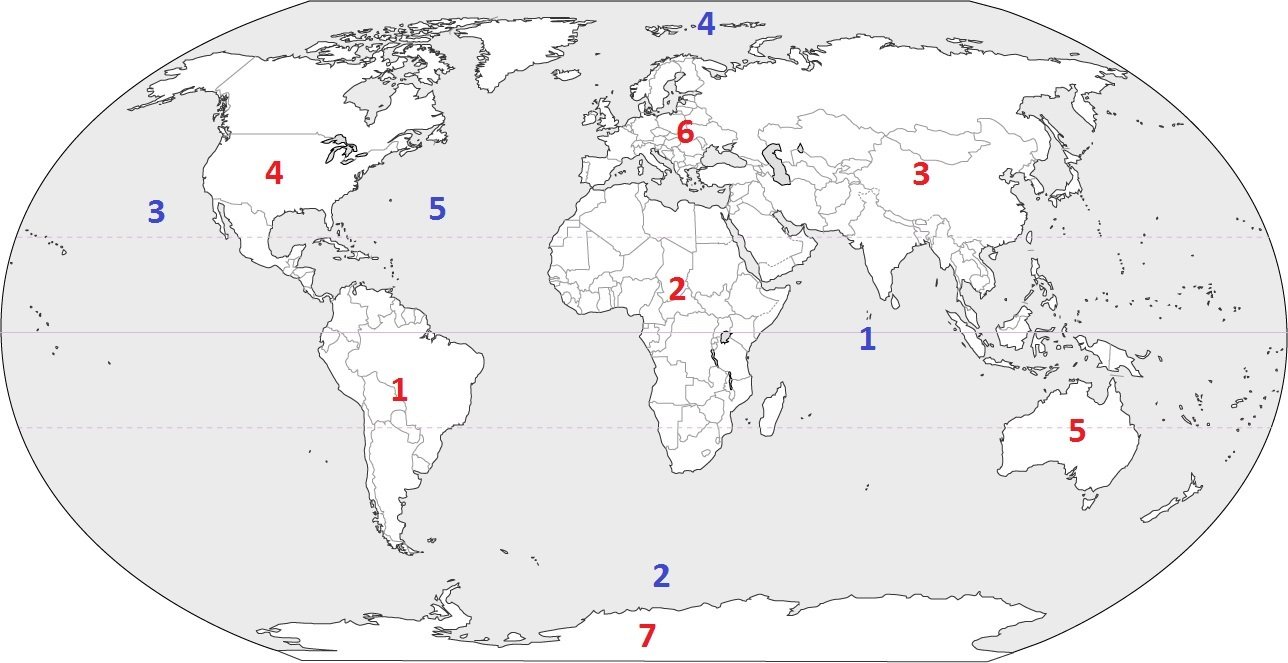
Identify the ocean at location #5
a)
Atlantic Ocean
b)
Southern Ocean
c)
Pacific Ocean
d)
Arctic Ocean
20.
Identify the ocean at location #3
a)
Atlantic Ocean
b)
Arctic Ocean
c)
Pacific Ocean
d)
Indian Ocean
21.
Which continent is located at #4?
a)
South America
b)
North America
c)
Europe
d)
Africa
22.
What causes surface currents?
a)
wind
b)
salinity
c)
temperature
d)
density
23.
Why do currents curve to the right in the Northern Hemisphere?
a)
riptides
b)
density
c)
salinity
d)
Coriolis effect
24.
Which process will increase the salinity of ocean water?
a)
evaporation
b)
currents
c)
Coriolis effect
d)
density
25.
How will the melting of icecaps change the salinity of ocean water?
a)
raise the salinity
b)
lower the salinity
c)
no change to the salinity
d)
I have no idea
26.
As the ocean depth increases, how to temperature and density change?
a)
it gets colder and more dense
b)
it gets colder and less dense
c)
it gets warmer and more dense
d)
it gets warmer and less dense
27.
What is the primary cause of waves?
a)
wind
b)
density
c)
salinity
d)
the moon
28.

When density increases, temperature ___________ .

a)

increases

b)

decreases

c)

stays the same

29.

As temperature increases, density ___________.

a)

decrease

b)

increases

c)

stays the same

30.

As salinity increases, density ______________.

a)

increases

b)

decreases

c)

stays the same

31.
Movement of water through oceans
a)
current
b)
tide
c)
wave 
d)
upwelling
32.

Which number represents the Gulf Stream Current?

a)

1

b)

2

c)

3

d)

4

e)

5

33.

The largest and most powerful surface current in the North Atlantic Ocean. It carries warm water.

a)

Pacific Ocean

b)

The Gulf Stream

c)

California Current

d)

Atlantic Ocean

34.

A climate event that occurs every two to seven years in the Pacific Ocean, during which winds shift and push warm water toward the coast of South America.

a)

The Gulf Stream

b)

Coriolis Effect

c)

El Nino

d)

Climate

35.

The movement of cold water upward from the deep ocean that is caused by wind.

a)

El Nino

b)

Climate

c)

Coriolis Effect

d)

Upwelling