
Font size
 Worksheets
Logarithms Review
Total questions: 33
Worksheet time: 1hrs 1mins
Rewrite log28 = 3 in exponential form
28 = 3
23 = 8
32 = 8
83 = 2
Rewrite xp = m in logarithmic form.
logxp = m
logmx = p
logxm = p
logpm = x
Evaluate the following logarithm:
log416
1
-2
2
1/2
Evaluate the following logarithm:
log327
3
2
9
31
Evaluate the following logarithm:
log55
1
0
-1
1/2
Evaluate the following logarithm:
log497
1/7
-2
2
1/2
Expand log(x7)
log(7x)
log7+logx
xlog7
7logx
Expand:
log(nm3)
logm−log3−logn
3logm+logn
3logm−logn
3log(m−n)
Expand the logarithm:
log(x⋅y)
(a)
Expand the logarithm:
log(yx)
(a)
log(xy3)
log(x6−y3)
log(y3x6)
log(x6+y3)

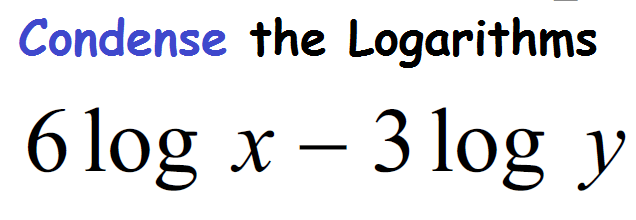
Condense
log(xyz3)
log(z3xy)
logx+logy+logz3
log(x3y3z3)
Write as one logarithm. Simplify, if possible.
log2800−log2100
8
3
-3
1
Write as one logarithm. Simplify, if possible.
log37.5+log31.2
8.7
2
3
6.25
Solve the equation
5x−2=20
log202log5
log5log20+2
log(4)+2
log6
Solve the equation, round to the nearest hundredth.
5x−2=20
(a)
Solve the equation:
63x−5=15
31(log(615)+5)
3(log(15)−log(6)−5)
31(log6log15+5)
3(log15log6)−5
Solve the equation, round to the nearest hundredth.
63x−5=15
(a)
The population of a town is increasing, modeled by the function:
p(t)=20,000(1.05)t
After how many years will the population reach 27,000? Round to the nearest hundredth.
(a)
The bacteria in a Petri dish culture are self-duplicating at a rapid pace.
The relationship between the elapsed time t, in minutes, and the number of bacteria, B(t), in the Petri dish is modeled by the following function.
B(t)=10(2)15t
After how many minutes will there be 120 bacteria? Round your answer to the nearest hundredth.
(a)
Solve the equation:
e3x=12
3ln12
ln4
3e12
ln3ln12
Solve the equation:
e3x=12
Round to the nearest hundredth.
(a)
find the asymptote: y = log10 (x+3) - 5
x=−3
y=3
x=−5
y=5
Write the equation of the function f(x)=log3x after the following transformations:
Translate 6 units left and 4 units up.
g(x)=log3(x+6)+4
g(x)=log3(x+4)-6
g(x)=log3(x-6)+4
g(x)=(x+6)log3+4
Describe the transformations of:
f(x)=−log2(x+1)
left one & y-axis reflection
right one & y-axis reflection
left one & x-axis reflection
right one & x-axis reflection

Match the graph with its equation
y=−log6(x)+2
y=log6(x−2)+1
y=log6(x+2)−1

Select the equation of the function shown
f(x)=log3(x−4)−1
f(x)=−log3(x−4)+1
f(x)=log3(x+4)−1
f(x)=−3x+4
Describe domain of the function shown
(−∞,∞)
(−4,∞)
(−∞,−4)
(−∞,2)
Select the graph of the function:
f(x)=log4(x−3)−5


Select the graph of the function:
f(x)=−log5(x+4)



