
 Worksheets
Ch. 9 and 11 Test 2020
Total questions: 50
Worksheet time: 25mins
The medium seismic waves (i.e. these can result in earthquakes) travel through is ______.
a vacuum
the ground
the air
energy
What is the SI unit of measurement for wavelength?
Hertz
meters
meters per second
seconds
A disturbance that carries energy through matter or space.
medium
wave
electromagnetic wave
longitudinal wave

The string of a piano that produces the note middle C vibrates with a frequency of 262 Hz. If the sound waves produced by this string have a wavelength in air of 1.30 m, what is the speed of the sound waves?
201.5 m/s
0.0496 m/s
341 m/s
201.5 m
Sound waves travel fastest in _________ then _________ and slowest in _________.
gases, liquids, solids
solids, gases, liquids
solids, liquids, gases
gases, solids, liquids
Which types of wave requires a medium?
electromagnetic wave
perpendicular wave
refraction
mechanical wave
Waves transfer which of the following?
energy only
matter only
neither energy nor matter
both energy and matter
What are the two classifications of waves? (Select two)
transverse
matter
medium
longitudinal
Which type of waves move both parallel and perpendicular?
seismic waves
longitudinal waves
surface waves
none of these are correct
The maximum distance that particles of a wave’s medium vibrate from their rest position to the crest or from their rest position to the trough is called ______.
frequency
wavelength
velocity
amplitude
The number of waves that occur at a given point in one second is called ___________.
frequency
wavelength
longitudinal wave
transverse wave
The SI unit for frequency is _____.
m/s
Hz
1/s
m
In one second, four waves pass a given point. What is the wave’s frequency?
1 Hz
2 Hz
3 Hz
4 Hz

Looking at the image, what happens to the wavelength of a wave when the frequency of an electromagnetic wave increases?
decreases (gets smaller)
increases (gets longer)
stays the same
stretches (spreads out)

A student is studying how sound travels through a solid medium by timing the movement of sound through a boulder. Each trial records data when the boulder is at different temperatures. Using the information below, how fast will sound move through the boulder when it reaches 20°C?
569 m/s
570 m/s
571 m/s
572 m/s

Which of the following represents the crest of the wave shown below?
P
Q
R
S
T

Which of the following represents the wavelength of the wave shown below?
W
X
Y
Z
An observed change in the frequency of a wave when the source or the observer is moving is known as ______.
rarefaction
reflection
the Doppler Effect
diffraction
Which two are examples of electromagnetic waves? (Select two)
sound wave
radio waves
light waves
seismic waves
Most waves are caused by _____________.
a medium
rarefaction
vibrations
reflection
Which two are examples of longitudinal waves? (Select two)
UV waves
surface waves
sound waves
springs

A wave has a wavelength of 0.5 m and a frequency of 120 Hz. What is the speed of the wave?
240 m/s
60 m/s
600 m/s
6 m/s

Choose the statement below that best describes what is represented by the image below.
Long wavelengths travel more slowly than short wavelengths.
Long wavelengths have a greater frequency than short wavelengths.
Long wavelengths diffract around objects more easily than do short wavelengths.
Long wavelengths are able to generate far more power than are short wavelengths.

The image shown at right is demonstrating SONAR technology to detect objects underwater. Which wave behavior is used by SONAR?
Interference of sound waves.
Diffraction of sound waves.
Reflection of sound waves.
Refraction of sound waves.
Which of the following technologies makes use of radio waves?
CD-ROM
X-ray machines
Radiation therapy
Radar

Which two explain the function of sunscreen? (Select two)
It helps you tan.
It protects the skin by diffracting the UV rays.
It protects the skin by absorbing UV light from the sun.
It protects the skin by blocking UV light from the sun.
Electromagnetic waves used in medicine to kill cancer cells and view bones.
Infrared rays and UV rays
Gamma rays and X-rays
Radio waves and Infrared rays
Visible light and X-rays
When you see the color black, ____.
black is being absorbed
black is being reflected
all light is being absorbed
none of these is correct
Sound waves are examples of ____.
longitudinal waves
transverse waves
perpendicular waves
ocean waves
In a vacuum, the speed of light is _____.
9.8 m/s2
3 x 10⁸ m/s
1.97 x 10⁸ m/s
2.05 x 10⁸ m/s
Light waves that do not require a medium are called ______ waves.
longitudinal
mechanical
surface
electromagnetic
This type of electromagnetic radiation is used for cooking and communication.
sound waves
UV light
microwaves
gamma rays
Which of the following is the best explanation for why a piece of paper might appear blue?
The paper absorbs blue light.
The paper reflects blue light.
The paper reflects all colors except blue.
The paper is transparent to all colors of light except blue.
This type of interference decreases amplitude.
diffraction
refraction
constructive interference
destructive interference
Objects that absorb all colors of light and reflect little or no light back to your eye will appear as which of the following?
green
white
black
invisible

What type of wave is this?
transverse wave
longitudinal wave
ocean wave
surface wave

Wearing noise canceling headphones is an example of which type of wave behavior?
reflection
diffraction
constructive interference
destructive interference
The letter Q on this wave is called the ____?
wavelength
compression
rest position
amplitude
The letter R on this wave is called the ____?
crest
trough
wavelength
amplitude

Look at the image, which type of wave behavior is exhibited after the two separate waves are added?
diffraction
reflection
constructive interference
destructive interference

What type of wave is this wave?
ocean wave
surface wave
transverse wave
longitudinal wave
The compressed portion of this wave that is packed together is called _____.
wavelength
amplitude
compression
rarefaction
The stretched out portion of this wave that is separated is called _____.
wavelength
amplitude
compression
rarefaction
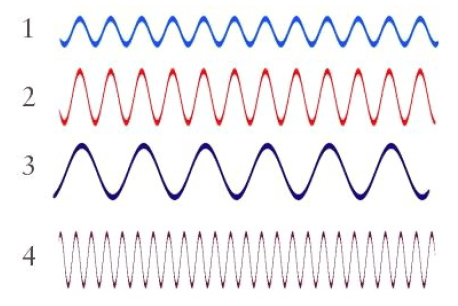
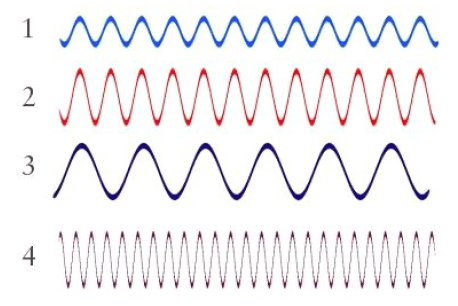
This is the distance from crest to crest or trough to trough.
crest
trough
amplitude
wavelength
Regular disturbances that carry energy through matter or space is called ___.
crest
energy
wave
trough

Which radiation type has the lowest energy among this group?
Radio
Microwave
Infrared
Ultraviolet

Which radiation type has the largest wavelength among this group?
X-rays
Microwave
Infrared
Ultraviolet

Which of the following is the bending of a wave, which changes its speed?
Reflection
Diffraction
Refraction
Frequency

