
 Worksheets
Chapter 5 Light
Total questions: 50
Worksheet time: 40mins

Which of these provides the best explanation for why the pencil appears broken?
The pencil absorbs the light rays that hit it.
Water reflects light rays away from the pencil.
Light rays are bent by the water in the glass.
The surface of the water reflects the light rays.
Light travels in straight lines until reflected by another object. Which illustration best shows the light being reflected?


What makes it possible to see an object when looking through a periscope?
It contains mirrors that reflect the object.
It magnifies small objects so they can be seen.
It absorbs the light rays passing through it.
It separates the light into different colors.
Which of the following is demonstrated when light bounces off of mirrors or shiny surfaces?
Scattering
Refraction
Absorption
Reflection
A combination of all the wavelengths with in the visible light portion of the electromagnetic spectrum will result in which of the following colors?
White
Red
Violet
Blue


What does light travel fastest in?
solid
liqid
gas
vacuum

states that when a wave is reflected from a surface, the angle of reflection is equal to the angle of incidence
law of universal gravitation
law of the conservation of energy
law of reflection
Newton's second law of motion

lens that is thicker at the edges than in the middle
concave lens
convex lens

lens that is thicker in the middle than at the edges
concave lens
convex lens
Light is made up of...
electricity and waves
magnetism and waves
electricity and magnetism
electricity and energy
The color with the longest wavelength is...
Blue
Red
Green
Yellow

Why does refraction occur?
Light travels through different materials at different speeds.
Different colors of light travel at different speeds.
Different materials physically twist light around.
Light from different sources travels at different rates.

When you look at your teacher's face, how can you see it?
Light reflects off of his or her face.
His or her face emanates light.
Light refracts through his or her face.
His or fer face emits electromagnetic radiation.

The incident ray parallel to the principal axis of a mirror ______ after reflection.
passes through C
passes through F
passes through the pole
reverts back in the opposite direction
Perspex has a higher refractive index (density) than air. Light entering air from perspex will
slow down slightly and be bent towards the normal
slow down slightly and be bent away from the normal
speed up slightly and be bent towards the normal
speed up slightly and be bent away from the normal

Which lens represents the path light takes through a diverging lens?


Which figure represents the path light takes through a converging lens?
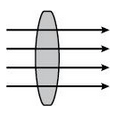
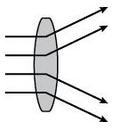
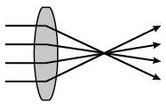
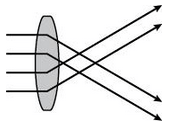
When an object is placed on the focal point in front of a convex lens, the image produced is ___.
real, reduced, and inverted
real, magnified, and inverted
real, true, and inverted
There is no image
When an object is placed between the focal point and the convex lens, the image produced is ___.
real, reduced, and inverted
real, magnified, and inverted
virtual, magnified, and upright
virtual, reduced, and upright

Diagram 18 shows a crocodile in water and its image.
Which light phenomenon forms the image?
Reflection
Refraction
Diffraction
Total internal reflection

Diagram 19.1 and Diagram 19.2 show a fish seeing a beetle at different position.
Why does the difference in sighting occur by the fish between Diagram 19.1 Diagram 19.2?
The sighting in Diagram 19.2 is done at an angle to the normal
The mass of fish in Diagram 19.1 is bigger
The distance between the fish and the beetle in Diagram 19.1 is further
An object is placed 15.0 cm in front of a convex lens with a focal length of 10.0 cm.
What is the image distance?
6 cm
25 cm
30 cm
150 cm
What are the characteristics of an image formed by a plane mirror?
Upright and real
Upright and virtual
Inverted and real
Inverted and virtual

Diagram 14 shows a ray of light entering a transparent glass block.
What is the refractive index of the glass block?
0.59
0.69
1.44
1.70

Diagram 15 shows a light ray propagating from air into water.
What happens to the light ray in the water?
Refracts towards normal
Refracts away from normal
Experiences total intemal reflection
Reflects with the same angle as the incidence angle
Which equipment uses total internal reflection?
Binocular
Telescope
Microscope
Slide projector

Which path A, B, C or D, shows the correct propagation of light as it enters medium Z of greatest refractive index?
A
B
C
D

Diagram 16 shows a periscope with two prisms, X and Y.
Which arrangement of prisms X and Y is correct so that the observer can see the image of the object?


Diagram 19 shows a ray diagram of a convex lens.
The power of the convex lens is
+0.2 D
+5.0 D
+10.0 D
+20.0 D

Diagram 18 shows a marble at the base of a glass container. The image of the marble can only be seen when liquid is poured to a depth of 10 cm in the container.
the refractive index of liquid is 1.33, what is the distance of the image from the actual marble?
1.00 cm
2.48 cm
7.52 cm
13.33 cm

Diagram 20 shows a light ray, P is directed to the centre, O of semicircular glass block. Refractive index of the glass is 1.57.
At which direction A, B, C or D does the light propagate after point O?
A
B
C
D

Diagram 22 shows Azli is standing in front of a plane mirror at a distance of 5 m.
What is the distance that Azli has to walk so that the distance between Azli and his image is 3 m.
1.0 m
1.5 m
2.0 m
3.5 m

Diagram 19 shows a beam of light travelling from air to medium X.
What is the refractive index of medium X?
0.4
0.7
1.5
2.2
A pool is filled with water to a depth of 5 m.
What is the apparent depth of the pool?
[Refractive index of water is I .33]
0.27 m
3.67 m
2.76 m
6.65 m
Which of the diagram shows the correct refraction of light ray after passing through a concave lens?


Diagram 16 shows a ray hits a semicircular glass block at an angle, Ɵ. Which is the correct path of light if Ɵ less than critical angle of the glass block?
A
B
C
D
The refractive index of a glass block is 1.63.
Calculate the velocity of light in the glass block.
Velocity of light in air = 3.0 x 10⁸ ms-1
1.84 x 10⁶ ms-1
4.98 x 10⁶ ms-1
1.84 x 10⁸ ms-1
4.98 x 10⁸ ms-1

Diagram 14 shows an arrangement of objective lens, Lo and eyepiece, Le in a microscope.
What are the required conditions for both lenses to produced large, inverted and
final image?


Diagram below shows an object placed at O, in front of a concave mirror.
F is the focal point of the mirror.
What are the characteristics of the image formed?
Virtual and smaller than the object
Real and smaller than the object
Virtual and bigger than the object
Real and bigger than the object
Which of the following ray diagrams is correct for a magnifying glass?


Diagram shows an object placed in front of a convex lens.
What are the characteristics of the image formed?
Real, inverted, diminished
Real, inverted, same size
Virtual, upright, enlarged
Real, inverted, enlarged
Which ray diagram for a concave mirror is not drawn correctly?
[C = centre of curvature of mirror, F = focal point of mirror]


Diagram shows a ray of light propagates in a transparent semi circular block.
What is the refractive index of the transparent block?
1.25
1.33
1.43
1.66
A shopkeeper wants to keep an eye on his store in order to prevent shoplifting. What could the shopkeeper hang on the wall in order to see a wider image of his store and his customers?
a convex mirror
a concave mirror
a convex lens
a concave lens

