wayground logo

Free Printable Worksheets

Font size

S
M
L
XL
Worksheets

23 Physics Spring DPM Review 2nd

Total questions: 50

Worksheet time: 1hrs 15mins

Name
Class
Date
1.
Airplane drop: An airplane is flying horizontally, it drops a package while it is in motion: Where does the package land?
a)

behind the airplane

b)

under the airplane

c)

in front of the airplane

2.
A rock is kicked horizontally off the ledge of a building at a velocity of 5 m/s. The building is 14.6 m high. How long does it take to the rock to hit the ground?
a)
2.92s
b)
1.7s
c)
8.5s
d)
5s
3.
A rock is kicked horizontally off the ledge of a building at a velocity of 5 m/s. The building is 14.6 m high and it takes 1.7s to fall down. How far away from the building will the rock land?
a)
14.6m
b)
8.5m
c)
42.5m
d)
25m
4.
Describe the horizontal components of a horizontally launched projectile:
a)
acceleration is zero velocity is increasing
b)
acceleration is zero velocity is constant
c)
acceleration is zero velocity is decreasing
d)
acceleration is -10m/s/s velocity is constant
5.
Describe the vertical components of a horizontally launched projectile :
a)
acceleration is zero velocity is increasing
b)
acceleration is zero velocity is constant
c)
acceleration is -10 m/s/s velocity is changing by 10m/s every second
d)
acceleration is -10m/s/s velocity is constant
6.
As the height increased the time in the air of a projectile
a)
increase
b)
decrease
c)
remain unchanged
7.
Does the horizontal distance (range) an object flies depend on its mass?
a)
yes
b)
no
8.
A student rubs a balloon on his hair and the balloon becomes negatively charged. What is the net charge of the student’s hair?
a)
positive
b)
negative
c)
neutral
9.
A student rubs a balloon on his hair and the balloon becomes negatively charged. Which particles moved to cause this net charge?
a)
proton
b)
electron
c)
neutron
10.
A student rubs a balloon on his hair and the balloon becomes negatively charged. Did these particles move from the balloon to the hair or the hair to the balloon?
a)
from the balloon to the hair
b)
from the hair to the balloon
11.
Two charged spheres separated by a distance, d, exert a force of F Newtons on each other. If the charge on one sphere is doubled, does F increase or decrease? By how much?
a)
2x
b)
1/2x
c)
4x
d)
1/4x
12.
Two charged spheres separated by a distance, d, exert a force of F Newtons on each other. If the charge on both spheres is tripled, does F increase or decrease? By how much?
a)
3x
b)
6x
c)
9x
d)
1/9x
13.
Two charged spheres separated by a distance, d, exert a force of F Newtons on each other. If the distance is tripled, does F increase or decrease? By how much?
a)
3x
b)
1/3x
c)
9x
d)
1/9x
14.
Two charged spheres separated by a distance, d, exert a force of F Newtons on each other. If you double one charge and triple the other charge and also double the distance, by what factor will the electric force be affected?
a)
6x
b)
4x
c)
1.5x
d)
3x
15.
In the can you light a lightbulb activity why did the wire get hot? Explain why the wires to our charges are covered in plastic.
a)
there is not current running so it is just over heating
b)
there is a current running causing the wires to get hot
16.
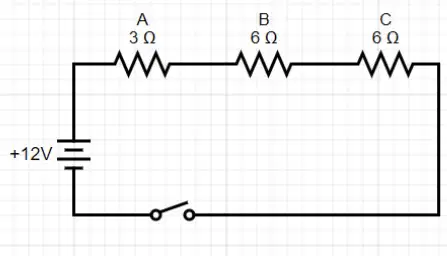
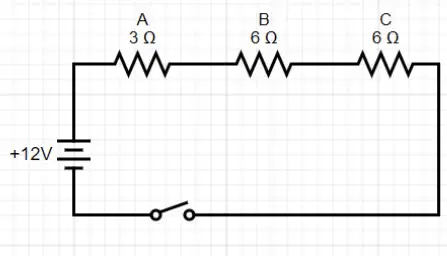
Calculate the current in the circuit above
a)

4A

b)

2A

c)

1A

d)

0.8A

17.
Calculate the electrical power in the circuit above:
a)

48W

b)

24W

c)

12W

d)

9.6W

18.
How does the current at resistor A compare to the current at resistor C?
a)

Current at A is less than Current at C

b)

Current at A is equal to Current at C

c)

Current at A is greater than Current at C
19.
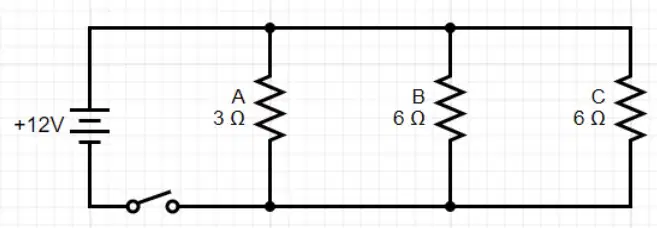
How does the current at each of the resistors compare to the current at the Battery?
a)

the currents are always equal to each other everywhere

b)

the currents at each path add up to the current at the battery

c)

the currents at each path are greater than the current at the battery
20.
If resistance increases, what happens to the current?
a)
increases
b)
decreases
c)
stays the same
21.
If voltage increases what happens to the current?
a)
increases
b)
decreases
c)
stays the same
22.
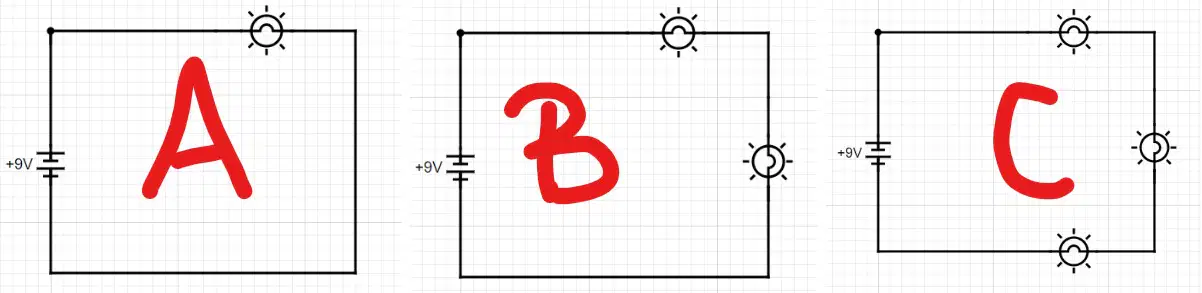
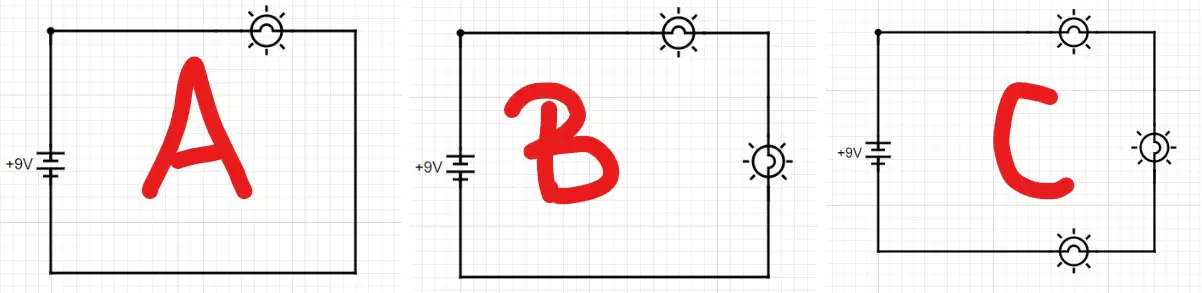
Which circuit will have the brighter bulbs?
a)

A

b)

B

c)

C

23.
Which circuit has the greatest current?
a)

A

b)

B

c)

C

24.
Motor
a)
A device that changes one voltage to a different voltage.
b)
An fan plugged into a power source
c)
Dams, cars, and power plants all produce electricity in this way.
d)
Devices that convert electrical energy to mechanical energy.
e)
Mechanical energy usually in the form of rotational motion is used to turn the loop is converted to electrical energy
25.
Transformer
a)

A device that changes one voltage to a different voltage.

b)

An fan plugged into a power source

c)

Dams, cars, and power plants all produce electricity in this way.

d)

Devices that convert electrical energy to mechanical energy.

e)

Mechanical energy usually in the form of rotational motion is used to turn the loop is converted to electrical energy

26.
Generator
a)
A device that changes one voltage to a different voltage.
b)
An fan plugged into a power source
c)
Dams, cars, and power plants all produce electricity in this way.
d)
Devices that convert electrical energy to mechanical energy.
e)
Mechanical energy usually in the form of rotational motion is used to turn the loop is converted to electrical energy
27.
In magnetic field lines, what surrounds the moving electrons?
a)
electric field
b)
magnetic field
c)
electric & magnetic fields
28.
If you increase the loops in an electromagnet, what will happen
a)
electromagnet becomes stronger
b)
electromagnet becomes weaker
c)
electromagnet remains unchanged
29.
How could you make your electromagnet stronger or weaker?
a)
increase the number of looks
b)
increase the voltage source
c)
ensure you have an iron core
30.
Define the Doppler Effect:
a)

change in pitch due to motion. moving towards increases pitch, moving away

decreases pitch

b)

when one object vibrating at the same natural frequency of a second object forces the second object into vibrational motion

c)

amount of energy, depends on the amplitude of the sound waves. Large amplitude=loud sound

d)

measurement of loudness

e)

used to locate underwater objects and distances. Uses wave reflection
31.
If a car is approaching you, will the pitch be higher or lower than the original pitch?
a)
lower
b)
higher
c)
unchanged
32.
If a car is moving away from you, will the pitch be higher or lower than the original pitch?
a)
lower
b)
higher
c)
unchanged
33.
If a wave has a frequency of 200Hertz and a wavelength of 5m. What is the wave’s velocity?
a)
40 m/s
b)
1000 m/s
c)
0.025 m/s
34.
The wave has a frequency of 200Hz and is traveling at 400m/s. What is the wavelength of the wave?
a)
2m
b)
80000m
c)
0.5m
35.
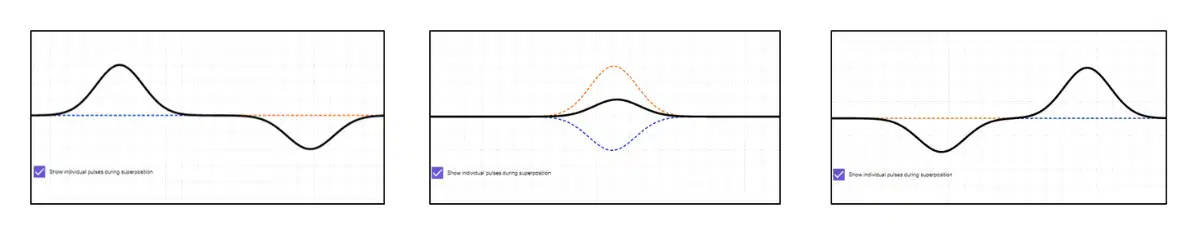
Label the wave as constructive or destructive and explain how you know.
a)

constructive because the combined wave is smaller

b)

constructive because the combined wave is larger

c)

destructive because the combined wave is larger

d)

destructive because the combined wave is smaller

36.
Label the wave as constructive or destructive and explain how you know.
a)

constructive because the combined wave is smaller

b)

constructive because the combined wave is larger

c)

destructive because the combined wave is larger

d)

destructive because the combined wave is smaller

37.
What does resonance do to the sound of a musical instrument?
a)
make the sound quieter
b)
make the sound louder
c)
make no changes to the sound
38.
Define photon:
a)
massless bundles of concentrated electromagnetic energy.
b)
on a flat surface the angle of incidence (angle of incoming ray) equals the angle of reflection (angle of outgoing ray)
39.
Light waves, transverse or longitudinal waves?
a)
transverse wave
b)
longitudinal wave
40.
Sound waves, transverse or longitudinal waves?
a)
transverse wave
b)
longitudinal wave
41.
Light waves
a)
require a medium
b)
do not require a medium
42.
Sound waves
a)
require a medium
b)
do not require a medium
43.
light waves
a)
can travel in a vacuum like space
b)
cannot travel in a vacuum like space
44.
Sound waves
a)
can travel in a vacuum like space
b)
cannot travel in a vacuum like space
45.
Frequency of Light waves tells you
a)
the color
b)
the pitch
46.
Frequency of Sound waves tells
a)
the color
b)
the pitch
47.
Amplitude of Light waves tells
a)
brightness
b)
loudness
48.
Amplitude of Sound Waves tells
a)
brightness
b)
loudness
49.
Speed of Light in Air
a)

3x1083x10^8 m/s

b)

343 m/s

50.
Speed of Sound in Air
a)

3x1083x10^8 m/s

b)

343 m/s