
 Worksheets
Current electricity Revision 12 C
Total questions: 50
Worksheet time: 34mins

total current
and the voltage through resistor 3.


what is an electric cell?
a device that converts mechanical energy into electrical energy
a device that turns stored chemical energy into electrical energy
a device that devours electrical energy
a device that converts static electricity into mechanical energy
What type of cell is necessary to make solar cells practical?
primary cells
storage cells
none exist that can hold that much energy
Correct
ϵ=V+Ir
ϵ=I(R+r)
ϵ=V
What is emf?
the electro motive "force" or the force on electrons
the electromotive "force" or the Voltage of a cell measured when there is no current flowing
the electromotive "field" or the Voltage of a cell measured when there is no current
the electromotive "force" or Voltage of a cell measured when connected to a circuit
What is internal resistance?
the resistance inside the cell that increases with more current drawn from the cell
the resistance inside the cell that decreases with more current drawn from the cell
the resistance inside the cell that remains constant as the current drawn from the cell changes
the resistance inside each component which increases as more resistances are added in series

Calculate the emf USING THE GRAPH LINE
1.53 V
1.54 V
0V
1.47 V
If 5 lemons are connected in series and then these 5 are connected to 5 more also in series as a parallel arrangement (5 in parallel with 5) what is the total emf and the total internal resistance?
emf = 10 V, resistance = 1000 ohms
emf = 5 V resistance = 10,000 ohms
emf = 10 V resistance = 1000 ohms
emf = 5V and resistance = 2500 ohms
A lemon has an emf = 1.0 V and internal resistance of 1000 ohms. What is the total internal resistance when 5 lemons are connected in series and the total emf?
5 ohms 5V
5000 ohms 1V
0.2 ohm 5V
2 ohms 1V

A potentiometer wire of length 1 m is connected to a driver cell of emf 3 V as shown in the figure. When a cell of 1×5 V emf is used in the secondary circuit, the balance point is found to be 60 cm. On replacing this cell and using a cell of unknown emf, the balance point shifts to 80 cm.Calculate unknown emf of the cell.
1 V
1.5 V
3 V
2 V
2.2 V

The following graph shows the variation of terminal potential difference V, across a combination of three cells in series to a resistor, versus the current. Calculate the emf and internal resistance of each cell
E = 6 V & r = 3 ohm
E = 2 V & r = 1 ohm
E = 6 V & r = 1 ohm
E = 2 V & r = 3 ohm
E = 1 V & r = 1 ohm
Name the factors decide internal resistance of a cell
1. temperature
2. nature of the electrolyte
3. nature of the electrodes
4.distance between the electrodes
1,2,3 & 4
What is the principle of potentiometer ?
V is proportional to L, when steady current flows through a wire of uniform area of cross section at constant temperature
deflection in G is proportional to current
resistance is proportional to length
resistance is inversely proportional to area of cross section
resistance is proportional to temperature

Calculate the balance point of the cell. Resistance of the potentiometer wire is 20 ohm and length of the wire is 400 cm.
0.75 m
7.5 cm
25 cm
200 cm
300 cm

What happens to the balancing length if the value of the variable resistance R is increased?
decreases
increases
no change
can not predict

Find the potential difference across the 50 ohm resistance?
10 V
5 V
2.5 V
2 V
1 V
What can be reason for one sided deflection in a potentiometer experiment?
Emf of a cell in the primary circuit may be less than that in secondary circuit
Cells in the primary and secondary circuit are connected with opposite terminals
connections may be loose
length of the wire may be too long

If the deflection of the galvanometer increases from A to B, but not zero on reaching B. what could be the reason?
emf of cell in primary circuit may be less compared to that in
secondary
connections may be loose
emf of cell in primary circuit may be more compared to that in
secondary
Cells may be connected with opposite polarity

If the deflection of the galvanometer decreases from A to B, but not zero on reaching B. what could be the reason?
emf of cell in primary circuit may be less compared to that in
secondary
connections may be loose
emf of cell in primary circuit may be more compared to that in
secondary
Cells may be connected with opposite polarity

With K2 closed, if S is increased, how the balancing the length will change?
increases
decreases
no change
may increase or decrease
Potential gradient is .........
V/L
current X resistivity/Area of cross section
inversely proportional to sensitivity
IR
A 3.0 Ω resistor and a 6.0 Ω resistor are connected in parallel.What is their combined resistance?
0.50Ω
2.0Ω
4.5Ω
9.0Ω

The circuit diagram shows a 4.0 Ω resistor and an 8.0 Ω resistor connected to a 6.0V battery.What is the current in the 8.0 Ωresistor?
0 A
0.50A
0.75A
1.0A

The diagram shows a circuit with a 3.0 Ω resistor and a 2.0 Ω resistor connected in parallel. The switch is open, and the ammeter reads 2.0A. The switch is now closed and the ammeter reads the total current in both resistors. What is the ammeter reading with the switch closed?
1.2 A
3.0 A
4.0 A
5.0 A

A 30 Ω resistor is connected in series with another resistor and a 6.0 V battery. The current in the circuit is 0.12 A. A voltmeter is connected across the other resistor. What is the reading on the voltmeter?
2.4 V
3.6 V
6.0 V
9.6 V
Which one of the following resistors connected in parallel with a 24 Ω would give a total resistance of 8 Ω
16 Ω
12 Ω
8 Ω
6 Ω
The speed at which an electron moves in an electric field in a conductor is the
speed of light.
average collision speed.
drift velocity.
average electron speed.
When a current moves through a copper conductor, electrons collide with copper atoms. The result of these collisions is
an increase in voltage.
a decrease in resistance.
an increase in temperature.
a decrease in voltage.
Which factor is least likely to affect the resistance of a conductor?
the length of the conductor
the temperature of the conductor
the overall shape of the conductor
the material the conductor is made from
When a conductor carries a current, the number of conduction electrons that flow in the conductor for 10 s is 3.75 ×10²⁰ . What is the current that flows in the conductor?
3.8 A
4.2 A
6.0 A
10 A
A conductor of cross-sectional area 0.10 mm2 carries a current of 2.5 A. If the number of conduction electrons per cubic metre is 1.0×1028 m−3 . What is the value of drift velocity of the free electrons in the conductor?
1.6 ×10⁻² m s−1
3.9 ×10⁻² m s−1
3.0 ×10⁻³ m s−1
6.2 ×10⁻³ m s−1
Which statement is true about the drift velocity of the electrons in a current-carrying metallic conductor?
It is directly proportional to the diameter of the conductor.
It is inversely proportional to the current.
It is inversely proportional to the number of conduction electrons per unit volume.
It is directly proportional to the resistance of the conductor if the potential difference across the conductor is kept constant.
A conductor of length 2.0 m and cross-sectional area 5.0 ×10⁻⁶ m2 carries a current of 6.0 A. If the drift velocity of the conduction electrons is 1.5 ×10⁻⁴ m s−1 , what is the number of electrons in the conductor?
2.5 ×10²³
2.9 ×10²³
4.2 ×10²³
5.0 ×10²³
A charge of 60 Coulomb flows in a wire for 45 minutes. If the diameter of the wire is 1.0 mm, what is the current density in the wire?
2.2 ×10⁴A m−2
2.8 ×10⁴A m−2
7.6 ×10⁷A m−2
5.6 ×10⁸A m−2
A current flows in a copper wire. The current density in the wire is 1.4 ×10⁶A m−2 . If the number of free electrons in 1 m3 of wire is 8.4 ×1028 , what is the drift velocity of the electrons?
1.04 ×10⁻⁴m s−1
3.10 ×10⁻⁴m s−1
1.67 ×10⁻³m s−1
1.90 ×10⁻³m s−1
A copper wire of length 2.0 m has resistance 20 Ω . The wire is stretched to an extension of 0.001m. If the volume of the wire remains unchanged, what is the new resistance of the wire?
20.01 Ω
20.02 Ω
20.03 Ω
20.04 Ω

A hollow copper rod has an inner radius of 0.65 cm and an outer radius of 1.0 cm as shown in the diagram. A current flows from P to Q. If the length of the rod is 20 cm and its resistivity is 1.7 ×10⁻⁸Ω m , what is the resistance of the copper rod?
3.4 ×10⁻⁹Ω
1.9 ×10⁻⁵Ω
1.8 ×10⁻⁴Ω
2.9 ×10⁻³Ω

The figure shows a cable which consists of a wire X of resistivity ρ , cross-sectional area A and length l , and four wires of metal Y of resistivity 3 ρ , each with cross-sectional area 2A and of the same length. Find the resistance of this cable in terms of ρ ,A and l .
11A3ρl
A7ρl
2A5ρl
The conductivity of copper is 6.0 ×10⁷Ω−1m−1. The free electron density copper is 8.45 ×1028m−3 . Estimate the mean time between collisions of free electrons and positive ions in copper.
2.52 ×10⁻¹⁴ s
4.04 ×10⁻³³ s
4.04 ×10⁻¹⁴ s
7.10 ×10⁻²² s
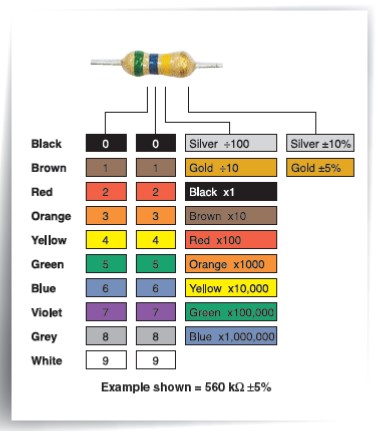
What is the value of a resistor with the colour code: Red, Orange, Green?
234 ohms
20004 ohms
230000 ohms
Write your parents Email address

