Wayground logo

Free Printable Worksheets

Font size

S
M
L
XL
Worksheets

Heredity, Genetics, and DNA review

Total questions: 73

Worksheet time: 1hrs 11mins

Name
Class
Date
1.

Special characteristics that are determined by parents and passed to offspring are

a)

chromosomes.

b)

learned traits.

c)

inherited traits.

d)

environmental factors.

2.

What is the part of the cell with the plan or rule for what we look like on the outside and how we work on the inside?

a)

gene/chromosome

b)

nucleus

c)

alleles

d)

environmental factors

3.

Which organism receives its genes from the parents?

a)

genes

b)

offspring

c)

alleles

d)

characteristics

4.

These can affect an organisms abilities or characteristics

a)

inherited traits

b)

environmental factors

c)

learned traits

d)

environmental issues

5.

Humans have 23 pairs of _______________ with over 22,000 combinations of genes.

a)

traits

b)

chromosomes

c)

cells

d)

chemicals

6.

What kind of trait is eye color?

a)

learned

b)

processed

c)

inherited

d)

natural

7.

A characteristic will be seen in an offspring if what is received from either parent?

a)

recessive gene

b)

dominant gene

c)

pair of genes

d)

invisible genes

8.

Which traits can only be seen if both parents pass the factor for it to the offspring?

a)

dominant traits

b)

recessive traits

c)

invisible traits

d)

natural traits

9.

What is the table that illustrates the possible results for the genetic characteristics of an offspring of two parents?

a)

Pungent Polygon

b)

Prudent Circle

c)

Power Triangle

d)

Punnett Square

10.

What does DNA stand for?

a)

Do Not Allow

b)

Dioxygen Ntirate Analysis

c)

Deoxyriboneucleic Acid

d)

Dehydrated Nucleus Acids

11.

Which of the following genetic combinations shows a dominant Brown eye?

a)

bb

b)

Db

c)

BB

d)

Br

12.

Which of the following shows a hybrid genetic combination for a tall offspring?

a)

tt

b)

Tt

c)

TT

d)

tl

13.

Which of the following shows a recessive blue eye genetic combination?

a)

bb

b)

Bb

c)

BB

d)

bl

14.

If Tom's mom has hybrid brown hair (Bb) and Tom's dad has dominant brown hair (BB), what color hair will Tom most likely have?

a)

blond

b)

brown

c)

black

d)

red

15.

the science that studies how traits are inherited through the interactions of alleles

a)

heredity

b)

genetics

c)

biology

16.

the genetic make-up; the actual gene pair

a)

genotype

b)

phenotype

17.

the physical or visible appearance of an organism; a trait we can see

a)

genotype

b)

phenotype

18.

the physical or visible appearance of an organism; a trait we can see

a)

genotype

b)

phenotype

19.

blue eyes, curly hair

a)

genotype

b)

phenotype

20.

Tt, BB, rr

a)

genotype

b)

phenotype

21.

the weaker trait; you need 2 genes for the trait to show up in an organism

a)

dominant

b)

recessive

22.

the different forms of a trait that make up a gene, R OR r

a)

allele

b)

dominant

c)

recessive

23.

purebred; the same gene pair

a)

homozygous

b)

heterozygous

24.

hybrid; a different gene pair

a)

homozygous

b)

heterozygous

25.

Rr, Ff

a)

homozygous

b)

heterozygous

26.

TT, tt

a)

homozygous

b)

heterozygous

27.

BB, RR, TT

a)

heterozygous

b)

homozygous dominant

c)

homozygous recessive

28.

nn, ww, gg

a)

heterozygous

b)

homozygous dominant

c)

homozygous recessive

29.

Tt, Bb, Ww

a)

heterozygous

b)

homozygous dominant

c)

homozygous recessive

30.

the father of genetics

a)

James Watson

b)

Robert Hooke

c)

Gregor Mendel

d)

Reginald Punnett

31.

CC, DD, EE

a)

heterozygous

b)

homozygous dominant

c)

homozygous recessive

32.
Genotype refers to the ...
a)
physical expression of the genes
b)
the possible combination of alleles in a gene
c)
whether an allele is dominant or recessive
d)
how an organism will appear
33.
A homozygous dominant dog with brown fur is crossed with a heterozygous dog with brown fur. What are the percentages of the possible genotypes?
a)
100% BB
b)
75% BB and 25%Bb
c)
50 % BB and 50% Bb
d)
50% Bb and 50% bb
34.
An offspring will receive how many alleles from each parent to determine a specific trait?
a)
one
b)
two
c)
three
d)
five
35.
Magda is a tall, 11 year old drummer. She has a scar on her right cheek. She is good at swimming. Which of her traits did Magda most likely inherit?
a)
height
b)
the scar
c)
ability to swim
d)
ability to play drums
36.
Two brown eyed parents (Bb) have a baby. What is the chance the baby is blue eyed?
a)
0 %
b)
25%
c)
50%
d)
75%
37.
A human usually has _____ total chromosomes.
a)
23
b)
46
c)
22
d)
4
38.
_______ carry the information that determines your traits such as eye color. 
a)
phenotype
b)
genotype
c)
genes
d)
dominant
39.

This is what phase of Mitosis?

a)

Interphase

b)

Prophase

c)

Metaphase

d)

Anaphase

e)

Telophase

40.

In which phase does a cell spend most of its life?

a)

Interphase

b)

Prophase

c)

Metaphase

d)

Anaphase

e)

Telophase

41.

What phase of mitosis is in the picture?

a)

Interphase

b)

Prophase

c)

Metaphase

d)

Anaphase

e)

Telophase

42.

What phase of Mitosis is the picture showing?

a)

Interphase

b)

Prophase

c)

Telophase

d)

Metaphase

43.

Which phase of mitosis is the picture showing?

a)

Interphase

b)

Prophase

c)

Anaphase

d)

Telophase

44.

In what phase of Mitosis does the DNA replicate?

a)

Interphase

b)

Prophase

c)

Metaphase

d)

Telophase

45.

What holds the sister chromatids together?

a)

Centromeres

b)

Centrioles

c)

Chromosomes

46.

The splitting of the cytoplasm and cell membranes is called?

a)

Interphase

b)

Telophase

c)

Centromere

d)

Cytokinesis

47.

The chromosome are pushed toward the center of the cell by what?

a)

Centrioles

b)

Spindle Fibers

c)

Chromosomes

48.

A cat has a total of 40 chromosomes in its body cells. How many in its sex cells?

a)

38

b)

20

c)

76

d)

10

49.
The process of crossing over occurs in what meiotic phase?
a)
anaphase 1
b)
prophase 1
c)
prophase 2
d)
telophase 1
50.
The chromosomes that pair up during meiosis, are called __________ chromosomes.  
a)
homozygous 
b)
asexual
c)
homologous
d)
genes
51.

In humans, sperm cell have ___________ chromosomes and are ___________________, while skin cells have _____________ chromosomes are are diploid.

a)

23. haploid. 46 diploid

b)

46. haploid. 23. diploid

c)

23 diploid. 46 haploid

d)

46. diploid. 23. haploid.

52.
Crossing over helps promote ?
a)
male genotype
b)
genetic variation
c)
DNA replication
d)
mitosis
53.
You get one homologous chromosome from your ________ and one from your _______.  
a)
dad, mom
b)
brother, sister
c)
grandmother, grandfather
d)
dog, cat
54.
With mitosis you get ___, _________ cells, but with meiosis, you get ___, ____________.
a)
4 different, 2 identical
b)
4 identical, 2 different
c)
2 different, 4 identical
d)
2 identical, 4 different
55.
The purpose of meiosis is to form ________ cells.
a)
body
b)
sex
c)
somatic
d)
brain
56.
What is the relationship between DNA and chromosomes?
a)
Chromosomes are made of DNA
b)
DNA is made of chromosomes
c)
DNA and chromosomes are the same thing.
d)
All of the above are correct
57.
Which of the following best describes a DNA molecule?
a)
double helix
b)
contains ribose
c)
made of amino acids
d)
contains Uracil
58.
Why is DNA important?
a)
it is very small and very complicated
b)
it's in everything
c)
it serves as the blueprint for traits of all living things
d)
because we eat it every day for energy
59.
Which 2 molecules form the sides (backbone) of the DNA ladder?
a)
deoxyribose sugar and adenine
b)
deoxyribose sugar and a hydrogen bond
c)
deoxyribose sugar and the nucleus
d)
deoxyribose sugar and phosphate
60.
Nitrogenous bases are joined by which type of bond?
a)
polar bonds
b)
ionic bonds
c)
covalent bonds
d)
hydrogen bonds
61.
What are the three components of a nucleotide?
a)
sugar, hydrogen, nitrogen base
b)
sugar, oxygen, nitrogen base
c)
sugar, phosphate, nitrogen base
d)
sugar, phosphate, protein
62.
Cytosine always pairs with
a)
Adenine
b)
Thymine
c)
Uracil
d)
Guanine
63.
Which organelle is DNA usually found in?
a)
cell membrane
b)
vacuole
c)
ribosome
d)
nucleus
64.
What is the complement to the DNA strand below:
5'-ATGCCAT-3'
a)
5'-TACGGTA-3'
b)
3'-TACGGTA-5'
c)
3'-ATGGCAT-5'
d)
5'-ATGGCAT-3'
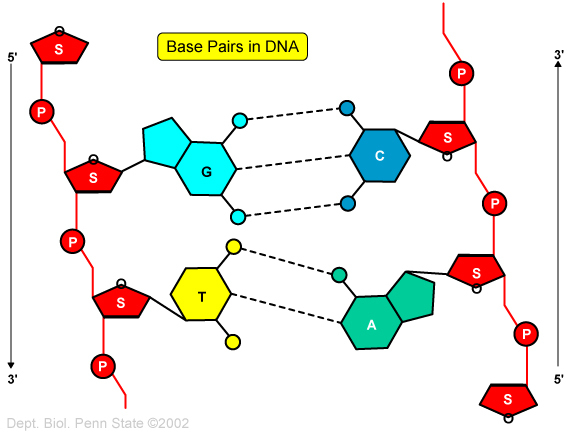
65.

Which of the following is a base pair?

a)

Adenine - Cytosine

b)

Cytosine - Thymine

c)

Deoxyribose - Cytosine

d)

Cytosine - Guanine

66.
Adenine bonds with ______________.
a)
Guanine
b)
Thymine
c)
Cytosine
d)
Adenine
67.
Which sequence of DNA bases would pair with this partial strand
ATG TGA CAG
a)
ATG TGA CAG
b)
TAC ACT GTC
c)
GTA AGT GAC
d)
CAT TCA CTG
68.
Replicate the following strand of DNA: 
AATCATGGA
a)
AATCATGGA
b)
TTAGTACCT
c)
UUAGUACCU
d)
GGATAUCUA
69.
DNA replication results in two DNA molecules,
a)
each one with two original strands
b)
each one with two new strands
c)
each one with one new strand and one original strand
d)
one with two new strands and the other with two original strands
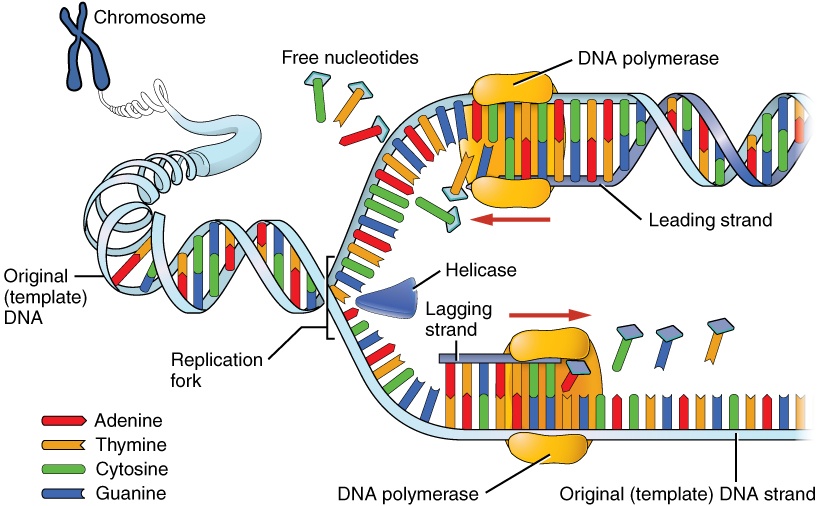
70.
A process in which DNA has the unique ability to make an exact copy of itself.
a)
Replication
b)
Translation
c)
Transcription
71.
Who is responsible for producing this image?
a)
Francis Crick
b)
James Watson
c)
Rosalind Franklin
d)
Watson and Crick
72.
What was Watson and Crick's main scientific accomplishment?
a)
Building the first accurate model of DNA
b)
Isolating strains of pneumonia causing bacteria
c)
Determining base pairing rules
d)
Discovering the process of genetic transformation
73.
Who was responsible for the model shown?
a)
Oswald Avery
b)
Watson and Crick
c)
Erwin Chargaff
d)
Rosalind Franklin