Wayground logo

Free Printable Worksheets

Font size

S
M
L
XL
Worksheets

Thermochem Quiz #1

Total questions: 37

Worksheet time: 1hrs 3mins

Name
Class
Date
1.
The SI unit of heat and energy is the __________.
a)
calorie
b)
heat
c)
joule
d)
watt
2.

Temperature is a measure of average _____energy of individual atoms.

a)

heat

b)

potential

c)

mechanical

d)

kinetic

3.
ΔH value in an endothermic reaction is a positive number.
a)
True
b)
False
4.
Which phase of matter has the greatest motion and least orderly arrangement?
a)
solid
b)
liquid
c)
gas
5.
As 120 g of hot milk cools in a mug, it transfers 20, 000 J of heat to the environment. What is the temperature change of the milk? The specific heat of milk is 2.6 J/g·°C. (Q=mcΔT)
a)
64 °C
b)
1.56 °C
c)
640 °C
d)
cannot be determined
6.
If 100 g of aluminum at 145ºC gains 6,800 J of heat, what is the final temperature (Tfinal) of the aluminum? Aluminum has a specific heat of 0.897 J/gºC. (Q=mcΔT)
a)
-69°C
b)
0.52°C
c)
221°C
7.

How do you calculate Enthalpy of a reaction?

a)

ΔH = ΔHproducts - ΔHreactants

b)

ΔT = q / mC

c)

ΔG = ΔH -TΔS

d)

E = mc2

8.
Specific heat capacity is
a)
heat energy needed to raise temp by 1C
b)
heat energy needed to raise temp of 1g of substance by 1C
c)
heat energy absorb to raise 1g of substance to higher temp
d)
heat energy need to raise temp for 1g of substance
9.
Universe
a)
the Sytem AND the Surroundings
b)
everything else except the System
c)
heat content of a system, at a constant pressure
d)
Babymetal song
10.
Enthalpy
a)
heat content of a system, at a constant pressure
b)
reaction that gives heat to the surroundings
c)
part of the Universe that is being studied
d)
temperature of the system
11.

Endothermic Reaction

a)

reaction that takes heat from the surroundings

b)

reaction that gives heat to the surroundings

c)

reaction at constant pressure

d)

reaction at a constat speed

12.

Exothermic Reaction

a)

reaction that gives heat to the surroundings

b)

reaction that takes heat from the surroundings

c)

reaction at constant pressure

d)

reaction at a constat speed

13.
Enthalpy of Reaction
a)
change in Enthalpy during a reaction
b)
part of the Universe that is being studied
c)
reaction at constant pressure
d)
speed of a reaction
14.

ΔHrxn

a)

symbol for enthalpy of reaction

b)

symbol for enthalpy

c)

exothermic reaction

d)

difference in altitude

15.

NH4NO3 --> NH4+ +NO3-

ΔH = + 27 kJ

a)

endothermic reaction

b)

exothermic reaction

c)

reaction with catalyst

d)

equilibrium reaction

16.

part of the Universe that is being studied

a)

System

b)

Surrounding

c)

Enthalpy

d)

Endothermic Reaction

17.
everything else except the System
a)
Surrounding
b)
Universe
c)
Enthalpy
d)
Enthalpy of Reaction
18.
the Sytem AND the Surroundings
a)
Universe
b)
Enthalpy
c)
Endothermic Reaction
d)
Endothermic Reaction
19.
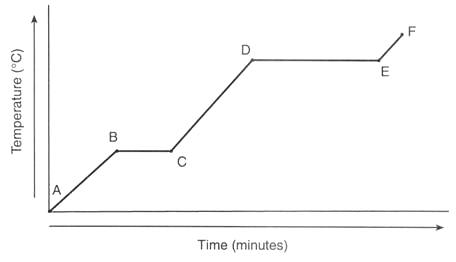
What line segment represents only the solid state?
a)
A-B
b)
B-C
c)
C-D
d)
D-E
20.
Between which points is the temperature of the substance remaining constant?
a)
A-B only. 
b)
A-B, C-D, E-F
c)
B-C only. 
d)
B-C, D-E
21.

Between which two points is Heat of Fusion?

a)

A <----> B

b)

B <----> C

c)

C <----> D

d)

D <----> E

e)

E <----> F

22.

Between which two points is Heat of Vaporization?

a)

A <----> B

b)

B <----> C

c)

C <----> D

d)

D <----> E

e)

E <----> F

23.
In which segment is the kinetic energy remaining constant?
a)
A-B
b)
B-C
c)
C-D
d)
E-F
24.
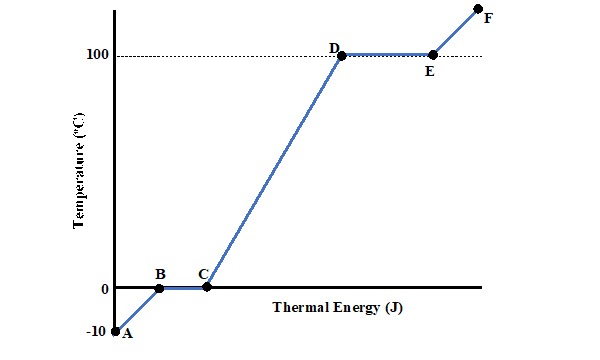
A substance's heating curve is shown in the graph.  What is its boiling point?
a)
100 C
b)
60 C
c)
80 C
d)
20 C
25.
The graph shows a cooling curve for an unknown substance.  What is happening during segment DE?
a)
boiling
b)
condensation
c)
freezing
d)
melting
26.

Which equation do you use to solve for the energy of segment D-E?

a)

q= mCΔT

b)

q= Hv*mol

c)

PV=nRT

d)

q= Hf*mol

27.

The energy of which segments can be found using the equation q=mCΔT?

a)

A-B, D-E, E-F

b)

B-C, D-E ,E-F

c)

B-C, C-D, E-F

d)

A-B, C-D, E-F

28.

Which equation do you use to solve for the energy of segment C-D?

a)

q=mCΔT

b)

q= Hv*m

c)

q= Hf*m

d)

PV=nRT

29.

Which equation would you use to solve the following: Calculate the heat necessary to change 10 g of ice(s) at 0°C to 10 g of water(l) at 0°C.

a)

q=mCΔT

b)

q= Hv*m

c)

q= Hf*m

d)

PV=nRT

30.
A reaction is performed in a beaker with a temperature probe recording the temperature changes of the reaction.  If the temperature began at 15.0 degrees Celsius and ended at 27.5 degrees Celsius.  If the reaction is our system, is the system endothermic or exothermic?
a)
Exothermic
b)
Endothermic
31.
Do reactants in an endothermic reaction have a higher or lower energy than the products? 
a)
Higher
b)
Lower
32.

When you freeze water, it turns to ice. What kind of change is this?

a)

endothermic

b)

exothermic

33.
True or false: melting and freezing occur at the same temperature!
a)
True
b)
False
c)
I don't know
34.
When water is heated from 10°C to 15°C What is the change in temperature?
a)
10 °C
b)
5 °C
c)
15 °C
d)
25 °C
35.
If I heat up 2 pans of water one has 100 mL in it and one has 1000mL. Which one heats up the fastest?
a)
100 mL
b)
1000 mL
c)
They both heat up at the same speed
d)
They cool down.
36.
Calculate the amount of energy required to melt 35.0 grams of ice.
(not in sig figs)  Hf = 80.0 cal/g,  Hv = 560.0 cal/g, SH = 1.00 cal/g ºC

a)
19,600 cal
b)
35.0 cal
c)
2,800 cal 
d)
1,568,000 cal 
37.
If a 8.50g ice cube at -10o C sits out on the counter, completely melts, and then warms to room temperature (25o C) how much energy did the ice cube absorb? Use C = 2.108 J/goC for ice, C = 4.184 J/goC for water, and Hf = 334 J/g.
a)
179.18 J
b)
2839 J
c)
889.1 J
d)
3907.3 J