
 Worksheets
Evolution Review
Total questions: 40
Worksheet time: 20mins

What are the preserved remains of an organism that lived in the past?
Fossils
Acquired traits
Adaptations
Fitness

Who was the man who proposed the theory of natural selection and evolution?
James Watson
Gregor Mendel
Neil Degrasse Tyson
Charles Darwin

What is the BEST definition for evolution?
Changing to fit the surroundings
Adaptation
Nature's power
Change over time

What causes evolution?
Natural selection
Overpopulation
Climate change
Humans

What are the variations of mice in this environment?
white and grey
short and tall
red and green
long fur and short fur
Why is this variation best for survival?
longer claws for fighting
longer legs for running faster
bigger ears for better hearing
fur color that blends into its environment

What term refers to body parts that perform a similar function but differ in structure?
analogous structures
homologous structures
punctuated equilibrium
vestigial structures
Which term refers to the process by which populations of organisms with variations that help them survive in their environments live longer, compete better, and reproduce more than those that do not have the variations?
adaptation
mimicry
natural selection
selective breeding
Which is an inherited trait that increases an organism’s chance of surviving and reproducing in its environment?
adaptation
camouflage
natural selection
variation

The picture below shows the forelimbs of three different organisms: a bat, a bird, and a horse. All of these animals originally are descended from a common ancestor.
What is most likely responsible for the changes that occurred to form distinctly different organisms over millions of years?
The organisms' environments changed, and natural selection diversified each species.
The damage from basic injuries cause mutations to occur that passed onto offspring.
The organisms created new traits and species through selective breeding.
The introduction of humans allowed for artificial selection to take place.
Within a population, variation increases the likelihood that some individuals will be able to survive if the environment changes. Which of the following causes variations within a population?
Changes in extinction rates
Changes in the genetic material
Changes in the breeding rate
Changes in the environment

Many animals who live where it snows have fur. Explain how white fur makes surviving in the snowy environment easier.
Orange fur make them harder to spot.
White fur allows them to better blend in with their habitat.
The color of fur doesn't effect an animal's chance of survival.
White fur is cooler than other fur colors.

The pictures are from different types of animals. What can be said about them that is true?
They all have different bones, which implies that they all share a different ancestor.
They all have different bones, which implies that they all share a common ancestor.
They all have similar bones, which implies that they all share a different ancestor.
They all have similar bones, which implies that they all share a common ancestor.
When scientists compare fossils from billions of years ago to recently formed fossils, what would they discover?
the species changed over time
the species stayed the same over time
the species chemically changed
the species moved to higher levels of the food chain
Some lizards have different size legs. Lizards with longer legs are able to better access food. Over time, lizards with short legs became less common. What is the adaptation in this situation?
Lizards
Long legs
Short legs
Access to food

Which layer is the oldest?
1
2
3
4
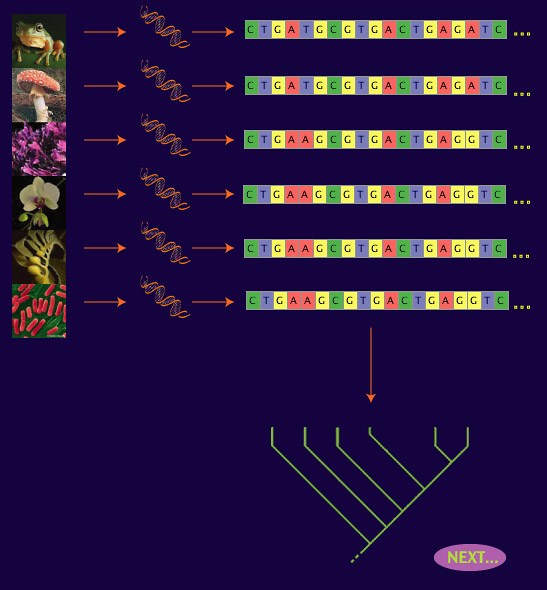
Two organisms that are closely related would have...?
very similar DNA sequences.
exactly the same DNA sequences.
no proteins in common.
completely different DNA sequences.

Which of the following is a term for a group of similar organisms that can reproduce fertile offspring?
individual
population
species
community
What is the term that describes the ability of an organism to survive and reproduce in its specific environment?
Diversity
Evolution
Adaptation
Fitness
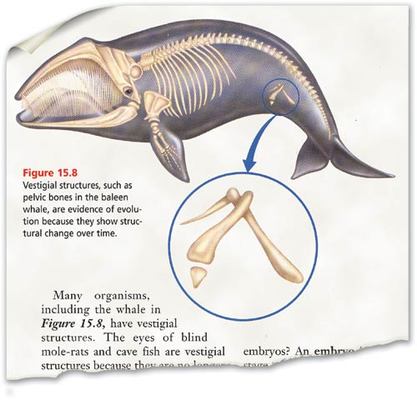
The hind leg bones in a whale are examples of...?
homologous structures
analogous structures
fossils
vestigial structures
On the Galapagos islands, Charles Darwin observed...?
completely unrelated birds on each of the islands.
birds exactly like those found in South America.
somewhat similar birds, with different beaks for different foods.
birds completely unrelated to those found in South America.

Based on the image, why are these similar looking birds now considered different species, even though they have a common ancestor?
All these birds could swim, so they went to different continents to evolve.
Their environments changed over time, so they had to adapt to those environments.
The birds acquired the new traits while trying to adapt to their new environments.
There were fewer species of birds in the past, now there are more.
How does artificial selection differ from natural selection?
Variation between individuals is not requried in artificial selection.
Human choice is the selective factor in artificial selection.
Genetic inheritance does not play a role in artificial selection.
There is no limiting factor affecting the population in artificial selection.


The adaptation of being able to outrun a predator is natural selection if...?
it helps them mutate their DNA.
it causes them to have lower mortality rates (live longer).
it allows them to live long enough to reproduce and pass on their advantageous trait.
it produces offspring that run at average speeds.

What is true about the brown snails after natural selection has acted on the population?
The frequency of the genes in 1 individual increases
The frequency of the brown shell gene increases
The number of genes in 1 chromosome increases
The number of genes in one species increases

What is going on in this picture?
Humans introduced a new species of mollusks
The mollusks hybridized (mated) to create a group of larger mollusks.
The length of mollusks gradually changed over time.
A sudden change to the environment caused big shells to be better adapted.

The bat, bird, and butterfly do not share a common ancestor, but have developed similar characteristics. This is an example of...?
genetic drift.
the bottleneck effect.
divergent evolution.
convergent evolution.

Who is the most fit in the picture?
Bird
Green beetle
Brown beetle
Both color of beetles


When an organism completely dies out, this is called.....?
adaption.
extinction.
fossilization.
mutation.
You want to see if two species share a common ancestor. Which type of evidence is the most reliable?
Embryology
DNA
Homologous structures
Vestigial structures
An earthquake causes an ocean channel to open up on an island where a low area previously existed. The island’s lizard population is now separated on the two parts of the island, providing an example of...?
geographic isolation.
the bottleneck effect.
the Founder effect.
allopatric speciation.

