
 Worksheets
unit 2 review AP Bio 2021
Total questions: 50
Worksheet time: 50mins

DNA


A continuous membrane system that forms a reticular network which transverses the cytoplasm is known as.....
Lysosome
Endoplasmic Reticulum
Golgi complex
Ribosome
Which of the following is the basic type of E.R. ?
Rough E.R.
Smooth E.R.
Both of above
None of above
Synthesis and packeging of proteins occurs in...
Rough ER
Smooth ER
Lysosome
Plasma membrane
......is important in the creation and storage of lipids and steroids.
Smooth ER
Rough ER
Lysosome
Mitochondria

What is the purpose of the mitochondria?
The mitochondria makes glucose and releases oxygen.
The mitochondria breaks down glucose to make ATP.
The mitochondria will produce proteins.
The mitochondria will absorb light energy.
Hydrolytic enzymes must be segregated and packaged to prevent general destruction of cellular components. In animal cells, which of the following organelles contains these hydrolytic enzymes?
central vacuole
peroxisome
lysosome
chloroplast

Which of the following is NOT a product of the light reactions?
Oxygen
NADPH
ATP
Glucose (Sugar)
What part of the plant cell performs photosynthesis?
The Mitochondrion
The Nucleus
The Chloroplast
The Cell Wall
What is the function of the intermembrane space of the mitochondria?
space where H+ ions accumulate quickly for ATP synthesis
space where electrons accumulate for ATP synthesis
to increase the surface area to volume ratio for ATP production
Increase the surface area available for ATP synthesis
cristae
matrix
inner membrane
outer membrane


Which pigment gives leaves their color?
chlorine
chlorophyll
cholesterol
Which of the following is true of the Calvin Cycle?
carbon dioxide and energy (ATP and NADPH) are used to make organic compounds
energy is absorbed from sunlight and converted to chemical energy stored in ATP and NADPH
Occurs in the thylakoid
Occurs in the cytoplasm

Plasma membranes are selectively permeable. This means
anything can pass in and out
the membrane regulates the passage of the material in and out of the cell
glucose cannot enter the cell
cholesterol cannot enter
Small, nonpolar, hydrophobic molecules such as fatty acids
easily pass through the membrane's bilayer
very slowly diffuse through the bilayer
require transport proteins
enter through endocytosis
Membrane phospholipids
have hydrophobic heads that face the center of the membrane and are shielded from water
have hydrophilic tails that face outward
remain fluid because they are tightly packed
none of these

Describe what will happen to the solution on the right over time.
Solutions remained unchanged as the membrane is impermeable to the particles
The larger purple particles will move to the left where there are a lower concentration of purple particles
Smaller red particles cross membrane into the higher concentration on the right
Smaller red particles cross membrane into the lower concentration on the right

X-cell wall
Y-cytoplasm
Z-nucleus
x-nucleus
Y-cytoplasm
Z-Chloroplast
x-nucleus
Y-cell wall
Z-chloroplast
X-chloroplast
Y-cell wall
Z-nucleus
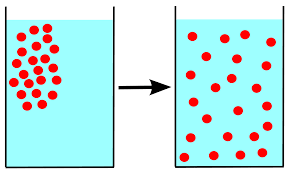


Which is not a form of passive transport?
Osmosis
Facilitated diffusion
Active transport
Diffusion
Passive transport moves molecules from...
low concentration to high concentration
high concentration to low concentration
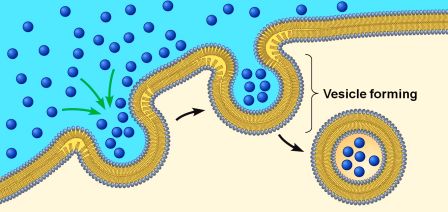
An example of facilitated diffusion is
CO2 and O2 exchange in the lungs
Glucose transport
Na+ / K+ Pumps
Endocytosis
Facilitated diffusion needs what to get particles from one side of the membrane to the other?
a membrane-spanning protein
a surface protein
a phospholipid
a carbohydrate
What is the movement of particles with the concentration gradient using protein "helpers"?
diffusion
facilitated diffusion
active transport
enzymatic reactions

