wayground logo

Free Printable Worksheets

NEW

Font size

S
M
L
XL
Worksheets

PHYSICS KSSM FORM 4 CHAPTER 2

Total questions: 56

Worksheet time: 40mins
Name
Class
Date
1.
What is the speed of an object at rest?
a)
9.81 m/s
b)
1 m/s
c)
0 m/s
d)
10 m/s
2.
Which of the following situations represents a negative displacement?(Assume positive position is measured vertically upward along ay-axis.)
a)
A cat stands on a tree limb.
b)
 A cat jumps from the ground onto a tree limb.
c)
A cat jumps from a lower tree limb to a higher one.
d)
A cat jumps from a tree limb to the ground.
3.
Which of the following units is the SI unit of velocity?
a)
meter
b)
meter•second
c)
meter per second
d)
second per meter
4.
The slope of a line drawn tangent to a point on the curve of a position versus time graph describes what concept? 
a)
 acceleration
b)
instantaneous velocity
c)
displacement
d)
position
5.
Acceleration is defined as
a)
a rate of displacement
b)
the rate of change of displacement.
c)
the change in velocity
d)
 the rate of change of velocity.
6.
What is the SI unit of acceleration? 
a)
m/s
b)
m2 /s
c)
m/s2
d)
m•s2
7.
If you know a car’s acceleration, the information you must have to determine if the car’s velocity is increasing is the
a)
direction of the car’s initial velocity
b)
direction of the car’s acceleration.
c)
initial speed of the car. 
d)
final velocity of the car.
8.
. If you know the acceleration of a car and its initial velocity, you can predict which of the following?
a)
the direction of the car’s final velocity
b)
the magnitude of the car’s final velocity
c)
the displacement of the car
d)
all of the above
9.
When a car’s velocity is positive and its acceleration is negative, what is happening to the car’s motion?
a)
 The car slows down.
b)
The car speeds up. 
c)
. The car travels at constant speed.
d)
The car remains at rest.
10.
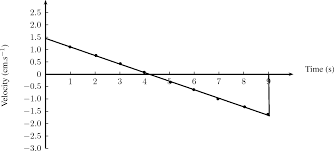
The graph above describes the motion of a ball. At what point does the ball have an instantaneous velocity of zero
a)
1 second
b)
2 seconds
c)
3 seconds
d)
4 seconds
11.
Acceleration due to gravity is also called
a)
negative velocity
b)
displacement
c)
free-fall acceleration
d)
instantaneous velocity
12.
When there is no air resistance, objects of different masses dropped from rest
a)
fall with equal accelerations and with equal displacements.
b)
fall with different accelerations and with different displacements.
c)
. fall with equal accelerations and with different displacements.
d)
fall with different accelerations and with equal displacements.
13.
Objects that are falling toward Earth in free fall move
a)
faster and faster
b)
slower and slower
c)
at a constant velocity
d)
slower then faster. 
14.
Which would hit the ground first if dropped from the same height in a vacuum—a feather or a metal bolt?
a)
. the feather
b)
the metal bolt
c)
They would hit the ground at the same time
d)
They would be suspended in a vacuum
15.
What is the name of the length of the straight line drawn from an object’s initial position to the object’s final position?
a)
displacement
b)
distance
c)
velocity
d)
acceleration
16.
Which of the following line segments on a velocity versus time graph is physically impossible?
a)
horizontal line
b)
straight line with positive slope
c)
straight line with negative slope
d)
vertical line
17.
A baseball catcher throws a ball vertically upward and catches it in the same spot as it returns to the mitt. At what point in the ball’s path does it experience zero velocity and nonzero acceleration at the same time?
a)
midway on the way up
b)
at the top of its path
c)
the instant it leaves the catcher’s hand
d)
            the instant before it arrives in the catcher’s mitt
18.

It is defined as the change in position of the object.

a)

Distance

b)

Displacement

c)

Velocity

d)

Speed

19.

A person walks toward the front of a train at 5 km/hr. The train is moving 80 km/hr with respect to the ground, so the walking person's speed is what ?

a)

75 km/hr

b)

85 km/hr

c)

37.5 km/hr

d)

42.5 km/hr

20.

A person walks 70 meter east, then 40 meter west. What is the total distance traveled by the person?

a)

110 meters

b)

30 meters

c)

55 meters

d)

30 km

21.

A person walks 70 meter east, then 40 meter west. What is the total displacement traveled by the person?

a)

110 meters

b)

30 meters

c)

55 meters

d)

30 km

22.

Distance traveled / time elapsed is the formula for what ?

a)

Average velocity

b)

Average speed

c)

Instantaneous velocity

d)

Instantaneous speed

23.

The speed of a falling objects is NOT proportional to its mass or weight.

a)

TRUE

b)

FALSE

c)

MAYBE

d)

SOMETIMES

24.
Which force produces a change in motion?
a)
unbalanced force
b)
balanced force
c)
gravitational force
d)
frictional force
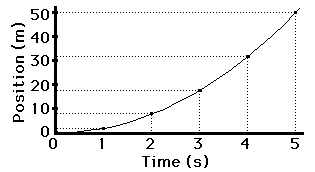
25.
The picture of the position vs. time graph shows an object that is...
a)
accelerating/speeding up
b)
moving at a constant speed 
c)
not moving 
d)
accelerating/slowing down. 
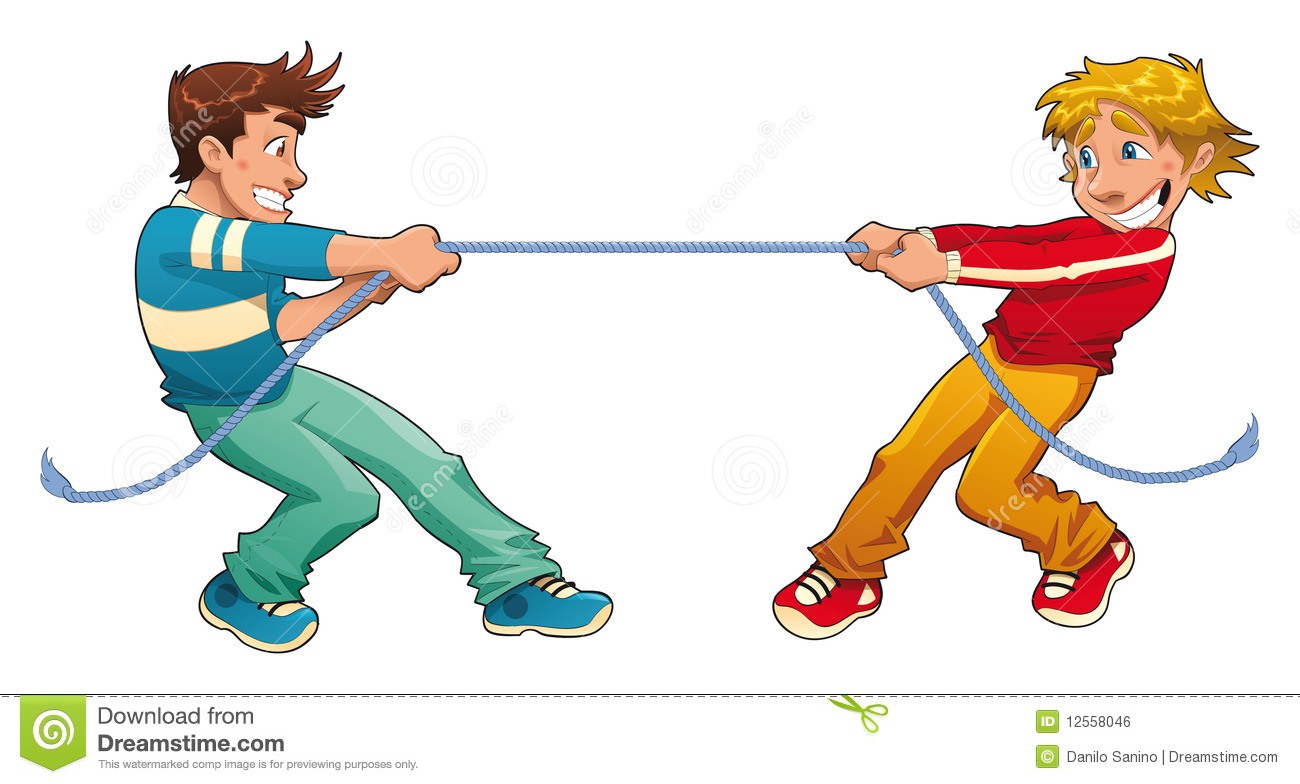
26.
If these boys are pulling with the same amount of force.  What will happen?
a)
The boy in blue will win.
b)
They will not move at all.
c)
The boy in red will win.
d)
Both will fall down.
27.
What is the standard unit force is measured in?
a)
Newtons
b)
pounds
c)
grams
d)
meters
28.
The tendency of an object to stay in motion or at rest is called 
a)
velocity
b)
acceleration
c)
speed
d)
inertia
29.
When two children of equal weight sit at opposite ends of a seesaw, they create
a)
gravity
b)
unbalanced forces
c)
motion
d)
balanced forces
30.
What is the law that states that energy cannot be created or destroyed only transform form one energy to another?
a)
Law of Conservation of Energy
b)
Law of Gravity
c)
Law of Inertia
d)
None of these
31.
At which point is potential energy greatest
a)
W
b)
X
c)
Y
d)
Z
32.
When an unbalanced force acts on an object, the force...
a)
Changes the motion of the object
b)
Is canceled by another force 
c)
Does not change the motion of the object 
d)
Is equal to the weight of the object 
33.
An object at rest stays at rest unless acted upon by an outside force is part of ...
a)
Newton's First Law
b)
Newton's Second Law 
c)
Newton's Third Law
d)
Darwin's Theory of Natural Selection
34.
According to Newton's First Law of Motion...
a)
 An object in motion will slow down when moving down a hill.
b)
An object in motion will stay in motion unless acted upon by an outside force.
c)
An object in motion will always move sideways when acted upon by an outside force.
d)
An object in motion will stay in motion when it is acted upon by an outside force.
35.
A change in velocity over time is...
a)
Weight 
b)
Speed
c)
Acceleration
d)
Force 
36.
When forces are balanced, the net force ....
a)
Is greater than the sum of the forces
b)
Is zero 
c)
Is negative 
d)
Is equal to the largest force
37.
A soccer ball takes 20s to roll 10 m. What is the average speed of the soccer ball?
Speed = distance/time 
a)
200 m/s
b)
5 m/s
c)
2 m/s
d)
0.5 m/s
38.
When an object is at rest, what is its velocity?
a)
2 m/s
b)
3 m/s
c)
1 m/s
d)
0 m/s
39.
Velocity is speed in a given...
a)
Direction 
b)
Acceleration 
c)
Force 
d)
Mass
40.
What is the acceleration of an object that speeds up from 1m/s to 5m/s in 2 seconds?
a)
2meters/seconds
b)
2meters/second squared
c)
4 meters per second
d)
4 meters per second squared
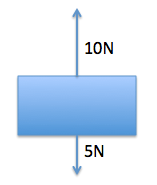
41.
What is the net force on the block? (click on the words to view the picture)
a)
5 Newtons up
b)
5 Newtons down
c)
15 Newtons up
d)
15 Newtons down
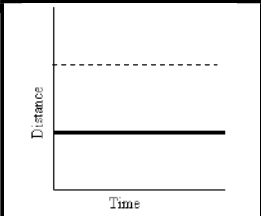
42.
What does this graph represent?
a)
Constant speed
b)
Acceleration
c)
Not moving
43.
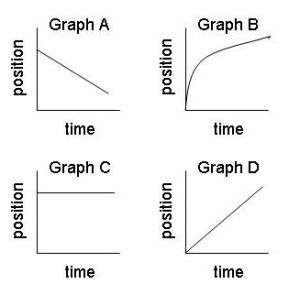
Which graph represents a student standing at their locker for a period of time.
a)
A
b)
B
c)
C
d)
D
44.
Four solid balls, each with a different mass (5, 10, 15, and 20 kg), are moving at the same speed.  Which ball would require the most force to stop its motion? 
a)
Ball with a mass of 5 kg
b)
Ball with a mass of 10 kg
c)
Ball with a mass of 20 kg
d)
Ball with a mass of 15 kg 
45.

The acceleration of an object is inversely proportional to the net force acting on it.

a)

True

b)

False

46.

The acceleration produced by a net force on an object is

a)

directly proportional to the magnitude of the net force.

b)

in the same direction as the net force

c)

inversely proportional to the mass of an object

d)

all of the above

47.

If the force acting on a cart doubles, what happens to the cart's acceleration?

a)

it quadruples

b)

it doubles

c)

it halves

d)

it quarters

48.

A tennis ball and a solid steel ball the same size are dropped at the same time. IN the absence of air resistance, which ball has the greater acceleration?

a)

the tennis ball

b)

the steel ball

c)

nonsense! they both have the same acceleration

49.

A tennis ball and a solid steel the same size are dropped at the same time. Which ball has the greater force acting on it?

a)

the tennis ball

b)

the steel ball

c)

they both have the same force acting on them

50.
A car with a velocity of 22 m/s is accelerated uniformly at the rate of 1.6 m/s2 for 6.8 s.  
What is its final velocity? 
a)
32.8 m/s
b)
11.1 m/s
c)
33 m/s
d)
11 m/s
51.
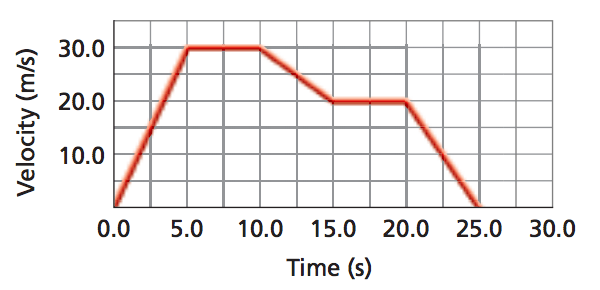
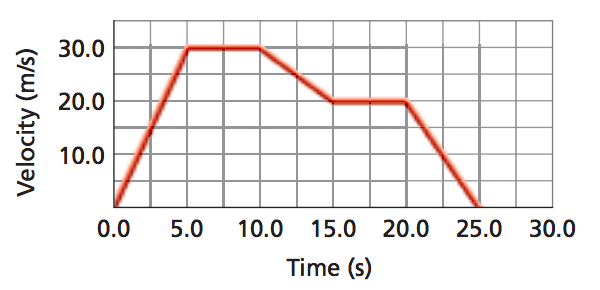
What is the acceleration between 5.00 and 10.00 seconds?
a)
0.00 m/s2
b)
30.0 m/s
c)
5.00 s
d)
6.00 m
52.
What is the acceleration between 10.0 and 15.0 seconds?
a)
10.0 m/s
b)
-10.0 m/s
c)
2.00 m/s2
d)
-2.00 m/s2
53.
What is the acceleration between 20.0 and 25.0 seconds?
a)
20.0 m/s
b)
-20.0 m/s
c)
4.00 m/s2
d)
-4.00 m/s2
54.
Determine the displacement of a plane that experiences uniform acceleration from 66 m/s to 88 m/s in 12 s. 
a)
1.8 m/s2
b)
790 m
c)
130 m
d)
920 m
55.
A race car can be slowed with a constant acceleration of 11 m/s2.
If the car is going 55 m/s, how many meters will it travel before it stops?

a)
140 m
b)
5.0 s
c)
2.5 m
d)
Does Not Exist
56.
A car is traveling 20.0 m/s when the driver sees a child standing on the road. She takes 0.80 s to react, then steps on the brakes and slows at 7.0 m/s2. How far does the car go before it stops? 
a)
16 m
b)
29 m
c)
45 m
d)
None of the above.