Wayground logo

Free Printable Worksheets

Font size

S
M
L
XL
Worksheets

Earth's Crust Unit Mr. Habscheid

Total questions: 52

Worksheet time: 27mins

Name
Class
Date
1.

Crust is...

a)

Earth's Solid Outer Layer

b)

Something on Pizza

c)

Shell surrounding the Earth

d)

Moved because of Earthquakes

2.

What is the largest portion of Earth’s interior?

a)

crust

b)

mantle

c)

outer core

d)

inner core

3.

This is the thin, rigid rock layer of Earth.

a)

crust

b)

mantle

c)

outer core

d)

inner core

4.

This part is made up of molten metal deep within Earth.

a)

crust

b)

mantle

c)

outer core

d)

inner core

5.

This is the theory that Earth’s crust is divided into plates that are always moving.

a)

Pangea

b)

Great Barrier Reef

c)

plate tectonics

d)

eruptions

6.

A _____ is a break in Earth’s crust where rock on one side can move in relation to rock on the other side.

a)

fault

b)

epicenter

c)

focus

d)

earthquake

7.

The release of energy and shaking of the ground is called a(n) what?

a)

volcano

b)

tsunami

c)

tornado

d)

earthquake

8.

A ____ is an opening that allows magma to reach Earth’s surface.

a)

volcano

b)

tsunami

c)

tornado

d)

earthquake

9.

Which layer of the earth is the arrow pointing to?

a)

crust

b)

mantle

c)

inner core

d)

outer core

10.

Which layer of the earth is the arrow pointing to?

a)

crust

b)

mantle

c)

inner core

d)

outer core

11.

Which layer of the earth is the arrow pointing to?

a)

crust

b)

mantle

c)

inner core

d)

outer core

12.

Which layer of the earth is the arrow pointing to?

a)

crust

b)

mantle

c)

inner core

d)

outer core

13.
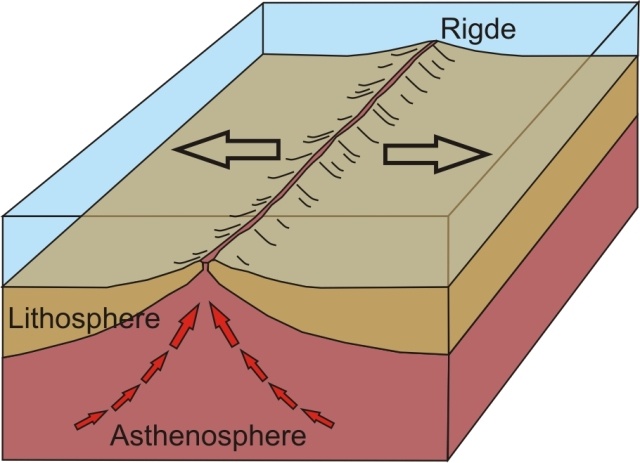
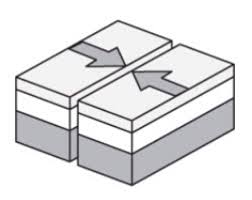
What kind of plate boundary is shown here?
a)
divergent
b)
convergent
c)
transform
d)
subducting
14.
What kind of plate boundary is shown here?
a)
divergent
b)
convergent
c)
transform
d)
subducting
15.
What kind of plate boundary is shown here?
a)
divergent
b)
convergent
c)
transform
d)
submergent
16.
What kind of plate boundary is shown here?
a)
divergent
b)
convergent
c)
transform
d)
strike slip
17.
What geologic feature/event you be most likely to find at a transform boundary?
a)
Earthquakes
b)
Volcanoes
c)
Mountains
d)
Rift Valleys
18.
What geologic feature/event would you most likely to find at a convergent boundary between two pieces of continental crust?
a)
Volcano
b)
Mountain
c)
Rift
d)
Island Arc
19.
Name the boundary
a)
convergent boundary
b)
divergent boundary
c)
transform boundary
d)
sergent boundary
20.

The area around the pacific plate where boundaries form is called...

a)

death ring

b)

fire zone

c)

ring of fire

d)

zone of fire

21.
The San Andreas Fault in California is an example of a ________.
a)
divergent boundary
b)
convergent boundary
c)
transform fault
d)
subduction zone
22.
Mountains form from ...
a)
plates sliding past one another
b)
collision of plates
c)
plates moving away from each other
23.
What would you be most likely to find at a convergent boundary between a continental and oceanic plate?
a)
Mountains
b)
Volcanoes
c)
Mid-Ocean Ridge
d)
Rift
24.
What would you be most likely to find at a transform boundary?
a)
Earthquakes
b)
Volcanoes
c)
Mountains
d)
Rift
25.
When an underwater earthquake causes a giant wave to come ashore, that wave is known as a...
a)
seismic wave
b)
shearing
c)
focus wave
d)
tsunami
26.
Earthquakes are caused by...
a)
seismic gaps
b)
sudden movement of water
c)
too much drilling along plate boundaries
d)
sudden movements of rock along a fault
27.
The area where two tectonic plates meet.
a)
mantle
b)
focus
c)
plate boundary
d)
convection
28.

The intensity of earthquake is measured using

a)

Baro meter

b)

Thermometer

c)

Seismograph

29.

The place in the crust of the Earth where the earthquake originates is known as

a)

Core

b)

Focus

c)

Mantle

30.

A Tsunami is caused due to

a)

Undersea Earthquake

b)

Lightning

c)

Heavy thunder

31.

The scale used to measure the intesity of earthquake is

a)

Ruler

b)

Ritcher scale

c)

weighing scale

32.
A rock formed from fragments of other rocks is a(n)
a)
Metamorphic Rock
b)
Sedimentary Rock
c)
Extrusive Rock
d)
Igneous Rock
33.
You find a rock in which the grains are arranged in parallel bands of white and black crystals.  The rock is probably a(n)
a)
Igneous rock
b)
Sedimentary rock
c)
Metamorphic rock
d)
Extrusive rock
34.
Fossils are only found in
a)
Sedimentary rocks
b)
Foliated Metamorphic rocks
c)
Igneous Rocks
d)
Nonfoliated Metamorphic rocks
35.

Limestone is an example of...

a)

Sedimentary

b)

Igneous

c)

Metamorphic

36.

Sandstone is an example of...

a)

Metamorphic

b)

Sedimentary

c)

Igneous

37.

Granite is an example of...

a)

Igneous

b)

Metamorphic

c)

Sedimentary

38.

Marble is an example of...

a)

Igneous

b)

Sedimentary

c)

Metamorphic

39.

Pumice is an example of

a)

Igneous

b)

Metamorphic

c)

Sedimentary

40.

Quartzite is an example of...

a)

Metamorphic

b)

Igneous

c)

Sedimentary

41.

Basalt is an example of...

a)

Igneous

b)

Sedimentary

c)

Metamorphic

42.

Shale is an example of...

a)

Metamorphic

b)

Sedimentary

c)

Igneous

43.

When large rocks are broken down into smaller parts by physical and chemical means

a)

Weathering

b)

Erosion

c)

Both

d)

Neither

44.
What are the 3 major types of rocks?
a)
Igneous, Metamorphic, Sedimentary
b)
Metamorphic, Igneous, Cementation
c)
Brown, Red, Gray
d)
Streak, Hardness, Breakage
45.
This rock was formed when molten rock cooled into a solid. What type of rock is it?
a)
Igneous Rock
b)
Metamorphic Rock
c)
Sedimentary Rock
46.

The name of a person that studies rocks and the earth.

a)

veterinarian

b)

geologist

c)

podiatrist

d)

teacher

47.
Subsoil is made mostly of
a)
parent material
b)
humus
c)
clay and silt
d)
bedrock
48.

It is difficult fro water to move through soil that has...

a)

Little or no pore space

b)

A high sand content

c)

Mostly large particles

d)

Many earthworms and ant homes

49.

Which type of soil has the lowest permeability?

a)

gravel

b)

clay

c)

sand

d)

humus

50.

The breakdown of rock by acidic water is an example of what?

a)

chemical weathering

b)

mechanical weathering

c)

abrasion

d)

exfoliation

51.

By breaking down rocks with their roots, plants commonly cause what?

a)

chemical weathering

b)

mechanical weathering

c)

exfoliation

d)

abrasion

52.

A soil that has a high porosity would most likely contain:

a)

silt

b)

sand

c)

humus

d)

gravel/pebbles