
 Worksheets
PMA 3 Review
Total questions: 55
Worksheet time: 3hrs 36mins


A cave explorer found a bunch of Megalodon sharks teeth in a cave in the middle of the Arizona Desert. What best explains why he would discover shark fossils here?
Megalodons would hunt their prey on the surface as well the ocean
Megalodons were known to fly
Millions of years ago, parts of Arizona were under water. Over time the Earth changed, the ocean became a desert, and the shark's teeth were fossilized.
Megalodons love Arizona, and go there to retire

How do we know that Intrusion A is YOUNGER THAN Layer C?
Law of Superposition
Law of Cross Cutting Relationships
Law of Inclusions
Law of Unconformities

Analyze the image Above. According to the Law of Superposition, which sequence of letters describes the rock layers in the diagram from oldest to youngest?
D,C,B,A
A,B,C,D
A,B,D,C
C,D,B,A


Which of these combinations identifies the appropriate labels in the order as shown in the diagram (1,2,3)?
Chromosome, Gene, DNA
Chromosome, DNA, Gene
DNA, Chromosome, Gene
DNA, Gene, Chromosome
What is the relationship among DNA, a gene, and a chromosome?
A gene is composed of DNA, but there is no relationship to a chromosome
A chromosome contains hundreds of genes, which are composed of protein.
A gene contains hundreds of chromosomes, which are composed of protein.
A chromosome contains hundreds of genes, which are composed of DNA.
Cells can reproduce through a process of either meiosis or mitosis. Which statement about reproduction is true? (More than one correct answer)
The cells produced by meiosis are genetically different to the parent cells.
The cells produced by mitosis are genetically different to the parent cells.
Meiosis is a form of asexual reproduction.
Mitosis is a form of asexual reproduction.
Which of the following is an advantage for sexual reproduction?
This type of reproduction takes more time
Doesn’t speed up evolution
2 parents are involved
Creates genetic variation
Which of the following requires only ONE parent creating a clone of themselves, with no diversity and large amounts of offspring?
Asexual reproduction
Meiosis
Sexual reproduction
DNA Replication
What are genes?
Pants
Specific traits
Sections of DNA arranged along the chromosomes
Chromosomes
The passing of traits from parent to offspring is called _______.
Heredity
Phenotypes
Extinction
Mutation
Chromosomes are made of _____ , contain a variety of _____ and can be found in the _____ of a cell.
RNA, mutations, nucleus
DNA, genes, cytoplasm
Proteins, mutations, Golgi body
DNA, genes, nucleus
How many chromosomes does a regular human body cell contain?
46
23
92
26
How many chromosomes does a human reproductive cell contain?
23
46
18
92


Which is a true statement about this picture?
Brown is recessive
Brown is dominant
Blue is dominant
Blue is codominant

In the punnett square below, what belongs in the missing square
tt
Tt
Bb
TT
If you crossed a PP (purple) with a pp (white), what would the phenotypes be?
all white
all tall
all purple
1/2 white, 1/2 purple
If you cross a white flower (pp) with a purple flower (PP), the possible genotypes of the offspring are
PP and pp
All Pp
All PP
All pp
The organism's appearance is known as its
heredity
pedigree
phenotype
genotype
If you cross two rabbits that have the genotype Bb, how many possible genotypes can be found in the offspring?
one
two
three
four
Rr x Rr
3/4 offspring will have the dominant phenotype
2/4 offspring will have the recessive phenotype
4/4 offspring will have RR genotype
1/4 offspring will be heterozygous
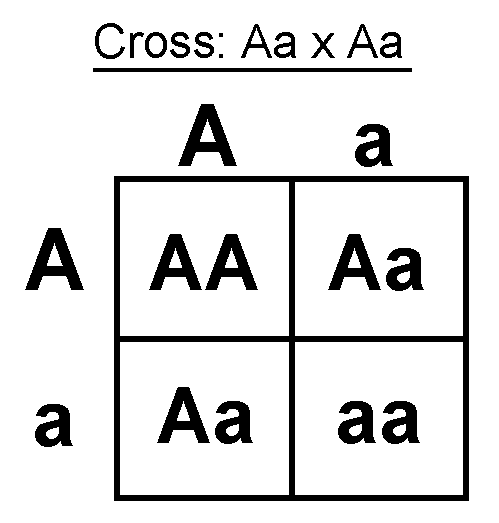
What are the possible phenotype(s) of the offspring? (A-Brown hair; a-blond hair)
50 % Brown Hair and 50% Blond Hair
25 % Brown Hair and 75% Blond Hair
75 % Brown Hair and 25% Blond Hair
0% Brown Hair and 100% Blond Hair

Huntington's Disease is a dominant trait.
What is the correct genotype for individual I-2?
HH
Hh
hh
H?

In the diagram, individual III-3 indicates
a female with no freckles
a male with no freckles
a male with freckles
a female with freckles
In the diagram, individual II-1 indicates
a female with no freckles
a male with no freckles
a male with freckles
a female with freckles
George Guinea Pig met Greta Guinea Pig at a dance. George is heterozygous for his long hair, but Greta has short hair. What are the chances that their baby would have long hair?
100%
75%
50%
25%
George Guinea Pig met Greta Guinea Pig at a party. George is heterozygous for his long hair, but Greta has short hair. What are the chances that they would have a heterozygous baby?
100%
75%
50%
25%
Stuart Snail is heterozygous for tall eyeballs. Sally Snail has tall eyeballs but does carry the recessive allele. What are the chances that their baby snail would have short eyeballs?
75%
50%
25%
0%
Stuart Snail is heterozygous for tall eyeballs. Sally Snail has tall eyeballs but does carry the recessive allele. If their baby snail has tall eyeballs then what is/are the possible genotype(s) he could have?
TT
TT , Tt
TT, Tt, tt
tt
Gary Goldfish is heterozygous for dark orange color. Ginny Goldfish is homozygous dominant. Their baby has light orange color. Is Gary the father?
Yes, because the light orange color is dominant
No, because there is no way they could produce a homozygous recessive baby
Yes, because Ginny has two alleles for light orange color, so their baby could be light orange
No, because Gary does not have the allele for light color.
Gary Goldfish is heterozygous for dark orange color. Ginny Goldfish is homozygous dominant. What is the chance that they will have a heterozygous offspring?
100%
75%
50%
25%


Food, water, sunlight, air, soil are resources that are often __________.
limiting factors
wet
messy
found in rocks
The living parts of an ecosystem
Biotic
Abiotic
Antibiotic
Probiotic
Nonliving parts of an ecosystem
Biotic
Abiotic
Prebiotic
Nonbiotic

If a disease destroying barley plants in a field swept through an ecosystem, what would happen to the barley eating bird population in the the field ?
The bird population would stay the same
The bird population would infinitely increase
The bird population would decrease

What would happen if the population of hawks suddenly increased? How would it affect the other organisms in the ecosystem?
The snakes would decrease due to more hawks eating them
All of the population of organisms would increase
The biotic factors in the ecosystem would increase
The hawks predators would decrease
What is a producer?
Organism that makes its own energy
Organism that breaks down dead organisms
Organism that eats other organisms for food & energy
What is a carnivore?
An organism that only eats plants for energy
An organism that eats animals for energy
An organism that eats both plants and animals for energy.
What is an herbivore?
An organism that only eats plants for energy
An organism that eats animals for energy
An organism that eats both plants and animals for energy.

The picture provided shows an ocean bay food chain. Sea otters move into the ocean bay. They eat all of the sea urchins. This change will cause the
kelp to have less food.
crabs to have more food.
sea ducks to have less food.
arctic foxes to have more food.

The picture shows an energy pyramid. What will most likely happen to the foxes and the wolves if the rabbits are removed?
The foxes will eat more wolves.
The foxes will eat fewer wolves.
There will be more foxes and wolves.
There will be fewer foxes and wolves.

