Wayground logo

Free Printable Worksheets

Font size

S
M
L
XL
Worksheets

ESB - U3Q3 Pulse Check - 2025

Total questions: 40

Worksheet time: 30mins
Name
Class
Date
1.
Scenario: An educational researcher conducts an experiment to determine if there is a link between the amount of time someone spends studying and the grade they get in a particular class. Question: What is the independent variable (IV) in the experiment?
a)
The IV in the experiment is the amount of time someone spends studying.
b)
The IV in the experiment is the grade someone gets in a particular class.
2.
Scenario: An exercise physiologist conducts an experiment to determine if "carb loading" (eating a lot of carbohydrates) the day before participating in endurance activities impacts performance. Question: What is the dependent variable (DV) in the experiment?
a)
The DV in the experiment is the amount of carbohydrates eaten within a defined timeframe.
b)
The DV in the experiment is the performance in an endurance activity.
3.
When is it appropriate to use a column (bar) graph to display data?
a)
It is appropriate to use a column (bar) graph to display data when comparing sets or groups of data.
b)
It is appropriate to use a column (bar) graph to display data when showing parts of a whole (percentages).
c)
It is appropriate to use a column (bar) graph to display data when showing the change in one sample, typically over time.
d)
It is appropriate to use a column (bar) graph to display data when showing the correlation (relationship) between two numeric variables.
4.
Relative to oceanic crust, continental crust is _____.
a)
much thicker and less dense
b)
much thicker and more dense
c)
thinner and less dense
d)
thinner and more dense
5.
Who advanced the Theory of Plate Tectonics?
a)
Harry Hess
b)
James Hutton
c)
Alfred Wegener
d)
J. Tuzo Wilson
6.

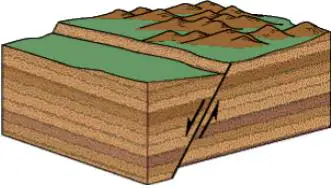
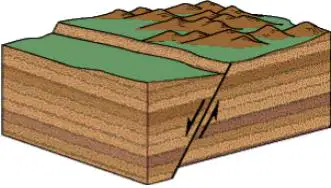
What type of fault is illustrated here? What is the name of the down-dropped wall?
a)
normal fault; foot wall
b)
normal fault; hanging wall
c)
reverse fault; foot wall
d)
reverse fault; hanging wall
7.

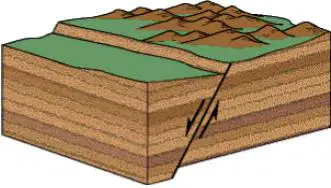
What type of stress causes the fault illustrated here?
a)
Compressional stress
b)
Confining stress
c)
Tensional stress
d)
Shearing stress
8.

What type of plate boundary is associated with the fault illustrated here?
a)
Convergent (Destructive)
b)
Divergent (Constructive)
c)
Transform (Conservative)
9.
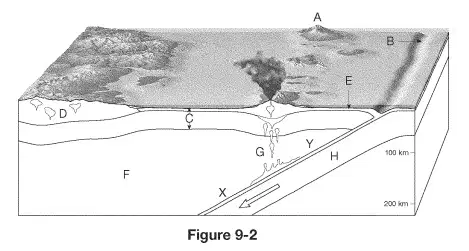
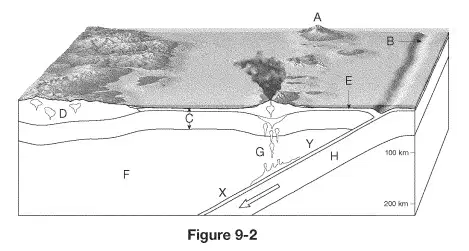
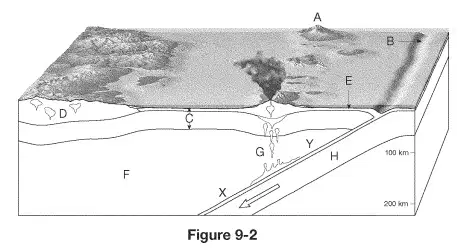
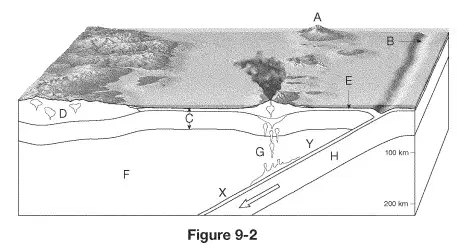
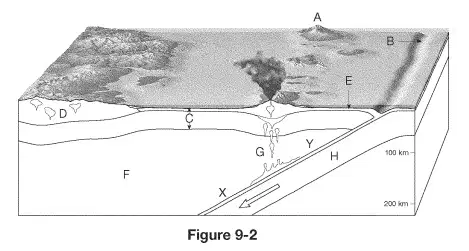
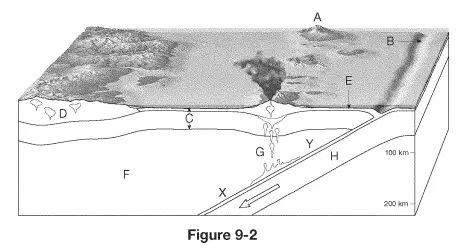
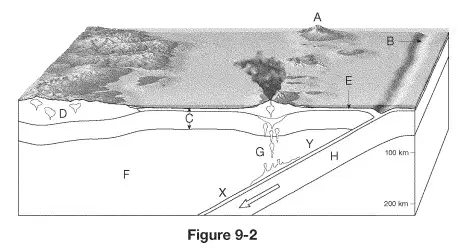
What specific type of plate boundary is illustrated in Figure 9-2?
a)
oceanic-oceanic convergent boundary
b)
divergent boundary on a continent
c)
divergent boundary on the ocean floor
d)
continental-continental convergent boundary
e)
oceanic-continental convergent boundary
10.
What surface feature is labeled A in Figure 9-2?
a)
continental volcanic arc
b)
mid-ocean ridge
c)
trench
d)
volcanic island arc
11.
What surface feature is labeled B in Figure 9-2?
a)
continental volcanic arc
b)
mid-ocean ridge
c)
trench
d)
volcanic island arc
12.
What layer of Earth is labeled C in Figure 9-2?
a)
continental crust
b)
continental lithosphere
c)
oceanic crust
d)
oceanic lithosphere
13.
What layer of Earth is labeled E in Figure 9-2?
a)
continental crust
b)
continental lithosphere
c)
oceanic crust
d)
oceanic lithosphere
14.
What layer of Earth is labeled F in Figure 9-2?
a)
asthenosphere
b)
continental lithosphere
c)
oceanic lithosphere
d)
outer core
15.
What plate tectonic process is illustrated in Figure 9-2?
a)
Convection
b)
Rifting
c)
Seafloor-spreading
d)
Subduction
16.
Which of the following products/features would be found at a Divergent plate boundary on the ocean floor? Select any that apply.
a)
earthquakes
b)
mid-ocean ridge
c)
new ocean floor
d)
rift valley
e)
volcanoes
17.
Identify an example of a Divergent plate boundary on the ocean floor.
a)
The Aleutian Island Arc south of Alaska
b)
The Great Rift Valley on the African Continent
c)
The Mid-Atlantic Ridge between North America and Eurasia
d)
The Peru-Chile Trench on the western edge of South America
18.
The location on Earth's surface directly above the origin of an earthquake is known as a(n) _____.
a)
epicenter
b)
fault
c)
focus
d)
triangulation
19.
How many seismic stations are required to determine the location on Earth's surface directly above the origin of an earthquake?
a)
1
b)
2
c)
3
d)
4
20.

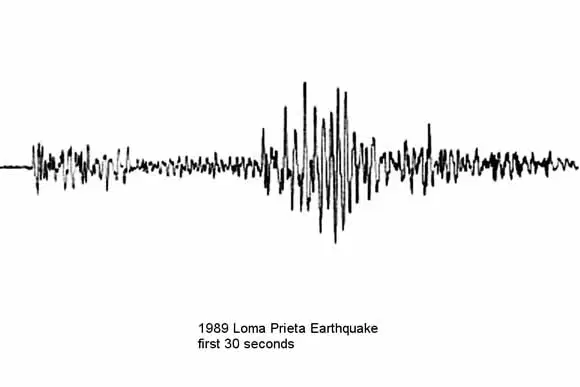
Which seismic wave is shown on the LEFT side of the seismogram shown?
a)
Love wave
b)
P wave
c)
Rayleigh wave
d)
S wave
21.

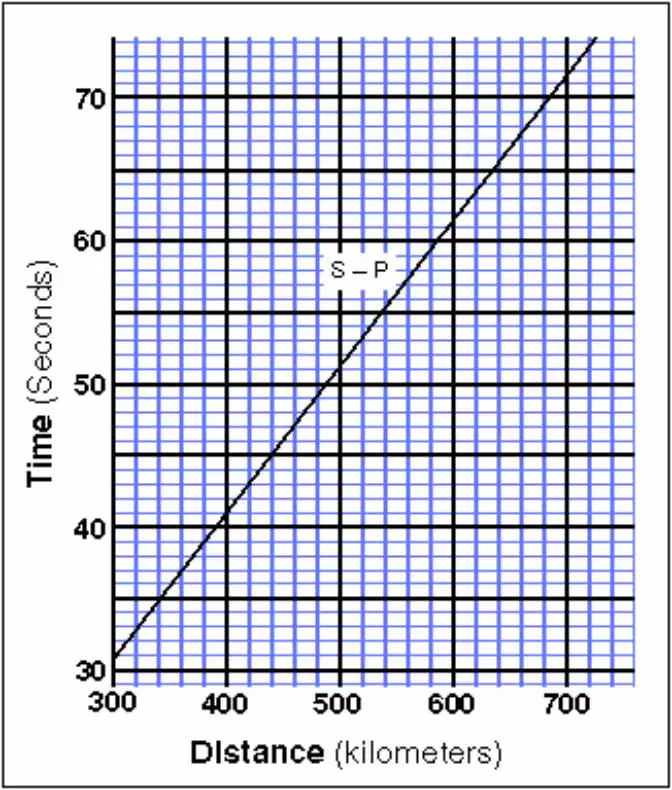
Using the S-P Interval graph, determine the distance between a seismic station and an earthquake when the difference in wave arrival times is 52 seconds.
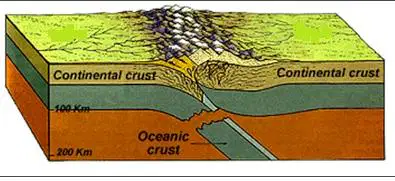
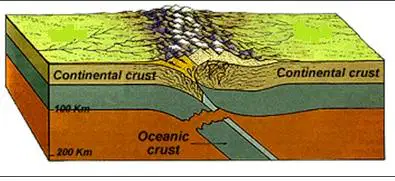
a)
500 kilometers
b)
505 kilometers
c)
510 kilometers
d)
515 kilometers
e)
520 kilometers
22.
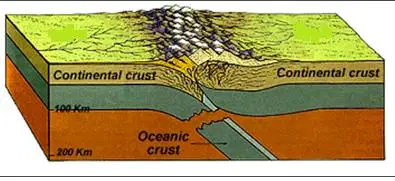
What is the tectonic setting beneath the Himalayan Mountain Range?
a)
C-C convergent plate boundary
b)
O-C convergent plate boundary
c)
O-O convergent plate boundary
d)
divergent plate boundary
e)
intraplate setting (hot spot)
23.
What type of stress is at work beneath the Himalayan Mountain Range?
a)
no stress required
b)
compressional stress
c)
shearing stress
d)
tensional stress
24.
What type of mountains make up the Himalayan Mountain Range?
a)
dome (or upwarped) mountains
b)
fault-block mountains
c)
folded (fold-thrust) mountains
d)
volcanic mountains
25.
What type of deformation (at depth) formed the Himalayan Mountain Range?
a)
no deformation required
b)
brittle deformation
c)
ductile deformation
d)
elastic deformation
26.
What type(s) of folded structure(s) would be found in the Himalayan Mountain Range?
a)
no fold required
b)
anticline
c)
syncline
d)
both anticline and syncline
27.
What type of faulting would occur in the Himalayan Mountain Range?
a)
no fault required
b)
normal
c)
reverse
d)
strike-slip
28.

Which type of plate boundary is responsible for the formation of volcanic island arcs?

a)

Oceanic-oceanic convergent boundary

b)

Continental-continental convergent boundary

c)

Divergent boundary

d)

Transform boundary

29.

What is the main cause of earthquakes at transform plate boundaries?

a)

Confining stress

b)

Tensional stress

c)

Shearing stress

d)

Compressional stress

30.

Which seismic wave arrives second at a seismic station after an earthquake?

a)

Love wave

b)

Rayleigh wave

c)

S wave

d)

P wave

31.

The picture shows a type a movement resulting from the compression of Rocks.

a)

Faulting

b)

Folding

c)

Stratification

d)

Tension

32.

Which among the pictures shows SYNCLINE (Folding)?

a)
b)
c)
d)
33.

Identify the disturbance (breaking)

a)

folding

b)

tilting

c)

intrusion

d)

fault

34.

What are two main types of folding?

a)

Horizontal and Vertical

b)

Synclines and Anticlines

c)

Up and down

d)

Bottom and Top

35.
What type of stress is happening to these layers of crust?
a)
Compression
b)
Seperation
c)
Faulting
d)
Tension
36.

What type of fault is shown?

a)

Normal

b)

Reverse

c)

Thrust

d)

Transform

37.

What type of fault is shown?

a)

Normal

b)

Reverse

c)

Thrust

d)

Transform

38.

In this photograph, which rock formation is represented by the blue lines?

a)

syncline

b)

joint

c)

anticline

d)

fault

39.

What are forces that push and pull on Earth's surface?

a)

faults

b)

folds

c)

tilting

d)

stress

40.

In the picture, what type of deformation is shown?

a)

folding

b)

faulting

c)

tilting

d)

rotating