
 Worksheets
Plate Tectonics Exploration One
Total questions: 30
Worksheet time: 1hrs 2mins
Name
Class
Date
1.
Scientists hypothesize that a super continent existed 200 million years ago. This continent is called
a)
America
b)
Super Earth
c)
Pangea
d)
Eurasia
2.
What is the difference between the lithosphere and asthenosphere that makes up the mantle?
a)
The lithosphere is ismade of dense solid meal whle the asthenosphere is made of liquid molten metal
b)
The lithosphere is a mixture of gasses while the asthenosphere is made of solid rock
c)
The lithosphere is molten rock that moves while the asthenosphere is ridid and thin
d)
The lithosphere is made of solid rock while the asthenosphere is more flexible hot rock that moves.
3.

What is the inner most layer of Earth?
a)
core
b)
outer core
c)
inner core
d)
asthenosphere
4.

Which layer of earth is molten?
a)
inner core
b)
outer core
c)
crust
d)
lithosphere
5.

Which layer of Earth is solid and why?
a)
The inner core is solid because of movement of the outer core.
b)
The inner core is solid because of the freezing temperatures.
c)
The inner core is solid because of the extreme pressure from the other layers.
d)
The outer core is solid because of the extreme pressure from the other layers.
6.

Which layers make up the mantle?
a)
crust, inner core, outer core
b)
mesosphere, asthenosphere, part of lithosphere
c)
bottom part of the mantle
d)
crust only
7.

Which layer is plastic and has the consistency of silly putty allowing movement?
a)
asthenosphere
b)
lithosphere
c)
mesosphere
d)
crust
8.

Which layer of Earth is about 6 miles (10 km) thick below the oceans and 25 miles (40 km) thick below the continents?
a)
crust
b)
mantle
c)
outer core
d)
inner core
9.

Which of Earth's layers is made of SOLID iron and nickel?
a)
crust
b)
mantle
c)
outer core
d)
inner core
10.

Which layer of the Earth is the thickest at about 1802 miles (2900 km) and makes up about 84% of Earth's total volume?
a)
crust
b)
mantle
c)
outer core
d)
inner core
11.
Which type of wave arrives to a point first?
a)
Primary Waves (P-Waves)
b)
Secondary Waves (S-Waves)
c)
Rayleigh Waves
d)
Love Waves
12.
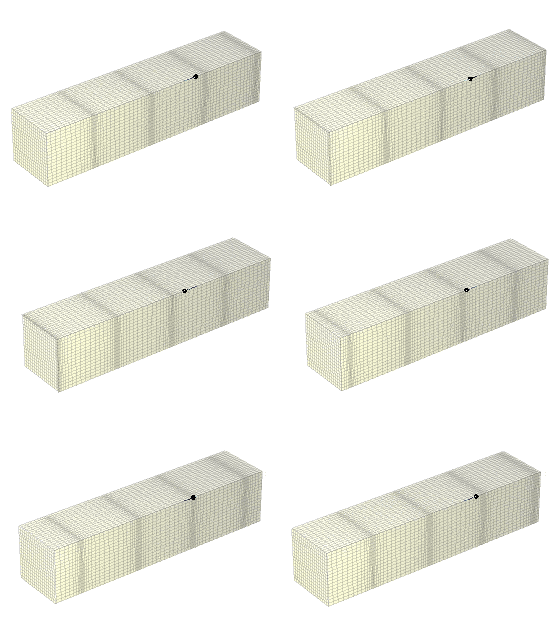
Which body wave is pictured?
a)
P-Wave
b)
S-Wave
c)
Rayleigh Wave
d)
Love Wave
13.
P Waves travel through...
a)
Solids
b)
Liquids
c)
Both
14.
S Waves travel through...
a)
Soilds
b)
Liquids
c)
Both
15.

These are the first waves released during an earthquake
a)
S waves
b)
Surface Waves
c)
P waves
16.

These are the secondary, or second waves to be released. They cannot travel through the liquid outer core
a)
S waves
b)
Surface Waves
c)
P waves
17.
True or False
The Earth's core is liquid surrounded by a solid outer core
The Earth's core is liquid surrounded by a solid outer core
a)
True
b)
False
18.
Energy from an Earthquake travels as.....
a)
seismic waves
b)
intergalactic waves
c)
sound waves
d)
plasma waves
19.
To study Earth’s interior, geologists often rely on indirect methods, such as evidence from fossils.
a)
True
b)
False
20.
Pressure increases from Earth’s surface toward the center of Earth.
a)
True
b)
False
21.
The outermost layer of Earth is called the mantle.
a)
True
b)
False
22.
The part of the mantle called the _____ is made of soft rock that bends like plastic.
a)
asthenosphere
b)
lithosphere
23.
Holes drilled several kilometers into Earth’s crust provide direct evidence about Earth’s interior in the form of ____.
a)
seismic waves
b)
rock samples
c)
liquid iron
d)
volcanic eruptions
24.
Geologists obtain indirect evidence about Earth’s interior by ____.
a)
measuring pressure differences at Earth’s surface.
b)
estimating temperature inside earth.
c)
directly looking under the many layers.
d)
recording and studying seismic waves.
25.
Earth’s inner core is ____.
a)
a dense ball of solid metal.
b)
a layer of molten metal.
c)
a layer of hot rock.
d)
a layer of rock that forms Earth’s outer skin.
26.
Using data from seismic waves, geologists have learned that Earth’s interior is made up of several ___.
a)
continents
b)
layers
c)
ridges
d)
trenches
27.
Earth’s mantle is ____.
a)
a layer of molten metal
b)
a layer of hot rock.
c)
a dense ball of solid metal.
d)
a layer of rock that forms Earth’s outer skin.
28.
Which is thicker, the oceanic crust or the continental crust?
a)
oceanic crust
b)
continental crust
29.
The Earth's lithosphere contains
a)
The upper mantle
b)
The oceanic crust
c)
The continental crust
d)
All are correct
30.
The Earth is approximately
a)
3 million years old
b)
50 million years old
c)
2 billion years old
d)
4.5 billion years old
100 %

