

wayground logo

Free Printable Worksheets

NEW

Font size

S
M
L
XL
Worksheets

EDUC 215 final review

Total questions: 36

Worksheet time: 21mins

Name
Class
Date
1.
After two months, the developing baby is technically called a
a)
embryo
b)
blastocyst
c)
fetus
d)
egg
2.
Which of the following is the stage of life between childhood and adulthood?
a)
adolescence
b)
Teenagers
c)
Peers
d)
Mid-Life
3.

Erikson's stage that occurs between birth to one year of age is concerned with:

a)

Trust v mistrust

b)

Initiative v guilt

c)

Autonomy v self doubt

d)

Identity v confusion

4.

A preschooler picking out their own clothes, even if they do not match, is an example of which of Erikson's stages?

a)

Trust v mistrust

b)

Autonomous v doubt

c)

Intimacy v isolation

d)

Integrity v despair

5.

How many stages of development occur in Eriksons model?

a)

5

b)

6

c)

7

d)

8

6.
Intimacy vs. Isolation occurs at what stage?
a)
infancy
b)
young adulthood
c)
maturity
7.
What stage am I?
Toddlers – They wish to do things on their own, or they’re ashamed
a)
Trust vs mistrust
b)
initiative vs guilt
c)
Autonomy vs shame
8.
What stage am I?
Kids feel good about being productive, or they feel inferior for failing to do so.
a)
Initiative vs guilt
b)
Industry vs inferiority
c)
Identity vs role confusion
9.
What stage am I?
Teens test different roles, or they’re confused about who they are.
a)
Trust vs mistrust
b)
generativity vs stagnation
c)
Identity vs role confusion
10.
What stage am I?
They look back on their lives and either see a sense of worth or failure.
a)
integrity vs despair
b)
Generativity vs stagnation
c)
Identity vs role con
11.
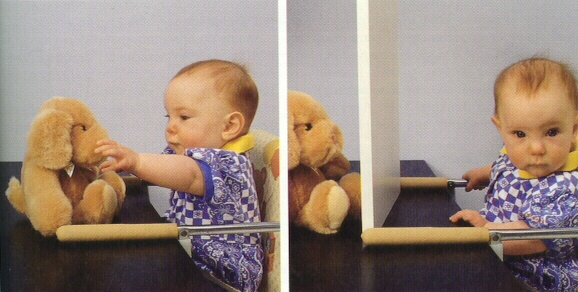
An infant who has developed object permanence...
a)
is attached to specific objects, such as a blanket.
b)
will see all objects as being the same.
c)
knows that an object, such as a rattle, exists even if it is not in view.
d)
cries when a wanted object is taken away.
12.
The cognitive ability to be able to recognize that quantities remain the same when two glasses of water are sitting beside each other, and one is poured into a taller glass.
a)
Irreversibility
b)
Centration
c)
Conservation
d)
Object Permanence 
13.
The inability of young children to see the world through someone else's view is termed:
a)
Centration
b)
Irreversibility
c)
Conservation
d)
Egocentrism
14.
How many stages did Piaget state people go through as they developed?
a)
5
b)
1
c)
4
d)
2
15.
If Jeremy begs for a new electronic gadget, his parents nearly always buy it for him. What type of family is this?
a)
Permissive
b)
Democratic
c)
Authoritarian
d)
Submissive
16.
This style of parenting calls for imposing rules and demanding obedience without debate or discussion between parent and child.
a)
Permissive
b)
Neglectful
c)
Authoritative
d)
Authoritarian
17.
Erikson said that when you are a teenager, your main goal is to find your . .
a)
Trust
b)
Calling
c)
Identity
d)
Integrity
18.
When the baby's cheek is stroked they turn towards the side it was stroked and begins making sucking motions
a)
rooting reflex
b)
sucking reflex
c)
grasp reflex
d)
Babinski reflex
19.
The experiment with Harry Harlow and the monkeys prove what about humans?
a)
 We need food to survive.
b)
 We need human touch to survive.
c)
We want human touch over food.
d)
 We want food over human touch.
20.
The  ________________________________ parenting style uses a "hands off" approach, where children learn from the consequences of their actions. The parent considers themselves as a friend to their child.
a)
Authoritative
b)
Neglecting
c)
Permissive
d)
Authoritarian
21.
Maria resents the burdens and constraints  of caring for her infant daughter and ignores her cries for attention.  Her daughter will likely show signs of
a)
egocentricism
b)
insecure attachment
c)
habituation
d)
gender typing
22.
According to Piaget, accommodation refers to
a)
parental efforts to include new children in the existing family structure
b)
incorporating new experiences into existing schemas.
c)
developmental changes in a child's behavior that facilitate social acceptance by family and peers.
d)
adjusting current schemas in order to make sense of new experiences.
23.
If research suggested that a pregnant mother's use of an artificial sweetener caused harm to the fetus, the artificial sweetener would be considered a(n):
a)
FAS
b)
form of DNA
c)
depressant
d)
teratogen
24.
Mary Ainsworth's Strange Situation paradigm is used to test young children's 
a)
ego strength
b)
intelligence
c)
reaction time
d)
attachment
25.

Dr. Schulte wants to investigate if aggressive behavior in children is increased if they view violent videos.  In this instance, the dependent variable is


a)


violent videos


b)


aggressive behavior


c)


a placebo


d)


the control condition


26.
When our child first says dada, dada, dada or mama, mama, mama. Rather than associating meaning with that combination of consonants and vowels, at first baby Fritz will be:
a)
Cooing
b)
Doodling
c)
Booing
d)
Babbling
27.
He stressed the importance of observation and imitation in learning. His research included studying children with a Bobo doll.
a)
Albert Bandura
b)
Carl Bobo
c)
Paul Ekman
d)
David Wechsler
28.
Interpreting new experiences in terms of existing schemas is called:
a)
learning
b)
assimilation
c)
accomodation
29.
How do cliques help adolescents with social development?
a)
They encourage them to develop stronger family ties.
b)
They emphasize the importance of preparing for college and a career.
c)
They foster friendships with individuals from a wide variety of cultures and social classes.
d)
They help adolescents establish an identity.
30.
 Authoritative parents can best be defined as:
a)
 Parents who befriend their children and do not use discipline
b)
Parents who are less controlling and behave with a more accepting attitude
c)
Parents who try to control the behavior of their children in accordance with a set standard of conduct
d)
Nurturing, but sets boundaries 
31.
Piaget's term for a framework of basic ideas about people, objects, and events based on past experience; building blocks of knowledge
a)
Accommodation
b)
Assimilation
c)
Schema
32.
Process by which we incorporate new information without major alterations in old information
a)
Accommodation
b)
Assimilation
c)
Schema
33.
Lisa is conducting a study on hours of TV watched throughout one's lifespan. She begins by taking a group of two 10 year olds, three 15 year olds, three 20 year olds and so on (increments of 5 years, up to 35 years of age.) Which method of research is she using?
a)
Cross sectional study
b)
Experimentation
c)
Longitudinal study
d)
Case study
34.
___________ design is where one group is research/followed and assessed at different times as the group ages.
a)
Longitudinal
b)
Cross-Sectional
c)
Cross-Sequential
d)
Human Development
35.
According to Kübler-Ross, the most common order of emotional reactions in preparing for death is:
a)
anger, depression, bargaining, denial, acceptance.
b)
denial, anger, bargaining, depression, acceptance.
c)
anger, depression, denial, bargaining, acceptance.
d)
depression, anger, denial, bargaining, acceptance.
36.

Who believed that infants are born hardwired with an internal biological mechanism to learn language? He described this mechanism LAD (Language Acquistion Device).

a)

Psychologist Eric Lenneberg

b)

Linguist Noam Chomsky

c)

Educationalist Maria Montessori

d)

Psychologist Jerome Bruner
