
 Worksheets
Acid Base Salts
Total questions: 45
Worksheet time: 1hrs 17mins

According to which scientist's theory is a base a substance which produces OH- ions in water?
Arrhenius
Bronsted-Lowry
Lewis
According to Bronsted-Lowry acid base theory, an acid is a.....
proton donor
proton acceptor
produces H+ when added to water
made of H+

According to Lewis acid-base theory, a Lewis base is.....
an electron pair acceptor
an electron pair donor
an oxidising agent
a reducing agent

According to Arrhenius acid-base theory, an acid is....
an H+ acceptor
a H+ donor
a substance that produces H+ in water
anything with an H+

Which reactant in the following equation is a Bronsted acid?
ammonium
ammonia
hydroxide
water

Which reactant in the following equation is a Bronsted acid?
Water
Hydrogen chloride
Hydronium
Chloride
HSO4-(aq) + H2O(l) → H3O+(aq) + SO42-(aq)
Identify the Acid in the above reaction.
HSO4-
H2O
H3O+
SO42-
A substance that remains when a base has accepted an H+ ion is
An acid
A base
A conjugate acid
A conjugate base
In the equation below, what is the Bronsted Lowry acid?
HCl + NH3 --> Cl- + NH4+
HCl
NH3
Cl-
NH4+
Neutral solutions have a pH of:
0
1
7
14

True or false: a neutral solution has equal amounts of H+ and OH-.
True
False

What is the pH of a solution that has a [H+] concentration of 2.5 x 10⁻⁵?
4.60
5.0
2.5
7
What is a solution's [H+] concentration if the pH is 10.0?
1.0 x 10⁻¹⁰ M
1.0 x 10⁻⁴ M
1.0 x 10⁻¹⁴ M
1.0 x 10⁻⁷ M
The lower the pH, the greater the concentration of:
OH-
H-
H3O+
Na+

HClO4 is a strong acid and dissociates completely. What is the pH of a 0.15 M solution of HClO4?
0.82
13.18
0.15
1
Acidic solutions exhibit a higher ratio of H3O+ ions, known as...
neutrons
hydroxide
electrons
hydronium
What completely ionizes in solution?
Weak acids
Strong acids
Strong Salts
Neutral salts

This solution is filled with:
Weak Acid
Strong Base
Strong Acid
Weak Base

Tastes bitter
acid
base
both an acid and a base

Turns indicators different colors
acid
base
both an acid and a base
What are the formulas for the following?
--sulfuric acid--
--nitric acid--
H2SO, HNO
H2SO3, HNO3
H2S, H3N
H2SO4, HNO3
NaOH

Kw for water is called
water dissociation constant
product constant
ionic product constant
acid dissociation constant
dissociation of weak acid, HA, is represented by following equation :
HA(aq) + H2O(l) ⇌ H3O+(aq) + A-(aq)
The equilibrium constant for this reaction is represented by Ka . Which of the following equation represents expression of equilibrium constant, Ka?


Complete the following reaction:
HCl + Mg(OH)2 -->
MgCl2 + H2O
Mg +H2O
MgCl2 + H2
MgCl2 + H2O + CO2

What is the molarity of a 30 mL HCl which is neutralized by 48 mL of 0.3 M sodium hydroxide? HCl + NaOH --> H2O + NaCl
0.16 M
6.25 M
0.48 M

What is the endpoint of a titration?
Where the amount of acid and base are equal as shown by a color change
Where there is no base
When the volume of base in the burette is used up
When there is no acid
What is the main purpose of acid-base titrations?
To test if reactants react.
To calculate the concentration of unknown analyte.
To calculate the concentration of known analyte.
To test quality of reactants.

What is the role of an indicator in a reaction?
To help reactants react successfully.
To bind to the analyte to form a product.
To show when the reaction has reached or past the equivalence point.
To provide a surface for the reaction to occur.

What is an equivalence point?
It is the point when enough analyte has been added.
It is the point when the amount of added titrant is equal to the amount of analyte in the solution.
It is the point when the volume of titrant is equivalent the volume of analyte.
It is the point when the concentration of titrant added is equivalent to the volume of analyte.
Which of the following best represents a 0.100-molar solution of H2SO4 in water?
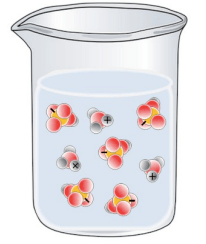
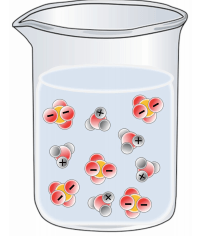
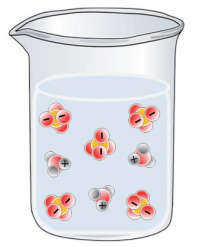
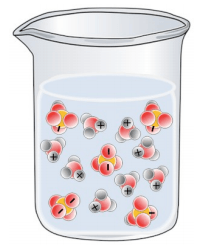

Which of the following best approximates the Ka value for this weak acid?
1 x 10⁻⁴
1 x 10⁻⁵
5x 10⁻⁶
5 x 10⁻⁷

Which of the following indicators is the best choice for this titration?
Methyl orange (pH range of color change is 3.2 - 4.4)
Methyl red (pH range of color change is 4.8 - 6.0)
Bromothymol blue (pH range of color change is 6.1 - 7.6)
Phenolphthalein (pH range of color change is 8.2 - 10.0)


This equation produces...
Kb
pKb
Ka
pOH
H3PO4 is an example of a ...
monoprotic acid
diprotic acid
triprotic acid
Which is a diprotic acid?
chlorous acid (HClO2)
nitrous acid (HNO2)
sulfurous acid (H2SO3)
phosphorous acid (H3SO4)
Since water can act as an acid or a base, it is called _____.
hydroprotic
amphoteric
weird
conjugate

Acids are __________, which means they "eat away" at other materials.
transitional metal
alkaline
flammable
corrosive

