wayground logo

Free Printable Worksheets

NEW

Font size

S
M
L
XL
Worksheets

ch.7 test review- Properties of Atoms and Periodic Table

Total questions: 67

Worksheet time: 3hrs 45mins

Name
Class
Date
1.

the basic structural unit of matter

a)

atom

b)

matter

c)

element

d)

nucleus

2.

a collection of atoms of one type that cannot be broken down into simpler substances by ordinary chemical or physical means

a)

element

b)

subatomic particle

c)

electron

d)

matter

3.

the positively charged subatomic particle contained in the nucleus of an atom

a)

proton

b)

neutron

c)

electron

d)

matter

4.

a subatomic particle, contained in the nucleus of an atom, having the same mass as a proton but no electrical charge

a)

proton

b)

neutron

c)

electron

d)

matter

5.

a negatively charged subatomic particle that orbits the nucleus of an atom

a)

proton

b)

neutron

c)

electron

d)

matter

6.

an arrangement of the elements according to their atomic numbers so that elements with similar properties are in the same column and properties repeat from row to row

a)

Periodic Table of Elements

b)

Atomic Theory

c)

Isotopes

d)

Subatomic Particles

7.

a unique number for each element that equals the number of protons in an atom of that element

a)

element name

b)

element symbol

c)

atomic number

d)

atomic mass

8.

the mass of an atom, calculated by adding the number of protons and neutrons in the nucleus of the atom

a)

element name

b)

element symbol

c)

atomic number

d)

atomic mass

9.
What is the name for a row on the Periodic Table?
a)
Group
b)
Period
c)
Lanthanide
d)
Actinide
10.
What is the name for a column on the Periodic Table?
a)
Group
b)
Period
c)
Halogen
d)
Alkali
11.
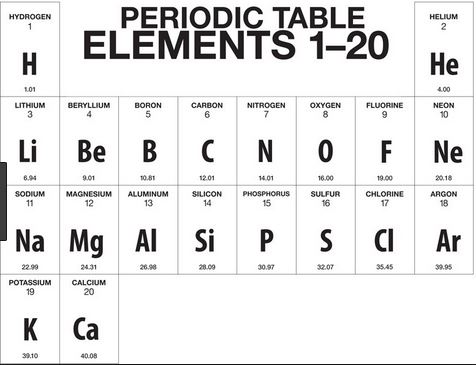
What is the first noble gas listed on the Periodic Table? (Use the tables posted around the room to help if you need!)
a)
Hydrogen
b)
Helium
c)
Neon
d)
Boron
12.
Which of the following has a positive charge?
a)
Proton
b)
Neutron
c)
Electron
d)
Ion
13.
Which of the following has a negative charge?
a)
Electron
b)
Proton
c)
Neutron
d)
Ion
14.
Which component of an atom increases or decreases when you have a different isotope?
a)
Protons
b)
Neutrons
c)
Electrons
d)
Nuclei
15.

An atom...

a)

is the smallest unit of matter

b)

exists in a neutral state

c)

is made up of protons, neutrons, electrons

d)

all of the above

16.

How is an atom and ion different?

a)

An atom has a charge and an ion has no charge.

b)

An atom has no charge and an ion has a charge.

17.

What charge will result if an ion gains 3 electrons?

a)

+3

b)

+1

c)

-3

d)

-2

18.

What charge will atoms in group 1 have (remember they will lose one electron)?

a)

+2

b)

+1

c)

-1

d)

-2

19.

What charge will elements in group 13 have (once they lose 3 electrons)?

a)

+1

b)

+3

c)

-1

d)

-3

20.

All atoms can become stable by...

a)

losing or gaining electrons to obtain a full valence (outer) shell

b)

losing or gaining protons to obtain a full valence (outer) shell

c)

losing or gaining neutrons to obtain a full valence (outer) shell

21.

If an atom has 7 valence electrons, what will its charge be as an ion once it gains stability?

a)

+1

b)

+7

c)

-7

d)

-1

22.

Will this atom gain or lose electrons to become stable?

a)

gain

b)

lose

c)

it will stay as is. Electrons are not gained or lost.

23.

Rutherford and his students did experiments that showed a positively charged

a)

quark

b)

nucleus

c)

neutron

d)

electron

24.

Bohr discovered that electrons are located in

a)

the nucleus

b)

inside protons

c)

electron cloud

d)

circular orbits around the nucleus

25.

Which one of the following parts of the atom is the smallest?

a)

atom

b)

neutron

c)

quark

26.

Which one of the following parts of the atom is the smallest?

a)

electron cloud

b)

electron

c)

nucleus

27.
Protons and neutrons is so small, they are assigned a mass of 1 in these units 
a)
grams
b)
milligrams
c)
amu (atomic mass unit)
d)
mass number
28.
The mass of 1 proton
a)
1 amu
b)
1 x 10 to the -24 amu
c)
-24 g
d)
-24 kg
29.
The mass of neutron
a)
1 x 10 to the -24 amu
b)
1 amu
c)
-24 g
d)
-24 kg
30.
Current model of the atom is called 
a)
Electron Cloud Model
b)
Planetary Model
c)
Plum Pudding Model
d)
Ringed Model
31.
The best images of atoms look fuzzy because of their 
a)
small size 
b)
constant motion
c)
fast-moving electrons
d)
thunder and lightning
32.
Silicon is a semiconductor and has properties of both metals and nonmetals. What type of element is Silicon? 
a)
Metal
b)
Nonmetal
c)
Metalloid
d)
Pretty
33.
Which elements are found on the left to middle of The Periodic Table? 
a)
Metals
b)
Nonmetals
c)
Metalloids
d)
Candles
34.
Which elements are found on the right side of The Periodic Table?
a)
Metals
b)
Nonmetals
c)
Metalloids
d)
Water
35.

Able to be drawn into wire is

a)

malleable

b)

insulator

c)

lustre

d)

ductile

36.

Able to be beaten or hammered into shapes

a)

lustre

b)

malleable

c)

brittle

d)

insulator

37.
What is an isotope? 
a)
A charged atom
b)
An atom with different amounts of neutrons
c)
An atom with different amounts of protons
d)
A neutral atom
38.
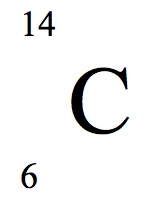
The photo above shows the isotopic notation for which isotope?
a)
Carbon 12
b)
Carbon 13
c)
Carbon 14
d)
Carbon 15
39.
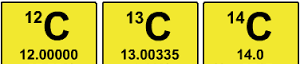
What do these isotopes of carbon all have in common?
a)
neutrons & mass number
b)
atomic number and neutrons
c)
atomic number and electrons
d)
protons, atomic number, and mass number
40.
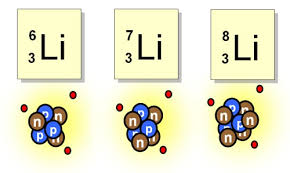
How many neutrons does the isotope of lithium have?
a)
8
b)
3
c)
4
d)
5
41.
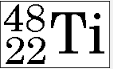
How many protons does this isotope of titanium have?
a)
48
b)
22
c)
26
d)
70
42.
In a correctly written symbol what would be located in the "A" position?
a)
number of neutrons
b)
atomic number
c)
number of electrons 
d)
mass number
43.
What quantities vary between isotopes of an element?
a)
protons, electrons, and atomic mass
b)
protons, electrons, and atomic number
c)
neutrons and electrons
d)
neutrons and atomic mass
44.
which atom has  4 neutrons?
a)
Li-6
b)
Li-7
c)
Li-8
d)
they have the same # of neutrons
45.
How many neutrons does the isotope below have?     89 36Kr
a)
53
b)
36
c)
89
d)
125
46.
An atom is electrically neutral when
a)
protons and neutrons are the same
b)
protons and electrons are the same
c)
neutrons and electrons are the same
d)
neutrons balance the protons and electrons
47.
Ions are: 
a)
atoms with a positive or negative charge
b)
atoms with no charge
c)
atoms with ONLY a positive charge
d)
atoms with ONLY a negative charge
48.
What is the name of the pictured isotope?
a)
Chlorine-Schmorine
b)
Chlorine-17
c)
Chlorine-35
d)
Chlorine-18
49.
What is the name of the pictured isotope?
a)
Copper-29
b)
Copper-63
c)
Copper-34
d)
CopperWopperHopperBopper
50.

Atomic number 5 and mass number of 11. How many neutrons does Boron-11 contain?

a)
5
b)
11
c)
6
d)
10.811
51.
What's a valence electron?
a)
electrons in the second energy level
b)
electrons in the outermost energy level
c)
the atomic number
d)
electrons in the first level
52.
How many valence electrons are in Phosphorus?
a)
15
b)
4
c)
5
d)
31
53.
How many electrons should Hydrogen have around its Lewis dot model?
a)
1
b)
2
c)
7
d)
8
54.
How many electrons should Chlorine have around its Lewis dot model?
a)
5
b)
6
c)
7
d)
8
55.

How many valence electrons does Sulfur Have?

a)

4 Valence electron

b)

5 Valence electron

c)

6 Valence electron

d)

7 Valence electron

e)

8 Valence electron

56.
Nitrogen will ____ valence electrons when forming an ionic bond.
a)
gain 1
b)
lose 1
c)
gain 3
d)
lose 3
57.
An isotope has three forms.  30% have a mass of 4 amu, 20% have a mass of 5 amu and 50% have a mass of 3 amu.  Average atomic mass will be closest to
a)
2 amu
b)
3 amu
c)
4 amu
d)
5 amu
58.
Calculate the average atomic mass of silver.
a)
106.38649amu
b)
111.91896amu
c)
107.8677amu
d)
121
59.
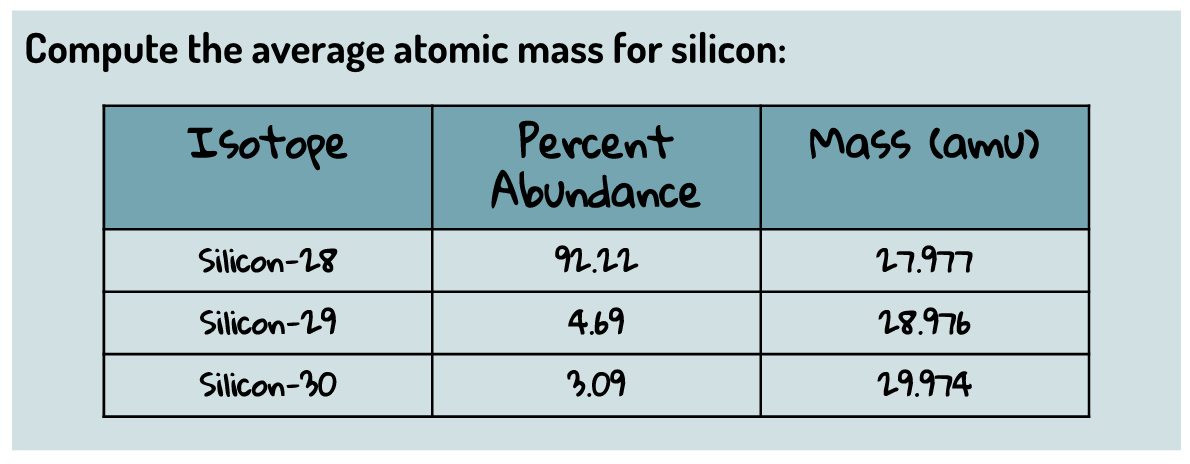
Compute the average atomic mass for silicon:
a)
27.977
b)
28.09
c)
28.976
d)
The average mass cannot be determined from provided information.
60.

Oxygen has 8 protons and 8 neutrons. What is oxygen's atomic number?

a)
16
b)
8
c)
15.999
d)
0
61.
A neutral atom of Carbon-13 has ________ electrons and _________ neutrons
a)
13, 13
b)
6, 7
c)
7, 7
d)
6, 6
62.
Isotopes are atoms of the same element that have the same number of __________ but different number of __________ . Therefore, isotopes of the same element have different masses. 
a)
protons, neutrons
b)
protons, electrons
c)
neutrons, protons
d)
electrons, protons
63.
A neutral atom would become an ion that has a charge of 2+ by 
a)
Losing two protons
b)
Losing two neutrons
c)
Losing two electrons
64.

After the 3 half-lifes, how much of the sample is left?

a)

50%

b)

33%

c)

25%

d)

12.5%

65.
If 10 mg of iodine 131 is given to a patient, how much is left after 24 days? The half-life of iodine-131 is 8 days.
a)
1.25mg
b)
1.25g
c)
10g
d)
10mg
66.
The half-life of strontium-90 is 25 years. How much strontium-90 will remain after 100 years if the initial amount is 4.0 g?
a)
3.0g
b)
0.25mg
c)
0.3g
d)
0.25g
67.
If the half-life of uranium-232 is 70 years, how many half-lives will it take for 10 g of it to be reduced to 1.25 g?
a)
1 half-life
b)
2 half-lives
c)
3 half-lives
d)
4 half-lives