wayground logo

Free Printable Worksheets

NEW

Font size

S
M
L
XL
Worksheets

History of the Earth

Total questions: 25

Worksheet time: 1hrs 25mins

Name
Class
Date
1.
The bottom layer is listed as the oldest. The top layer is listed as the youngest. What is this called?
a)
mineral content
b)
radioactive decay 
c)
the law of superposition 
d)
the principle of unconformity 
2.
How old do Paleontologists believe the Earth is?
a)
2015 years old
b)
3.6 billion years old
c)
4.6 billion years old
d)
4.6 million years old
3.
Which process would be most effective in determining the age of fossils embedded in rock?
a)
relative dating
b)
absolute dating
c)
use of index fossils
d)
use of core sampling
4.
By which method have scientists determined that the Earth is about 4.5 billion years old?
a)
plate tectonics
b)
relative dating
c)
radioactive dating
d)
law of superposition
5.
Which characteristic of carbon-14 dating helps scientists determine the approximate time a species became extinct?
a)
Carbon-14 is not present in more recent fossils
b)
Carbon-14 increases at a constant rate over time
c)
Carbon-14 decreases at a constant rate over time
d)
Carbon-14 can only be found in fossils of a certain period
6.
The half-life Carbon-14 is 5,730 years. How much parent material is left after 5,730 years?
a)
75%
b)
50%
7.

What causes continental plates to move?

a)

They don't move

b)

Convection currents

c)

Ocean currents

d)

Gravity from nearby planets and the moon

8.

What is a convection current?

a)

Hot material deep in the mantle moves upward by convection while cooler, denser slabs of oceanic lithosphere sink into the mantle.

b)

Massive movement of ocean waters due to winds near the surface

c)

Movement of cool, dense material upward while hotter, less dense material sinks into the mantle

d)

Random movement in the Earth's core

9.

Where does the heat that drives convection currents come from?

a)

The sun

b)

Friction

c)

Gravity

d)

Radioactive isotopes deep in the mantle

10.
If the half-life of a radioactive group of atoms is 100 years, then how old is the rock if there have been two half-lives?
a)
25 years
b)
200 years
c)
400 years
d)
800 years
11.
Suppose you found a material in which 12.5% of the original radioactive atoms were still present.  If the half-life of an atom is 60 years, how old is the material?
a)
30 years old
b)
60 years old
c)
120 years old
d)
180 years old
12.
What is 'half-life'?
a)
The age determined by the things around it.
b)
The age of an igneous rock.
c)
The age determined by radioactive dating.
d)
The time it takes for 1/2 of the radioactive atoms to decay in an element.
13.
The layer of rock between the Earth's core and crust.
a)
outer core
b)
crust
c)
inner core
d)
mantle
14.
The outer core is liquid.
a)
True
b)
False
15.
Which sphere supports living things?
a)
Hydrosphere
b)
Biosphere
c)
Atmosphere
16.

Which sphere of the Earth contains all of Earth's water.

a)

Lithosphere

b)

Hydrosphere

c)

Biosphere

d)

Atmosphere

17.

Scientists have determined an approximate age for Earth. To do this, they tested samples of meteorites, rock from the moon, and rocks from other parts of the solar system. Which method could be used to determine the age of these samples?

a)

Radiocarbon dating

b)

Index fossil dating

c)

Sedimentary rock dating

d)

Uranium-lead dating

18.

What materials does radiometric dating use to determine the age of objects?

a)

Rock layers

b)

Tree rings

c)

Fossils

d)

Isotopes

19.
Which type of wave is the most destructive wave?
a)
Primary Wave
b)
Secondary Wave
20.
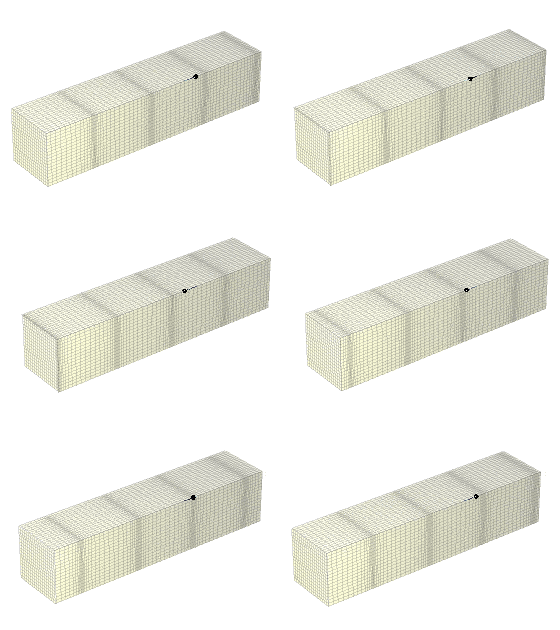
Which body wave is pictured?
a)
P-Wave
b)
S-Wave
c)
Rayleigh Wave
d)
Love Wave
21.

Primary (P) Waves can pass through...

a)

solids only

b)

liquids only

c)

gases only

d)

solids, liquids, and gases

22.
Smaller particles collecting together into larger and larger objects is called . . .
a)
accretion
b)
contraction
c)
explosion
d)
rotation
23.
When the inner planets (and moons) were bombarded by asteroids, what did the asteroids leave behind?
a)
craters
b)
calderas
c)
mountains
d)
valleys
24.
Why is Mercury covered with craters, but Earth is not?
a)
Earth's atmosphere protects and weathers
b)
Earth's moon blocks asteroids
c)
asteroids just missed Earth
d)
most asteroids land in Earth's oceans
25.
The period of heavy bombardment is over, but are asteroid impacts still a danger?
a)
Yes, and we don't have a solution to stop them!
b)
No, they all burn up in the atmosphere
c)
No, because we can blow them up with nukes
d)
only if Jupiter's orbit shifts again