
 Worksheets
The role of Gravity + Earth's Motion
Total questions: 42
Worksheet time: 51mins

What is Gravity?
An air mass
A force of attraction or pull between any two objects
A gas produced from pollution
A gas that is in space

The amount of gravitational pull depends on an objects ______.
Shape
Location
Mass

What prevents us from floating up into space?
Oxygen
Gravity
The Sun
Space Shuttles

Gravity is only on Earth
True
False
Which object has more gravity?


Who's gravitational pull is our moon attached too?
The Sun
Mercury's
Earth's
The stars

Gravity is affected by
mass and distance
shape and color
volume and density

The pull of gravity decreases when the mass of the object decreases.
True
False

The pull of gravity decreases when the distance between two objects decreases.
True
False
Every object that has a mass experiences a gravitational pull.
True
False

When an object is pulled down on earth from a certain height, it rushes downward due to (a)

The Barringer Crater is the result of ...... pulling a meteor to Earth's surface.
volume
density
gravity
The closest neighbor to the Earth is.......
Jupiter
Nepton
Moon
Mars

Why does the moon orbit the Earth?
Due to love
Due to gravitational force
Due to the gases around the Earth
Due to the big bang

Since the Moon's mass is..........than the Earth's mass, Moon's gravitational force is ........ than Earth's gravitational force.
less/ less
greater/greater
less/greater
greater/less
Moon's gravity is 1/6 Earth's gravity.
True
False
If you throw a ball up on the Moon it can goes higher 6 times than on the Earth since the gravity on the Moon is high.
True
False

What does the Moon's Gravitational force cause to the Earth?
It causes volcanoes
It causes hurricanes
It causes earthquakes
It causes tides

Earth's tides are....
regular raise and fall of water along the shore
regular hurricanes of water along the shore

Earth's water bulges on ......
Moon-facing side of Earth
adjacent side of the Earth
side facing away from the Moon
As the Moon travels around the Earth high and low tides form.
True
False

water level ....... where the bulge forms and ....... where the bulge is not.
rises - lowers
lowers - rises
A meteorite is a meteor that does not strike the earth's surface.


A meteor is a space rock that enters the earth's atmosphere.


An example of a meteorite is


The force that pulls meteors into the earth atmosphere is
gravity
friction
electric force

Which of the following actually hits the ground?
meteor
meteorite
meteoroid
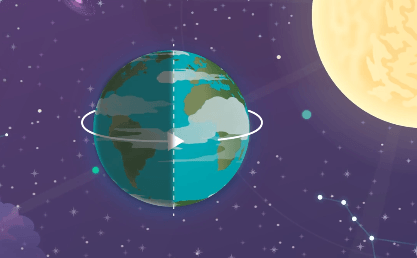

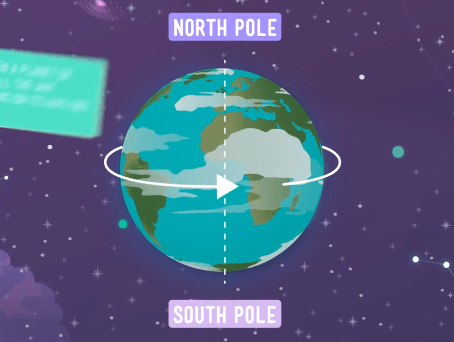
What is the name of the imaginary line running through the center of the Earth from the North Pole to the South Pole?
orbit
axis
equator
latitude
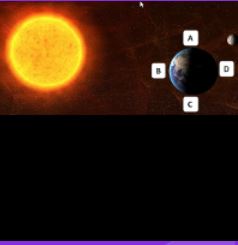
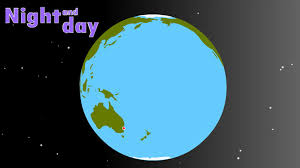

The rotation of Earth is responsible for day and night
true
false

The Earth makes one rotation around its axis every ...
One day (24 hours)
One year
One summer
One winter
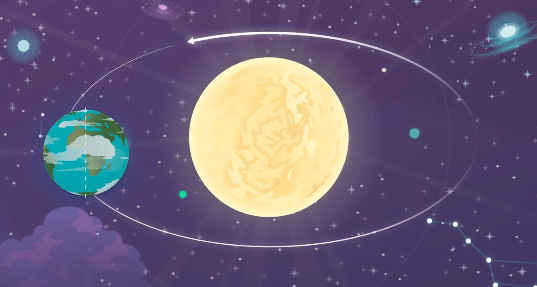
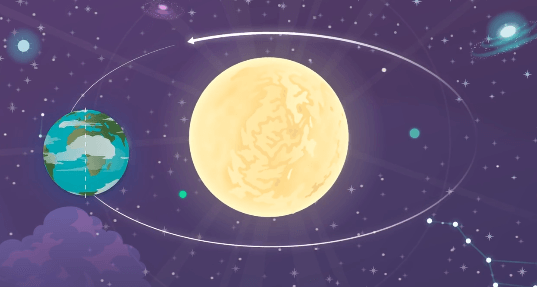
When the Earth completes a full orbit around the Sun, it has completed _____ rotations or days
7
30
91
365 1/4

The Earth is rotating AND revolving.
True
False

The path an object takes as it travels around another object is called a/an
line
orbit
axis

Seasons are caused by ....
(Choose more than 1 answer)
Earth's tilted axis
Earth's revolution
There are no seasons

