

wayground logo

Free Printable Worksheets

Font size

S
M
L
XL
Worksheets

PCH Limits, Derivative Defintion (Difference Quotient)

Total questions: 60

Worksheet time: 58mins
Name
Class
Date
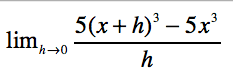
1.
Derivative means the same thing as
a)
slope of the tangent line
b)
slope of the normal line
c)
exponent
d)
potato
2.
a)

15x2

b)

(5/4)x4

c)

indeterminate

d)

3.

 limxx2+3x5\lim_{x\rightarrow\infty}x^2+3x-5  

a)

 -\infty  

b)

2

c)

0

d)

 \infty  

4.

 limx(x2+x3x4x3+1)\lim_{x\rightarrow\infty}\left(\frac{x^2+x-3}{x^4-x^3+1}\right)  

a)

 -\infty  

b)

0

c)

1

d)

 \infty  

5.
Evaluate the limit
a)
a
b)
b
c)
c
d)
d
6.
Evaluate the limit
a)
a
b)
b
c)
c
d)
d
7.
Evaluate the limit
a)
a
b)
b
c)
c
d)
d
8.
Evaluate the limit
a)
a
b)
b
c)
c
d)
d
9.
Use the definition of a derivative to find the derivative
a)
a
b)
b
c)
c
d)
d
10.
Find the equation of the line tangent to the function at the given point
a)
a
b)
b
c)
c
d)
d
11.
Find the equation of the line tangent to the function at the given point
a)
a
b)
b
c)
c
d)
d
12.
If a function has a derivative that is negative, what does that tell you?
a)
The function is increasing
b)
The function is decreasing
13.

Find the slope of the tangent line at x=2 for the function f(x) = 3x2 - 5.

a)

10

b)

11

c)

12

d)

13

14.
a)

not defined

b)

doesn't exist

c)

2

d)

0

15.
a)

1/11

b)

15/11

c)

-1

d)

-1/11

16.

It's where the graph of your function and the tangent line should always touch.

a)

at the y-intercept

b)

at the given point

c)

at the x-intercept

d)

at infinity

17.

Use the limit process to evaluate the derivative of f(x)=2x^2-5x-8 at the value x=-2.

a)

9

b)

-21

c)

-13

d)

3

18.

Given the graph of f(x), what can you tell about f ' (5) ?

a)

it's positive

b)

it's negative

c)

it does not exist

d)

nothing

19.
Given that f(x) = x2 - 3x, which of the following represents f(x + h)
a)
x2 - 3x + h
b)
x + h2 - 3x + h
c)
(x + h)2 - 3(x + h)
d)
x2 + h - 3x + h
20.
TRUE or FALSE: f ' (-1) = 3 means the slope of the the function f(x) at x = -1 is 3. 
a)
TRUE
b)
FALSE
21.
a)
The slope of f(x) at any value of x is 3.
b)
The slope of f(x) at x = 0 is 2.
c)
The slope of f(x) at any value of x is given by 3x-1. 
d)
The slope of f(x) at x=0 is given by 3x-1. 
22.
What is the limit?
a)
DNE
b)
Infinity
c)
6
d)
12
23.
a)
Does Not Exist
b)
9
c)
1
d)
0
24.
a)
6
b)
3
c)
1/6
d)
-1/6
25.
Determine whether f(x) approaches + or - infinity as x approaches 4 from the left.
a)
+ Infinity
b)
- Infinity
c)
Either one.
26.
Find the slope of the tangent line to
f(x) = -3x- 6x
at x = 1.
a)
m = 0
b)
f'(x) = -6x - 6
c)
f'(x) = 6x
d)
m = -12
27.
Find f(2).
a)
1
b)
-1
c)
5
d)
DNE
28.
Evaluate 
a)
-7
b)
0
c)
1
d)
DNE
29.

Find the limit as x approaches 1.

a)

0

b)

3

c)

DNE

d)

30.

From the table, determine if a limit exists at 2 and, if so, what is it?

a)

yes the limit exists; .8

b)

no the limit does not exist

c)

yes the limit exists; 2

d)

yes the limit exits; 8

31.

Find the limit.

a)

0

b)

DNE

c)

6/5

d)

15

32.

Find the limit.

a)

1/8

b)

8

c)

-1/8

d)

DNE

33.

Order the derivatives of each point on the graph from least to greatest.

a)

ABC

b)

BCA

c)

CBA

d)

BAC

34.

Write the equation of the line tangent to the curve f(x)=x2−x+2 at the point (1,2).

a)

y−2=1(x−1)

b)

y=x−1

c)

y−1=1(x−2)

d)

there is no line tangent to the curve at the point (1,2)

35.
a)

Factor, cancel, and substitute

b)

Multiply by the conjugate

c)

Substitute 2.99

d)

Substitute 3.01

36.
a)

Check Left, Check Right, See if Equal

b)

Multiply by conjugate

c)

Graph

d)

Set equal, solve for constant

37.
a)

Infinity

b)

Negative Infinity

c)

Zero

d)

5

38.
a)

5

b)

Infinity

c)

Negative Infinity

d)

Zero

39.

To find the horizontal asymptotes of  f(x)f\left(x\right)  , you consider

a)

The limit of  f(x)f\left(x\right)  as x approaches positive and negative infinity

b)

Set the denominator of  f(x)f\left(x\right)  equal to zero, ignoring holes

c)

Find the holes by cancelling common factors

40.

To find the vertical  asymptotes of  f(x)f\left(x\right)  , you consider

a)

The limit of  f(x)f\left(x\right)  as x approaches positive and negative infinity

b)

Set the denominator of  f(x)f\left(x\right)  equal to zero, ignoring holes

c)

Find the holes by cancelling common factors

41.

If  f(x)=5x2x+3f\left(x\right)=\frac{5x-2}{x+3} , the horizontal asymptote is 

a)

 x=3x=-3  

b)

 x=3x=3  

c)

 y=5y=5  

d)

 y=5y=-5  

42.

Use the definition of a derivative at x=c to calculate f'(c) exactly.


f(x) = x2 + 5x + 1, c = 2

a)

5

b)

4

c)

9

d)

1

43.
a)
Does not exist
b)
0
c)
-1
d)
1
44.

Find the limit of the function as x approaches 2.

a)

1

b)

-1

c)

5

d)

Fails to Exist (DNE)

45.

What is the limit of the function as x approaches 1 from the left?

a)

Fails to Exist (DNE)

b)

1

c)

4

d)

-2

46.

Find the limit of the function as x approaches 4 from the right.

a)

-1

b)

2

c)

-2

d)

Fails to Exist (DNE)

47.

Find the limit as x approaches 0

a)

0

b)

∞ (Fails to Exist)

c)

-∞ (Fails to Exist)

d)

1

48.
a)

1

b)

1.5

c)

0

d)

Fails to exist (DNE)

49.

At which point(s) will the slopes of the tangent line are zero?

a)

at C only

b)

at points A, C and E only

c)

at point B and D only

d)

at points A and E only

50.

What is the equation of the tangent line at x = 1  ofof   f(x)= xf\left(x\right)=\ \sqrt{x}  

a)

 y=12x12y=\frac{1}{2}x-\frac{1}{2}  

b)

 y=12x+12y=\frac{1}{2}x+\frac{1}{2}  

c)

 y=2x1y=2x-1  

d)

 y=2xy=2x  

51.
a)

0

b)

1

c)

2

d)

DNE

52.

 limx 3x122x134x12+x13\lim_{x\rightarrow\infty}\ \frac{3x^{\frac{1}{2}}-2x^{\frac{1}{3}}}{4x^{\frac{1}{2}}+x^{\frac{1}{3}}}  

a)

 34\frac{3}{4}  

b)

-2

c)

 15\frac{1}{5}  

d)

Fails to exist (DNE)

53.

Does the  limx1f(x)\lim_{x\rightarrow1}f\left(x\right)  exist? 

a)

Yes

b)

No

54.
a)

0

b)

2

c)

3

d)

4

55.

Evaluate  limx0(1x8+18x)=\lim_{x\rightarrow0}\left(\frac{\frac{1}{x-8}+\frac{1}{8}}{x}\right)=  

a)

 164\frac{1}{64}  

b)

 164\frac{-1}{64}  

c)

0

d)

Fails to Exist (DNE)

56.

For what value of "k" will  limx2(x2+kx+4x3)=5\lim_{x\rightarrow2}\left(\frac{x^2+kx+4}{x-3}\right)=5  ?

(a)  

57.

Evaluate  limx0(x+sin(x)x)=\lim_{x\rightarrow0}\left(\frac{x+\sin\left(x\right)}{x}\right)=  

(a)  

58.

 limx1(f(x))=\lim_{x\rightarrow1}\left(f\left(x\right)\right)=  

(a)  

59.

 limx6(f(x))=\lim_{x\rightarrow6^-}\left(f\left(x\right)\right)=  

(a)  

60.

Determine the limit.

a)

-\infty

b)

-5/4

c)

\infty

d)

0
