NEW
Font size
 Worksheets
Electrostatics and the Electroscope
Total questions: 28
Worksheet time: 14mins

Insulators are different than conductors in that insulators ____.
do not contain electrons or protons
do not contain any charge
have a weaker affinity for electrons
do not allow charge to freely move

A balloon is rubbed against a student's hair and then touched to a wall. The balloon sticks to the wall due to
magnetic forces between the particles of the balloon and the particles of the wall
electrostatic forces between the negatively charged balloon attract to the positive surface of the wall
magnetic forces between the charges of the wall repel the balloon
electrostatic forces between the excess electrons on the wall attract to the negatively charged balloon

Electrostatic force FE exists between two point charges. If the both charges are doubled and the distance is kept the same, the force between the charges will be:
F
4F
2F
F/4
Electrostatic force FE exists between two point charges. If the both charges are doubled AND the distance is increased by 4 times (4d), the electric force (FE) will:
F (same electric force)
4F (4x's greater FE)
2F (2x's greater FE)
F/4 (or 1/4 of FE)

The SI unit of charge is
the ampere
the newton
the coulomb
the joule

What is the end result of charging by contact?
Both object have the same charge, so they will attract one another
Both object have the same charge, so they will repel one another
Both object have the opposite charge, so they will attract one another
Both object have the opposite charge, so they will repel one another

A plastic rod is rubbed with cotton. Why does the plastic rod become negatively charged?
the plastic rod acquired extra protons from the cotton.
the plastic rod acquired extra protons from friction
protons were created as the result of the charging process
the plastic rod gained electrons from the cotton due to friction

A charged plastic rod charges a metal sphere by contact. Which of the following explains why?
Electrons move from the insulating stand into the sphere.
Protons move from the rod into the sphere.
Electrons move from the charged rod to the metal sphere.
Protons move from the sphere into the negatively charged rod.

A glass rod becomes positively charged when it is rubbed with plastic. This net positive charge accumulates because the glass rod:
gains electrons
loses electrons
gains protons
loses protons


If the leaves of an electroscope spread apart, it indicates that _____.
the leaves of the electroscope are neutral
both of the leaves of the electroscope have the same charged particles as one another
both of the leaves of the electroscope have opposite charges as one another
there is static electricity in the electroscope

When a rod is brought near a neutral electroscope, the leaves diverge. Which statement best describes the charge on the rod?
It must be positive.
It must be negative.
It may be positive or negative.
It may be neutral.
If a negatively charged rod is brought near a neutral electroscope, how will the electrons in the electroscope move?
Toward the rod
Away from the rod
Onto the rod
Away from the leaves

When the charge on the electroscope is removed, or neutralized, by touching it, this is called ____.
charging by conduction
charging by induction
energizing
grounding
If the electroscope was negatively charged, how does this (pictured) remove the charge from the electroscope?
Electrons move from the hand to the electroscope
Protons move from the hand to the electroscope
Electrons move from the electroscope to the hand
Protons move from the electroscope to the hand
If the electroscope was charged positively, how does this remove the charge from the electroscope?
Electrons move from the hand to the electroscope
Protons move from the hand to the electroscope
Electrons move from the electroscope to the hand
Protons move from the electroscope to the hand

A neutral electroscope is charged by bringing a negative rod next to it, then touching it.
A
B
C
E
The picture showing a neutral electroscope is charged by contact/conduction with a negative rod.
A
B
C
D

Two electrically neutral metal spheres, A and B, on insulating stands are placed in contact with each other. A negatively charged rod is brought near, but does not touch the spheres, as shown in the diagram below. You place a negatively charged piece of aluminum foil on a string next to sphere B. What does the aluminum foil do?
It attracts to B due to having opposite charges
Nothing happens due to the neutral charge of sphere B
The aluminum foil repels from sphere B due to having same charge
There is no way to determine what would happen

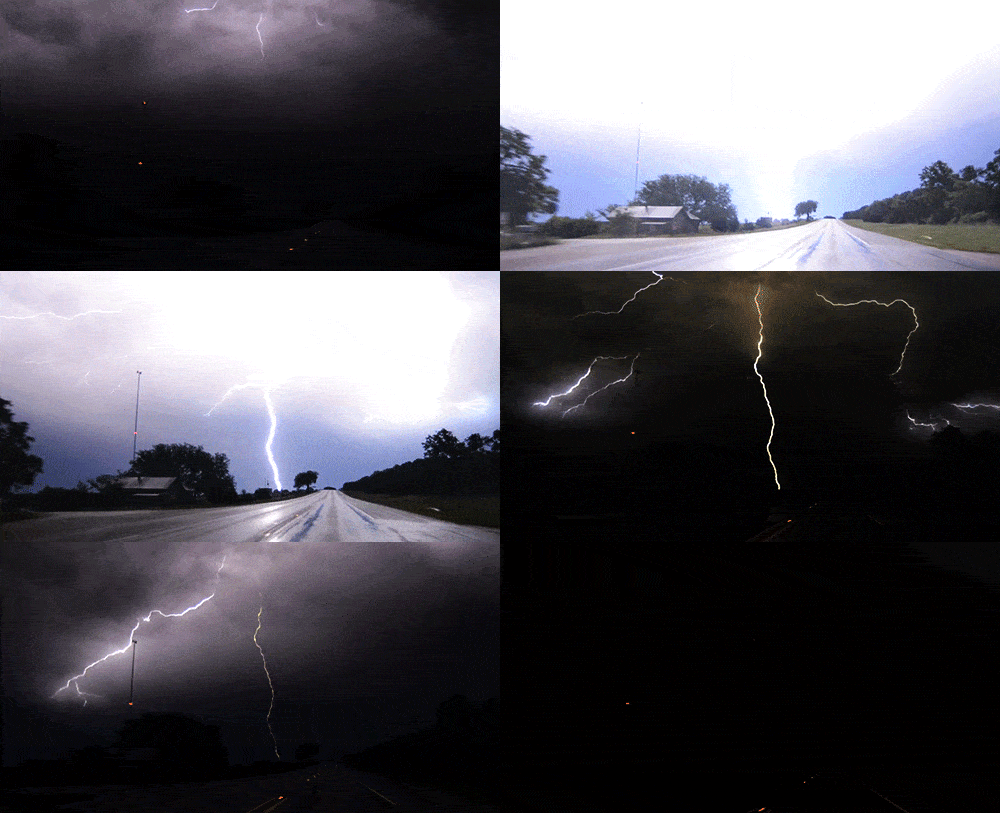
How does THUNDER occur?
Lightning creates a hole in the air and when it opens it creates thunder.
Lightning creates a hole in the air and creates thunder
Lightning super-heats and expands air molecules, as they cool and contract (very quickly) it generates sound
Lightning creates a hole in the air, and it closes and opens then it creates thunder