wayground logo

Free Printable Worksheets

NEW

Font size

S
M
L
XL
Worksheets

Chapter 16 Review

Total questions: 50

Worksheet time: 1hrs 7mins
Name
Class
Date
1.
Structures with the same parts have different functions; suggests that organisms share a common ancestry
a)
vestigial structures
b)
homologous structures
c)
adaptive radiation
d)
fossil
2.
Study of embryos of various organisms to show a common ancestor because of similarities in development
a)
natural selection
b)
embryology
c)
speciation
d)
evolution
3.
Two organisms that are closely related would have
a)
very similar DNA sequence
b)
exactly the same DNA sequences
c)
no proteins in common
d)
completely different DNA sequence
4.
What does Darwin's theory of evolution suggest?
a)
species change over time
b)
extinct species are not related to living species
c)
different species can interbreed
d)
animals that look alike are most closely related
5.
Some organisms that share a common ancestor have features that have different functions, but similar structures.  These are known as
a)
vestigial structures
b)
analogous structures
c)
homologous structures
d)
fossil structures
6.
If modern organisms have a lot of homologous structures, what inference might paleontologists make about those organisms?
a)
They are reptiles
b)
One organism evolved from the other.
c)
The organisms have a common ancestor
7.
Which is not evidence for evolution?
a)
many animals have homologous structures due to common ancestry
b)
Many animals have vestigial structures from an ancestor
c)
We can observe changes in life forms by observing the fossil record
d)
All of these are evidence for evolution
8.
What is a structure that is similar across species?
a)
vestigial
b)
homologous
c)
adaptaion
d)
variation
9.
When all of the organisms of a species have died it is called
a)
evolution
b)
extinction
c)
adaptation
d)
natural selection
10.
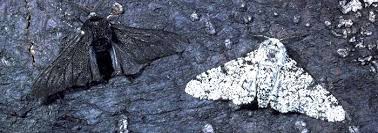
Predict which moth would increase in population
a)
light 
b)
dark
11.
How do fossils provide evidence that evolution has happened on Earth?
a)
Fossils show how the sizes of certain animals has changed drastically over millions of years
b)
Fossils show that some species have gone extinct
c)
Fossils show how life forms present today are different than those from the past
d)
Different sedimentary rock layers provide evidence for how the environment has changed over time
12.
Scientists compare organisms' DNA to support the theory that all species share a common _________________
a)
separation
b)
ancestor
c)
population
d)
environment
13.
What characteristic did Darwin observe about the finches on the Galapagos Islands?
a)
Their feathers 
b)
Genotypes 
c)
Their beaks
d)
Their body sizes
14.
The diagram illustrates an embryonic stage of two organisms.

Which of the following can be determined by observing the embryos shown in the diagram
a)
The organisms share a common ancestry.
b)
The organisms belong to the same genus.
c)
The organisms are native to the same geographic areas.
d)
The organisms will grow into anatomically similar adults.
15.

Recently, scientists have been able to use ___________to find common proteins and amino acids to determine how closely related species are.

a)

DNA

b)

Vestigial structures

c)

Fossils

d)

Homologous structures

16.

Which IS NOT used as evidence for evolution?

a)

Fossils

b)

Natural Selection

c)

Early Development/Embryos

d)

Body Structure/Anatomy

e)

DNA/Proteins

17.

Which evidence for evolution is shown below?

a)

Comparative embryology

b)

Homologous structures

c)

Biochemical evidence

d)

Vestigial structures

18.

Genome maps provide the DNA sequences of chromosomes. Some scientists have compared the genome maps of a hedgehog and a sloth. What do these genome maps allow the scientists to determine?

a)

The color patterns of the offspring of each species

b)

How much the size ranges of the two species differ

c)

The methods of protein synthesis that each species uses

d)

How closely related the two species are to each other.

19.

What conclusion can you draw from the fact that many modern whale species have vestigial pelvic and leg bones?

a)

The ancestors of whales may have been land mammals

b)

Whales could walk if they wanted to

c)

Whales are preparing to evolve into land animals

d)

Someday whales will be able to walk and will have legs

20.

Scientists discover that cells from two species of organisms are made up of similar proteins, suggesting a close evolutionary relationship. If the scientists do further biochemical analyses, which additional finding would support this conclusion?

a)

The fossils of both organisms are found relatively close to each other in the fossil record.

b)

The anatomical structure of both organisms is similar.

c)

The DNA nucleotide sequence of both organisms is similar.

d)

Both populations of organisms have undergone natural selection over time.

21.

The fact that both these mammals incubate their immature offspring in a pouch provides evidence that they-

a)

Belong to the same species

b)

Must range great distances to eat

c)

Have very similar skeletal structures

d)

Are descended from a common ancestor

22.
a)

Redi's hypothesis that spontaneous generation does not occur

b)

Haeckel's hypothesis that embryological development mimics the evolution of species

c)

Wallace's hypothesis that geography affects the distribution of species

d)

Darwin's hypothesis that the development of a species is a slow, gradual process
23.

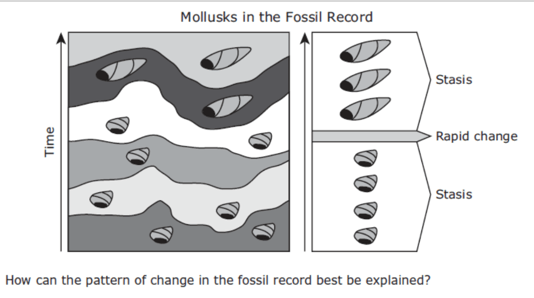
How can the pattern of change in the fossil record best be explained?

a)

The mollusks were well adapted to their stable environment. A large, sudden change occurred in their environment. After the change the mollusks with the bigger shells were better adapted for the new environment.

b)

The mollusks were well adapted to their stable environment. The mollusks hybridized with a smaller species of mollusk. A new species of mollusk with a bigger shell resulted.

c)

The mollusks were not well adapted to their environment. The length of the mollusks' shells changed gradually over time. The mollusks in the original population that had small shells died over a period of many years.

24.

Which of the following is the collection of life's remains found in sedimentary rock?

a)

natural selection

b)

homologous structures

c)

Charles Darwin

d)

the fossil record

25.

Which evidence show patterns of change in organisms from early life to modern life?

a)

homologous structures

b)

transitional fossils

c)

vestigial structures

d)

proteins

26.

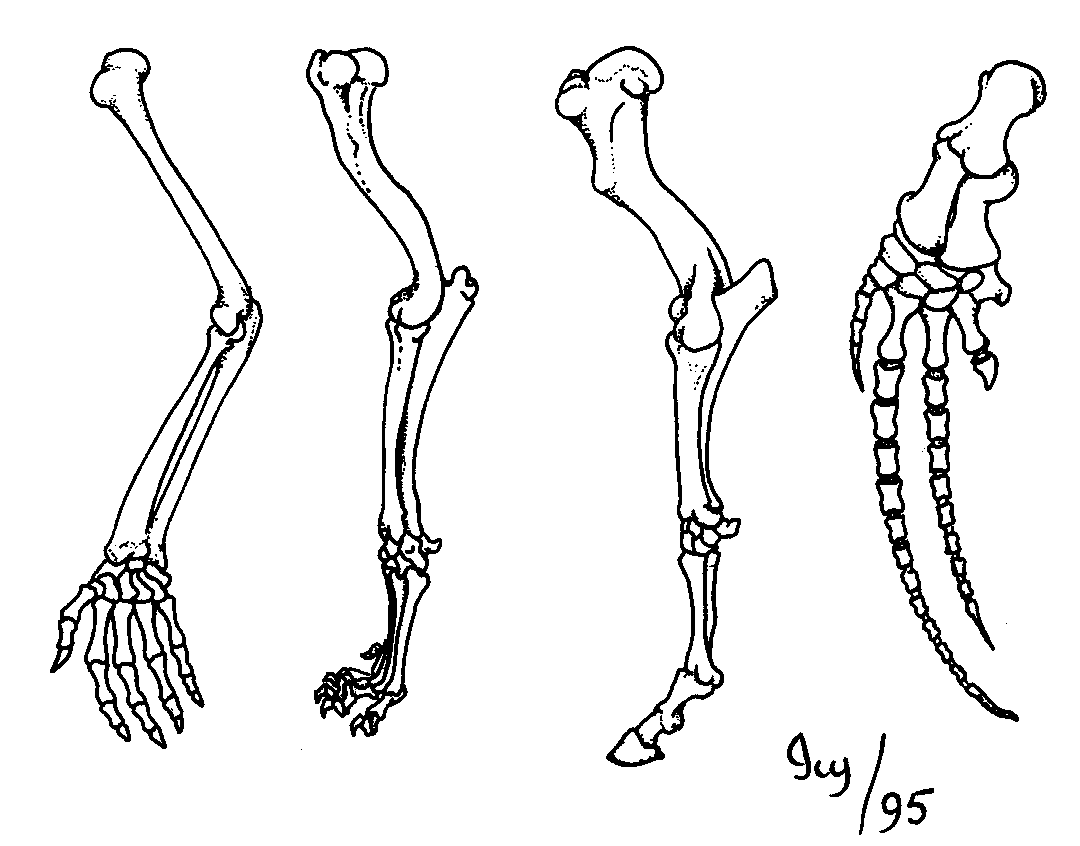
Which structure is shown in the picture?

a)

analogous structure

b)

homologous structure

c)

vestigial structure

d)

DNA

27.
Which species’ DNA is most similar to the DNA of the toothed whale? 
a)
Hippopotamus 
b)
Baleen Whale
c)
Grazing Mammals
d)
Camels
28.
The similarities of organisms in which two areas numbered in the picture provide the best evidence for common ancestry?
a)
1 and 2
b)
3 and 4
c)
5 and 6
d)
7 and 8
29.
Which word is defined as a reduced form of a functional structure in 1 organism that shows up as fully functional in another?
a)
homologous structures
b)
vestigial structures
c)
analogous structure
d)
DNA
30.

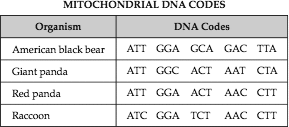
What conclusions can be made based on this table shown?

a)

the American black bear and the giant panda are most closely related

b)

the giant panda and the red panda are most closely related

c)

the red panda and the racoon are the most closely related

d)

the giant panda and the racoon are most closely related

31.
The survival of the fittest 
a)
Natural selction
b)
Evolution 
c)
Mimic 
d)
Camouflage 
32.
Which layer is the youngest
a)
1
b)
2
c)
3
d)
4
33.
Which layer is the oldest
a)
B
b)
A
c)
E
d)
C
34.
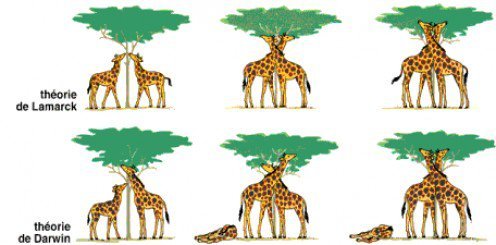
What would happen if the Giraffes never evolve?
a)
they would survive
b)
They would thrive
c)
They would become extinct
d)
They will find another source of food
35.
Genetic variation can arise from a random change in the DNA of a gene.  The change is called a(n)
a)
mutation
b)
gene flow
c)
gene pool
d)
allele
36.
Which statement best describes the process of evolution?
a)
Populations can survive in different locations on earth
b)
Environmental conditions limit the number of species on Earth
c)
Populations grow when resources are abundant
d)
The traits of a species can change over time
37.
Darwin theorized that individuals having an advantage due to their traits or abilities will be more likely to survive and reproduce.  This theory is known as
a)
evolution
b)
speciation
c)
adaptation
d)
natural selection
38.
Darwin's book was called On the Origin of
a)
individuals
b)
natural selection
c)
species
d)
evolution
39.
What factor must be in place for natural selection to occur?
a)
struggle for existence (overproduction)
b)
genetically identical individuals
c)
random mating
d)
no immigration or emigration 
40.

Which scientist stated that things like war, famine and disease help to keep the worlds population in check.

a)

Darwin

b)

Lamarck

c)

Malthus

41.
Natural selection can also be referred to as:
a)
Survival of the weakest
b)
Survival
c)
Survival of the fittest
d)
Artificial selection
42.
When did Charles Darwin live? 
a)
1600s
b)
1700s
c)
1800s
d)
1900s
43.
This scientist stated that by using or not using a certain body part, organisms could change in their lifetime and that the trait gained would be passed down to their offspring.
a)
James Hutton
b)
Charles Lyell
c)
Jean-Baptiste Lamarck
d)
Thomas Malthus
44.
Who was the naturalist that traveled the world to study plants and animals?
a)
Albert Einstein
b)
Charles Darwin
c)
Charles Barkley
d)
Isaac Newton
45.
What characteristic did Darwin observe about the finches on the Galapagos Islands?
a)
Their feathers 
b)
Genotypes 
c)
Their beaks
d)
Their body sizes
46.
Genetic differences between organisms of the same species
a)
Variation
b)
Adaptation
c)
Behavior
d)
Environment
47.
The struggle for existence against other members of an organisms species is
a)
Competition
b)
Natural Selection
c)
gene flow
d)
genetic drift
48.
Darwin's expedition was called the Voyage of the _________.
a)
Titanic
b)
Beagle
49.

What is the term for a feature that allows an organism to survive better in its environemtn?

a)

variation

b)

adaptation

c)

homologous structure

d)

vestigial structure

50.
Common ancestry relates to evolution because
a)
evolution only happens when there are common ancestors.
b)
Common ancestors make evolution happen more quickly.
c)
evolution can never take place with common ancestors.
d)
the more two organisms have in common, the more recent is their common ancestor during their evolution.