Wayground logo

Free Printable Worksheets

Font size

S
M
L
XL
Worksheets

Physical Science 2020 Part 1

Total questions: 40

Worksheet time: 40mins

Name
Class
Date
1.

Which property is describing an ionic compound

a)

share electrons

b)

Week bond

c)

High Melting point

d)

made up of non metals

2.

Which type of bonding has low melting and boiling points?

a)

Ionic

b)

Covalent

c)

Metallic

d)

All of the above

3.

Why ionic compounds have high melting and boiling points?

4 lines
4.
How are ionic bonds formed?
a)
Transfer of electrons
b)
Sharing of electrons
5.
Is this ionic bond drawn correctly?
a)
Yes
b)
No
6.
This picture shows a...
a)
Ionic Bond
b)
Covalent Bond
c)
Both bonds
d)
Neither bond
7.
What is the name of N2O3
a)
Nitrogen trioxide
b)
Dinitrogen oxide
c)
Dinitrogen trioxide
d)
Nitrogen oxide
8.
What is the name of Br6F10 ?
a)
Bromium fluoride
b)
Hexabromine fluoride
c)
Bromium decafluoride
d)
none of the above
9.
What is the chemical formula for CP ?
a)
Carbon phosphide
b)
Monocarbon phosphide
c)
Carbon monophosphide
d)
none of the above
10.
In a reaction A + B ----> C,  reactant A has 5g and product  C has 9g. How many grams does reactant B should have? 
a)
4g
b)
5g
c)
9g
d)
14g
11.
If a reaction starts with a total 75g of reactants it should produce 
a)
a total of 40g of products
b)
a total of 75g of products
c)
a total of 180 g of products
d)
None of the above
12.
Bob puts 200 grams of ice into a pitcher with 900 grams of water. He gets distracted and comes back later to find that the ice has melted in the water. How many grams of water does Bob now have in the pitcher?
a)
200 g
b)
700 g
c)
1,100 g
13.
When CaCO3 is heated, it forms CaO and CO2. Which of these statements best describes the mass of the products if 100 g of CaCO3 is heated?
a)
The difference in the products’ masses is equal to the mass of the CaCO3
b)
The sum of the products’ masses is less than the mass of the CaCO3
c)
The mass of each product is equal to the mass of the CaCO3
d)
The sum of the products’ masses equals the mass of the CaCO3
14.
24 g of magnesium reacts with 38 g of fluorine to produce _____ g magnesium fluoride
a)
62 
b)
38
c)
24
d)
14
15.

32 g of Oxygen completely reacts with 8 g of Hydrogen to produce _____ g Water

a)

8

b)

12

c)

24

d)

40

16.
What coefficient should be used to make the following equation balanced?
N2+O2--> _NO 
a)
1
b)
2
c)
3
d)
4
17.
Which problem is balanced?
(Check ALL answers)
a)
PbO2 + 2H2
b)
SO2 + H20 --> H2SO4
c)
2Na + 2H2O --> 2NaOH + H2
18.

What is the correct coefficient for the Balanced Chemical Equation?__Na + __H2O --> __NaOH + __H2

a)

2,2 --> 2,1

b)

4,4 --> 4,1

c)

1,2 --> 2,4

d)

1,2 --> 2,1

19.
An atom becomes _________ when it gains electrons.
a)
Positive
b)
Negative
c)
Neutral
d)
Invinsible
20.

According to the Octet Rule, atoms of elements react with each other in order to attain ____ electrons in their outermost energy level or shell.

a)

2

b)

4

c)

6

d)

8

e)

10

21.

Which of the following elements GAINS 1 electron in order to attain an octet?

a)

sodium

b)

calcium

c)

helium

d)

boron

e)

chlorine

22.

A neutral atom of Magnesium (shown in image) will...

a)

Lose 2 electrons when it becomes an ion

b)

Gain 2 electrons when it becomes an ion

c)

Gain 6 electrons when it becomes an ion

d)

Lose 1 electron when it becomes an ion

23.

Think fast! An element has 25 protons and 22 electrons. It has a charge of...

a)

3+

b)

3-

c)

2+

d)

1-

24.
What is the charge on a lithium atom that looses 1 electron?
a)
+1
b)
0
c)
-1
d)
-2
25.
An element's identity is determined by the number of
a)
electrons.
b)
protons.
c)
neutrons.
d)
valence.
26.

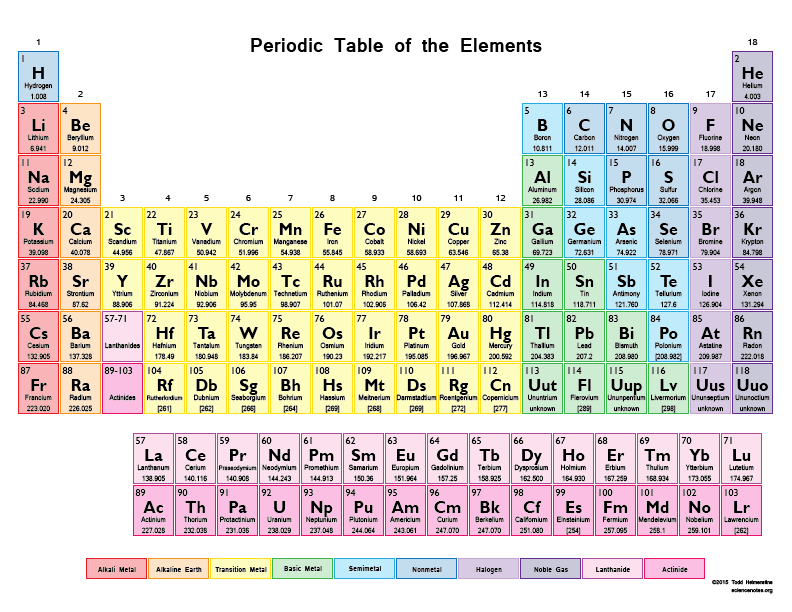
What is the atomic number of Barium, Ba? (enlarge the periodic table)

a)

20

b)

38

c)

56

d)

88

27.

If an atom has 10 electrons, how many protons does it have?

a)

0

b)

1

c)

10

d)

5

28.

Atomic number 21 is

a)

Ca

b)

Sc

c)

Fe

d)

Co

29.

Atomic number 26 is

a)

Fe

b)

Cr

c)

Si

d)

Cl

30.

Atomic number 19 is

a)

H

b)

He

c)

K

d)

Sc

31.
Which elements have the most similar chemical properties?
a)
K and Na
b)
K and Ca
c)
K and Cl
d)
K and S
32.

The vertical columns on the periodic table that have common properties are called

a)

Groups

b)

Periods

c)

Shells

d)

Valences

33.

The elements in a column of the periodic table...

a)

have similar atomic numbers

b)

start with the same letter

c)

have similar properties because of same number of valence electrons

d)

are not related in any way

34.
How many more valence electrons does Oxygen need to be stable?
a)
6
b)
2
c)
4
d)
It's already stable with 8
35.
What is the oxidation number for Flourine (F)?
a)
+1 
b)
-1
c)
17
d)
7
36.
Which of the following elements does NOT have an oxidation number of +2?
a)
Ca
b)
Sr
c)
K
d)
Ba
37.
What is the oxidation number for Be? 
a)
+1
b)
+2
c)
+3
d)
+4
38.
How would this element be classified?
a)
Metal
b)
Nonmetal
c)
Metalloid
d)
Metamorphic
39.

Have a high melting point

a)

Metals

b)

Non-Metals

40.
A student is given a sample of an unknown substance. He is asked to determine if it is classified as a metal, a metalloid, or a nonmetal. He discovered that the unknown element conducted some heat and electricity, had a shiny luster, and broke easily. This element is most likely a 
a)
metal
b)
nonmetal
c)
metalloid
d)
cannot be determined