
 Worksheets
Plate tectonics
Total questions: 95
Worksheet time: 2hrs 10mins
The movement of the tectonic plates is caused by
the rotation of the Earth.
convection currents in the Asthenosphere
the gravity of the iron-nickel core.
the Moho discontinuity.
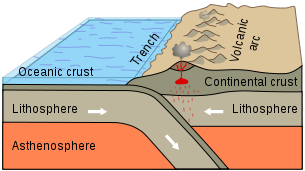
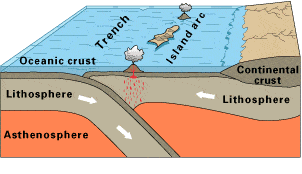
Observe this diagram of a plate boundary. One statement BEST describes what is happening. It is that
the oceanic crust is melting.
the denser ceanic crust is subducting under the less dense oceanic crust
volcanic islands are forming.
the tectonic plates are moving away from each other.
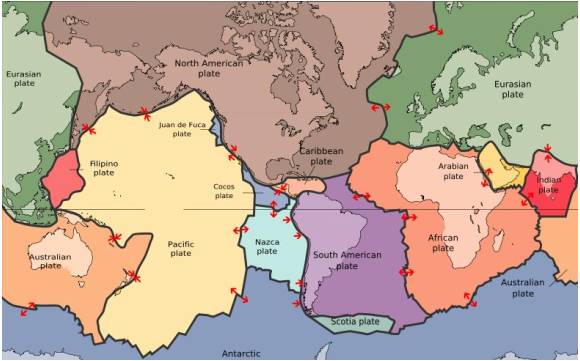
The map in the picture shows tectonic plate boundaries. This map would be useful in predicting the location of future
droughts
hurricanes
earthquakes
tornadoes
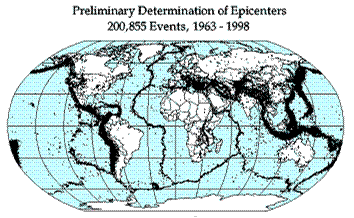
Earthquake epicenters (center of where the earthquakes started) were mapped for a 35 year period in the diagram above. The black dots indicate these epicenters. The black dots appear along what feature on Earth?
hot spots
plate boundaries
rift zones
sea floor spreading
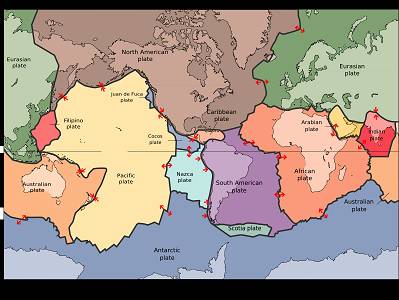
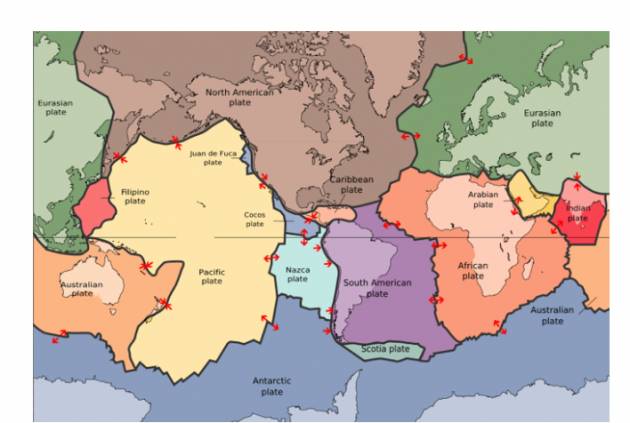
Where are earthquakes MOST LIKELY to occur?
close to the equator
close to the center of tectonic plates
at divergent or convergent plate boundaries
at transform plate boundaries
___________ currents in the Earth's asthenosphere cause plate to shift at their boundaries. This movement also causes earthquakes and volcanic activity.
conduction
convection
radiation
ocean
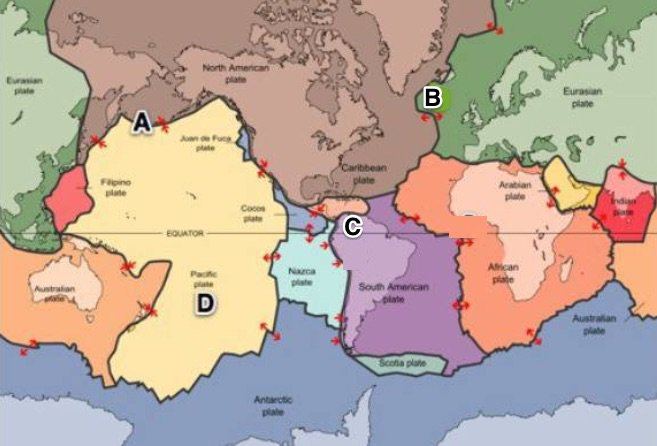
Where would sea floor spreading most likely occur?
At convergent boundaries (oceanic vs. oceanic)
At convergent boundaries (oceanic vs. continental)
At divergent plate boundaries (oceanic vs. oceanic)
At transform plate boundaries


This famous fault in California has a lot of earthquakes!
New Madrid
Denali Fault
Ramapo Seismic Zone
San Andreas Fault

What type of boundary is shown in the diagram?
Divergent
Convergent
Transform

What type of boundary is shown in the diagram?
Divergent
Convergent
Slide/Transform

What type of boundary is shown in the diagram?
Divergent
Convergent
Slide/Transform

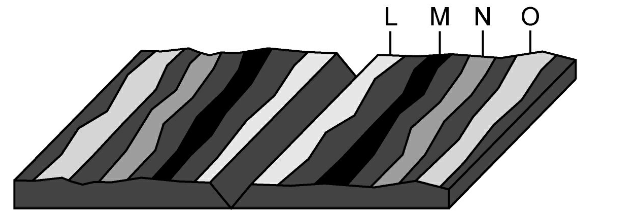


What does the theory of Continental Drift explain?
Ocean currents move continents around the planet
Convection works deep within the asthenosphere
Mid-ocean ridges force tectonic plates to move
Continents were once together and slowly drifted to where they are today
Where are the youngest rocks on Earth found?
Along mid-ocean ridges
Along transform boundaries
On the edges of the continents
Near ocean trenches
Who was the scientist who proposed the theory of continental drift?
Alfred Powell
Harry Hess
Alfred Wegener
Ernest Rutherford
Where does seafloor spreading take place?
Convergent boundaries
The continentals shelves
Transform boundary
Mid-ocean ridges
The super continent that existed when all continents were together was named
Gondwana
Laurasia
Eurasia
Pangea
What is the process of convection?
The process of hot material rising and cooler material sinking in circular patterns
The process of hot rock solidifying and forming new crust
The process of explaining what goes up must come down
Strong ocean currents moving tremendous amounts of material
Mountains are created along
Transform boundaries
Continental-Continental Convergent
Divergent
Oceanic-Continental Convergent

What will happen to the Mediterranean sea as the Eurasian plate and the African plate continue to move towards each other over time?
It will get smaller
It will get larger
It will eventually disappear
Nothing will happen
How will the land in this area change as the Eurasian plate and the African plate continue to move towards each other over time?
Mountains will form
Land will be destroyed
Nothing will happen
What processes helped prove the hypothesis of continental drift?
the water cycle
Subduction
Sea Floor Spreading
none of the above
What is the last step that forms a volcano?
the water lowers the melting point of them mantle and the mantle partially melts
Magma will then rise
When two plates collide and one is subducted under the other.
water enters the mantle

What is the theory of plate tectonics?
The theory that describes how Earth's outer layers is broken up into moving tectonic plates
Tectonic plates stay in one place
All of the continents were once apart of a Super Continent called Panthalassa
All of the plates were once a solid plate until they broke up and moved to their current position
Which picture below represents a convection current?
GPS


What evidence did Alfred Wegener use to prove the Theory of Continental Drift?
he used the moon's rotation and revolution as evidence
he looked at the clouds and noticed continental drift
he looked at the fossils, land forms and how continents fit together like puzzle pieces
he studied the weather patterns for Africa and South America

When oceanic plate and continental plate collide, what type of land form will be created?
mid ocean ridges
ocean trenches
islands
earthquakes

When tectonic plates move away from each other, what type of land form will be created?
islands
mid ocean ridges
ocean trenches
all of the above

Letter B on the diagram below represents which of the following:
The oldest lithosphere/crust
The youngest lithosphere/crust
hot spot
island chain

Letter B in the diagram shows a subduction zone. Why is the oceanic crust subducted?
it is less dense
it is more dense
it is heavier because the ocean is pushing it down
none of the above

What new technology enables scientists to track tectonic plate movement?
the new Iphone
a new smartwatch
GPS tracking
the new rover going to Mars called Perserverance
Wegener said the continents seemed to ...
fit together like puzzle pieces
have never moved
be made of coal
sinking into the mantle
Lystosaurus, Mesosaurus, and Cynognathus were...
reptiles that could not have swam across the Atlantic ocean
tropical ferns that could not survive in cold climates
glaciers that covered Pangea
matching mountain ranges
In Africa and South America, Wegener found ___________ matching in thickness and composition with the same fossils found within.
coal beds
glacier evidence
mountain ranges
rock layers
Wegener found that __________ in South America were the same type, height, composition, and were formed in the same way as the ___________ on the east coast of Africa.
coal beds
glaciers
mountains
fossils
_____________ only form in tropical environments near the equator but they are found even in Antarctica.
Mountains
Coal Beds
Glaciers
Fossils
Volcanic mountain ranges found in the middle of the Atlantic where new seafloor is being created are called ________________.
deep ocean trenches
mid ocean ridges
hot spots
subduction zones
The theories of Continental Drift and Seafloor Spreading led to the modern theory of ________________.
fault lines
plate drift
plate tectonics
lithospheric shift
What landform would you most likely find at a divergent boundary between two pieces of continental crust?
Mid-Ocean Ridge
Rift Valley
Mountain
Volcano
When one tectonic plate sinks under another, this is called...
Convegent
Divergent
Subduction
Transform
The Great Rift Valley in Africa and the Mid-Atlantic Ridge were both created by this type of plate boundary.
Convergent
Divergent
Transform
What is Pangaea?
The name of a German scientist
Another name for continental drift
The name of the super-continent that existed millions of years ago
The name of ancient fossil
What type of evidence was NOT used by Alfred Wegener to support his continental drift theory?
evidence from landforms
evidence from human remains
evidence from fossils
evidence from climate
Boundary between two colliding plates, often associated with mountain building, ocean trenches and volcanic islands
plate boundary
magma
divergent boundary
convergent boundary
where two plates are moving apart, magma comes up to create new crust
ridge
divergent boundary
convergent boundary
plate boundary
A deep crack in the Earth's surface associated with divergent boundary
lava
rift
ridge
trench
Three Types of Plate Boundaries
Transform (slide past)
Convergent (collision)
Divergent (pull apart)
All the above
Examples of convergent boundaries where two continental plates collide producing a large mountain range.
San Andreas Fault (USA)
Japan (Asia); Aleutian Islands (Alaska, USA)
Andes Mountains (S. America)
Himalaya Mtns (Asia); Appalachian Mtns (USA)

Example of divergent boundary between two continental plates.
Mid-Atlantic Ridge (Atlantic Ocean)
Andes Mountains (S. America)
East Africa Rift Valley
None of the above
A __________ plate is a large slab of crust and upper mantle that moves over the earth's surface.
lithosphere
Pangaea
subduction zone
tectonic
Wegener


The diagram shows a cross section of a portion of the Earth. Which letter represents a mid-ocean ridge?
W
X
Y
Z

The diagram shows a landform on Earth. How did the movement of Earth’s plates form the landform?
Two oceanic plates slid past each other.
Two continental plates collided.
One continental plate slid past an oceanic plate.
One continental plate subducted beneath an oceanic plate.

Which model is depicting a divergent boundary between two plates?
top
middle
bottom

Which model is depicting a transform boundary between two plates?
top
middle
bottom

Which model is depicting a convergent boundary between two plates?
top
middle
bottom
lithosphere?

