
 Worksheets
Heat and temperature
Total questions: 29
Worksheet time: 21mins
........................ is the transfer of heat from one place to another by the movement of fluids.
Convection
Conduction
Radiation
None of above
....................occurs as hot, rapidly moving or vibrating atoms and molecules interact with neighboring atoms and molecules, transferring some of their energy (heat) to these neighboring atoms.
Heat
Radiation
Convection
Conduction
Which one of the followings is not a heat transfer method?
Conduction
Convection
Distillation
Radiation
How does temperature difference between two ends affect the heat transfer?
It doesn't affect.
The greater the temperature difference between ends, the greater the heat transfer rate.
The bigger the temperature difference between ends, the smaller the heat transfer rate.
The smaller the temperature difference between ends, the bigger the heat transfer rate.
(a) effect is the stay of Sun rays in atmosphere for a long time because of the accumulation of SO2, CO2, COgasses which are caused by the overuse of fossil fuels and deforestation.
.......................... .........................is the increase of the temperature of the Earth’s surface because of the greenhouse effect.
(a)
How does heat transfer when you hold an ice cube in your hand?
from the cold ice cube to your warm hand
the cold ice cube makes your hand cold
from your warm hand to the cold ice cube
very carefully

McDonald's keeps my Big Macs warm under a heat lamp which transfers heat through
conduction
convection
radiation
science stuff

When I drink coffee in the morning, I warm my hands on the mug by what type of heat transfer?
conduction
convection
radiation
coziness

When I cook steak, it touches the pan. It is cooked because
heat transfers from the pan to the bacon through convection
heat transfers from the pan to the bacon through conduction
heat transfers from the bacon to the pan through conduction
heat is transferred as energy
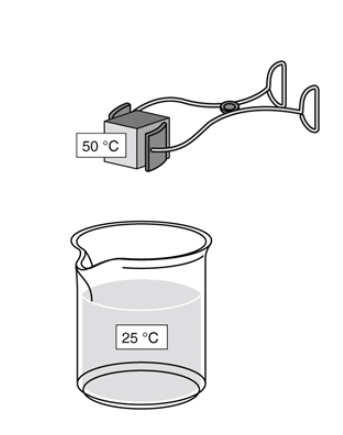
As part of a lab experiment, Tasha drops a metal cube into a beaker of water, as shown in the figure aside.(metal cube 50 0C, water 25 0C)
After energy in the form of heat transfers between the substances, what is the final temperature of the water?
The final temperature is 25 °C because there is more water than metal.
The final temperature is 50 °C because the metal warms the water to the temperature of the metal.
The final temperature is between 25 °C and 50 °C because energy is transferred from the metal to the water.
The final temperature is between 25 °C and 50 °C because most of the thermal energy is lost to the air around the substances.

The water in Mario’s swimming pool absorbs energy as heat during the day. Which of the following would the water in the pool be most likely to do?
condense
evaporate
freeze
melt
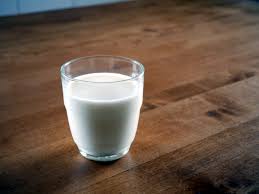
During the summer, Chang takes a glass of milk from the refrigerator and places it on the kitchen counter. Over time, energy as heat is transferred to the milk from the air. Which change would most likely occur?
The temperature of the milk will increase.
The temperature of the milk will decrease.
The milk will change from a liquid to a gas.
The milk will change from a liquid to a solid.
Mehmet places two metal cubes in contact with each other. Energy transfers as heat flows from Cube A to Cube B. What conclusion can you draw regarding Cube A?
It is larger than Cube B.
It is cooler than Cube B.
It is smaller than Cube B.
It is warmer than Cube B.

Emily has a cup of hot cocoa on the counter to cool off so she can drink it safely. She watches the steam rise from the hot cocoa. Which type of thermal energy transfer is occurring as the steam rises into the surrounding air?
conduction
convection
radiation
transformation
Mrs. Plata likes to collect river rocks on her daily walk. She picked up a rock and placed it in her pocket. If the rock is 10 degrees Celsius and Mrs. Plata is 31 degrees Celsius, which of the following BEST describes the transfer of energy?
Thermal energy will flow from Mrs. Plata to the rock.
Thermal energy will flow from the rock to Mrs. Plata.
Thermal energy will flow from Mrs. Plata into the air.
Thermal energy will flow into the air and to the rock.
At room temperature water is a liquid. How could the water be changed to a solid?
add heat
remove heat
decrease density
increase density
How much heat is required to raise the temperature of a sample of copper from 10.0°C to 55.0°C, if its mass is 10.00 g? specific heat of copper is 0.385 J/(g∙°C).
1881 J
250. J
173 J
359 J

The change of state from solid to liquid is called (a)

(a) is the change of phase from liquid to gas.

The change of state from gas to plasma is called ...................
sublimation
deposition
ionization
recombination

Put a tick for the correct sentences according to table given.
Oxygen is liquid at -185 0C
Mercury is in solid state at -40 0C
Water is in steam state at 120 0C
Gold is in liquid state at 1000 0C

In part I, what is the state of matter? (m.p:melting point)

