
 Worksheets
Motion, forces and energy
Total questions: 25
Worksheet time: 13mins
A student wishes to determine the density of a small solid object. First she finds the mass of the object. What should she do next?
Attach the object to a spring and measure the change in length of the spring.
Heat the object until it melts completely and measure how long it takes.
Let the object fall through a distance of 1.0 m and measure how long it takes.
Put the object in water in a measuring cylinder and measure the change in reading.
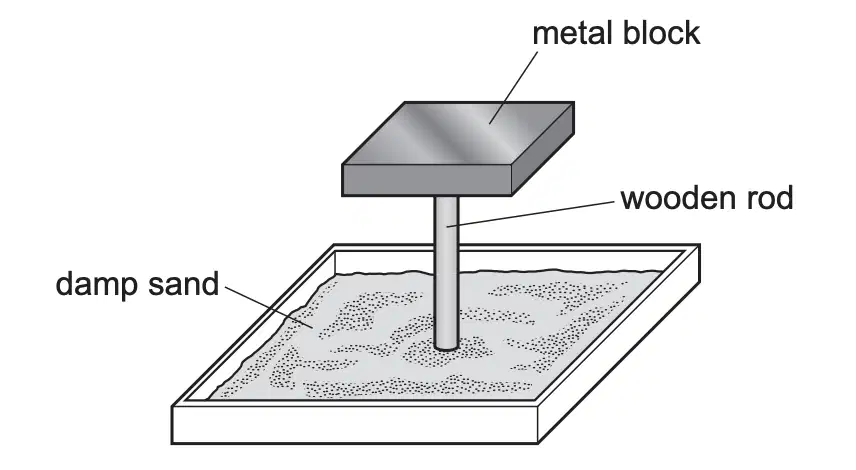
A student has two light wooden rods with different diameters, a light metal block, a heavy metal block and a tray of damp sand. Each metal block is placed on each wooden rod in turn. The diagram shows the arrangement.
Which combination of block and rod causes the rod to sink the furthest into the sand?
the heavy block on the rod with the larger diameter
the heavy block on the rod with the smaller diameter
the light block on the rod with the larger diameter
the light block on the rod with the smaller diameter
Which source of energy is renewable?
geothermal
natural gas
nuclear fission
oil
A car is travelling along a straight, horizontal road at constant speed. Which statement about forces on the car is correct?
There are no horizontal forces acting on the car.
There is a resultant force on the car in the direction of its movement.
There is a resultant force on the car in the direction opposite to its movement.
There is no resultant force acting on the car.
A ball is thrown vertically upwards. The ball rises, stops, falls back down and hits soft ground without bouncing. Which energy transfers occur, starting just after the ball is released?
kinetic to potential to kinetic to chemical
kinetic to potential to kinetic to thermal
potential to kinetic to potential to chemical
potential to kinetic to potential to thermal
A gas is trapped in a container of constant volume. The temperature of the gas increases. What happens to the speed of the molecules, and what happens to the pressure of the gas?
speed - decreases; pressure - decreases
speed - decreases; pressure - increases
speed - increases; pressure - decreases
speed - increases; pressure - increases
Which option gives a unit for energy and a unit for power?
energy - joule; power - newton
energy - joule; power - watt
energy - watt; power - joule
energy - watt; power - ohm
The diagrams show all the forces acting on each of four objects. Which object is not in equilibrium?


A man is standing in a bus that is moving forwards. The bus stops suddenly, causing the man to fall over. Which property of the man resists the change in his motion and in which direction does the man fall?
property - mass; direction of fall - backwards
property - mass; direction of fall - forwards
property - weight; direction of fall - backwards
property - weight; direction of fall - forwards
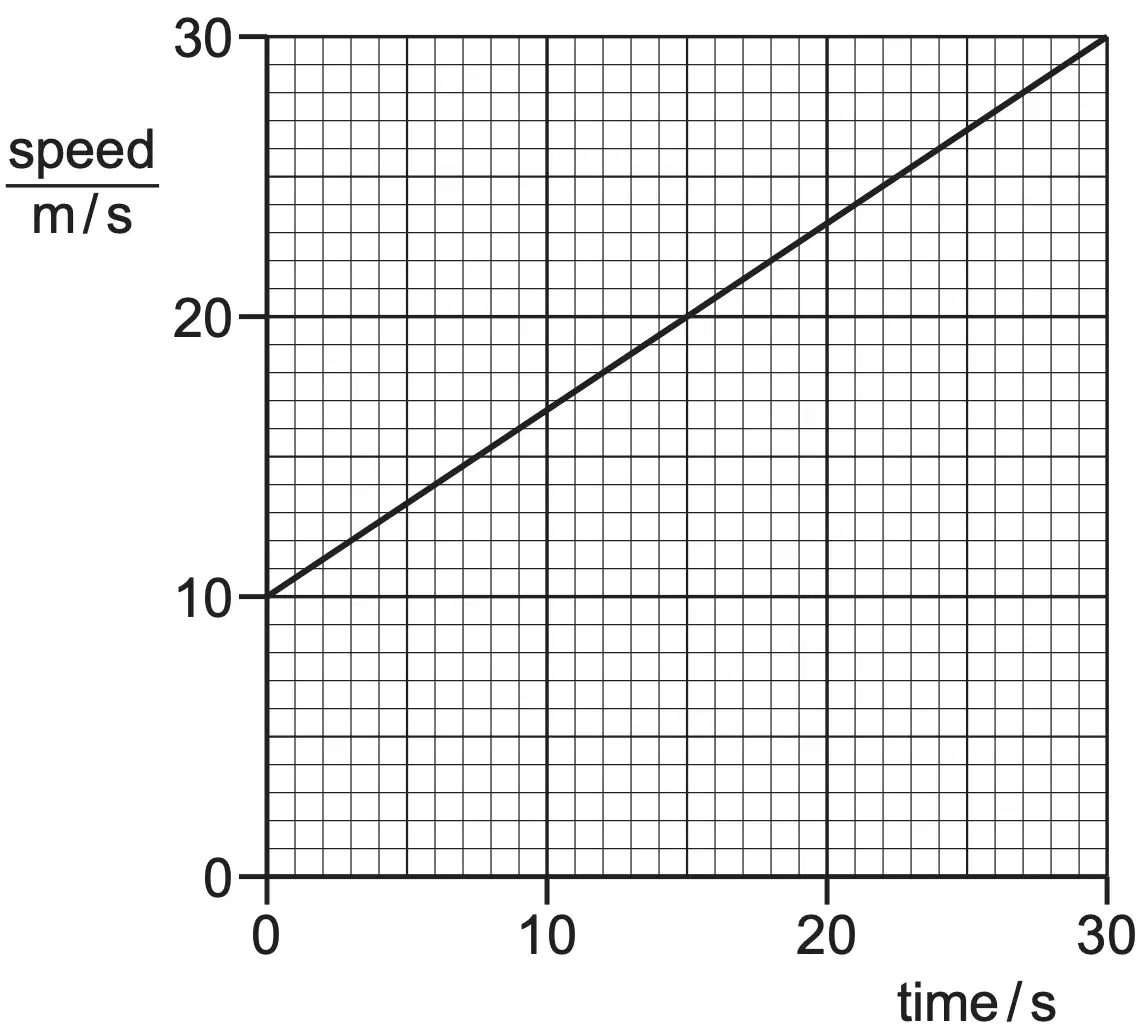
The diagram shows the speed-time graph for a car.
How far does the car travel in 30 seconds?
300 m
450 m
600 m
900 m
A model aircraft starts to move. It takes 16 seconds to reach its take-off speed of 32 m / s. What is the average acceleration of the aircraft during this time?
0.25 s2m
0.50 s2m
1.0 s2m
2.0 s2m
What is the unit of work and what is an equivalent combination of units?
unit - joule; equivalent combination - newton metre
unit - joule; equivalent combination - newton / metre
unit - newton; equivalent combination - joule metre
unit - newton; equivalent combination - joule / metre
What is the difference, if any, between the terms speed and velocity?
None. They have the same meaning.
Velocity is rate of change of speed.
Speed is velocity with a direction.
Velocity is speed with a direction.
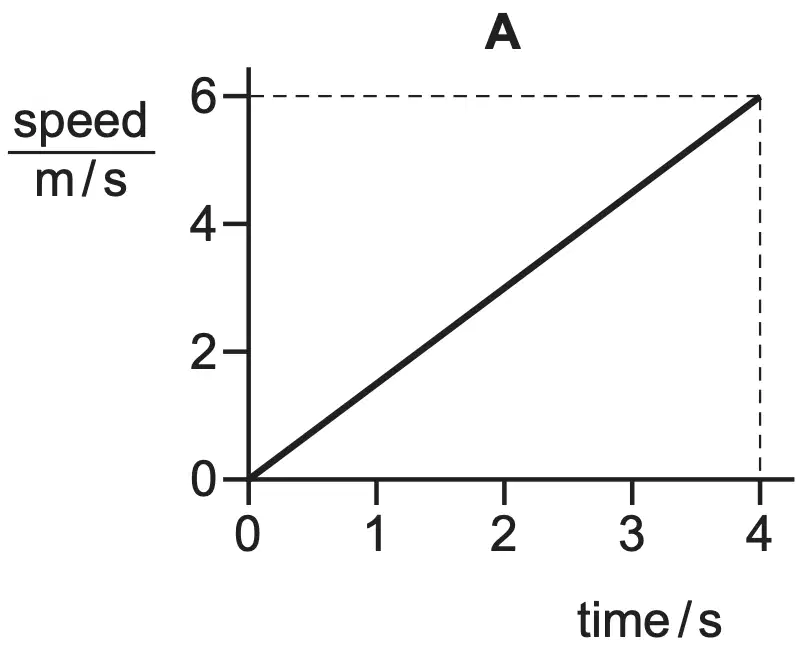
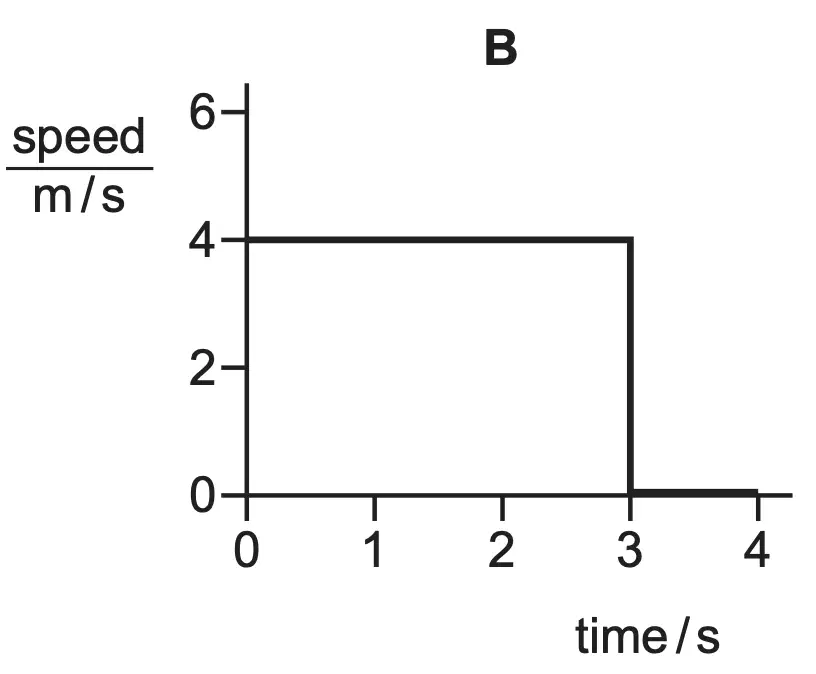
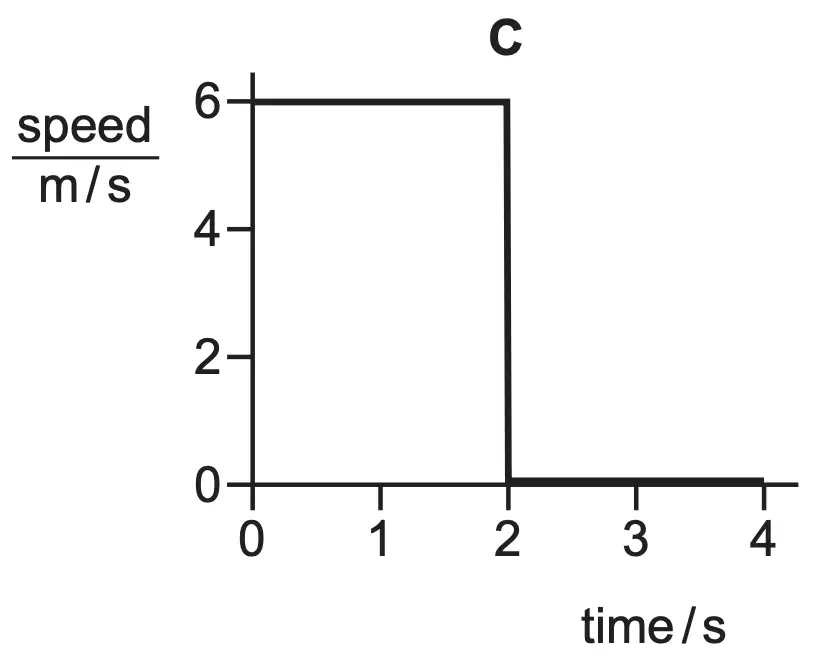
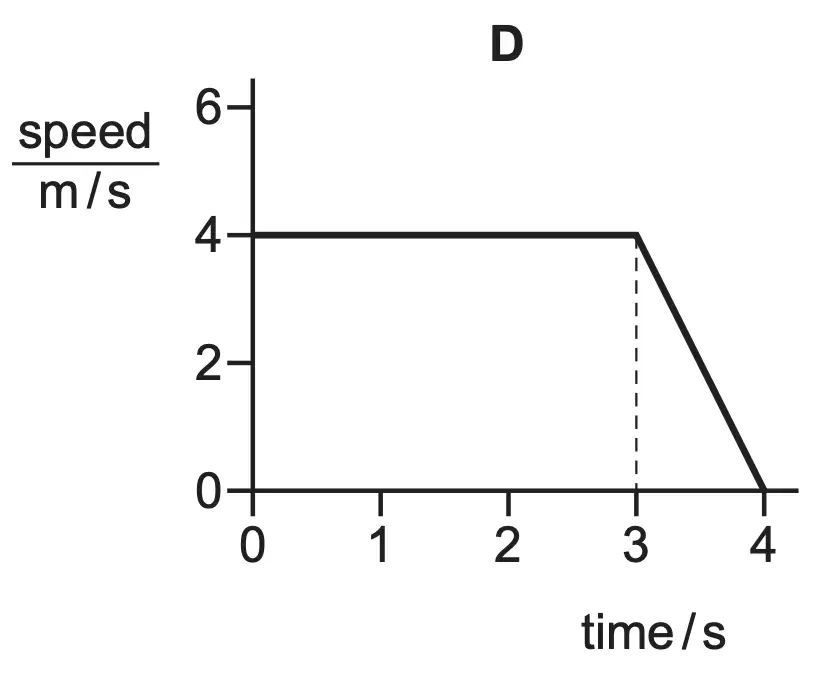
The diagrams show the speed-time graphs for four objects. Which object travels the greatest distance?
A student plots a speed-time graph for a car that is travelling at constant speed. What can be stated about the velocity of the car, and how can the distance travelled by the car be obtained?
velocity - constant; distance travelled - area under graph
velocity - constant; distance travelled - gradient of graph
velocity - need not be constant; distance travelled - area under graph
velocity - need not be constant; distance travelled - gradient of graph
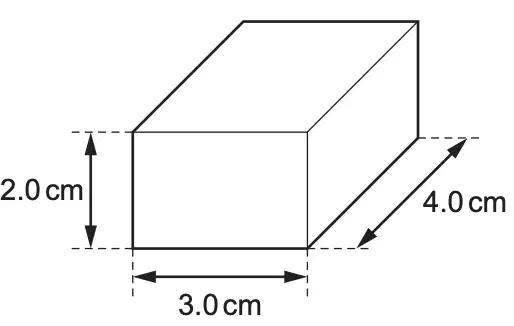
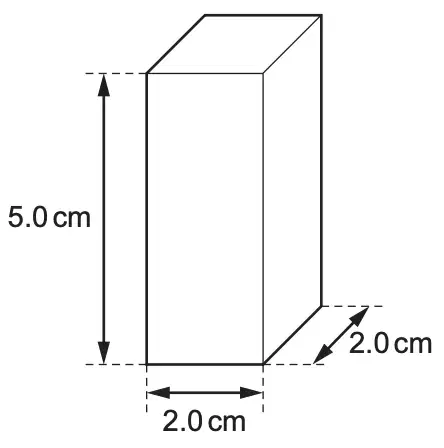
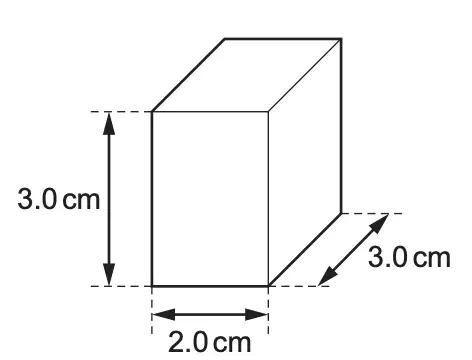
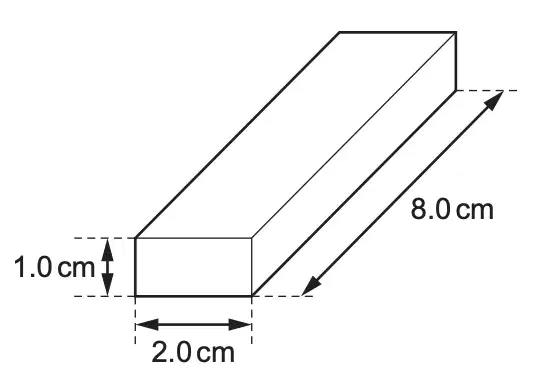
The diagrams show four solid blocks with the same mass. Which block is made from the least dense material?

The diagram shows the extension-load graph for a spring. The length of the unloaded spring is 4.0 cm.
A load is hung from the spring and the length of the spring increases to 5.0 cm. What is the value of the load?
0.5 N
2.0 N
8.0 N
10.0 N
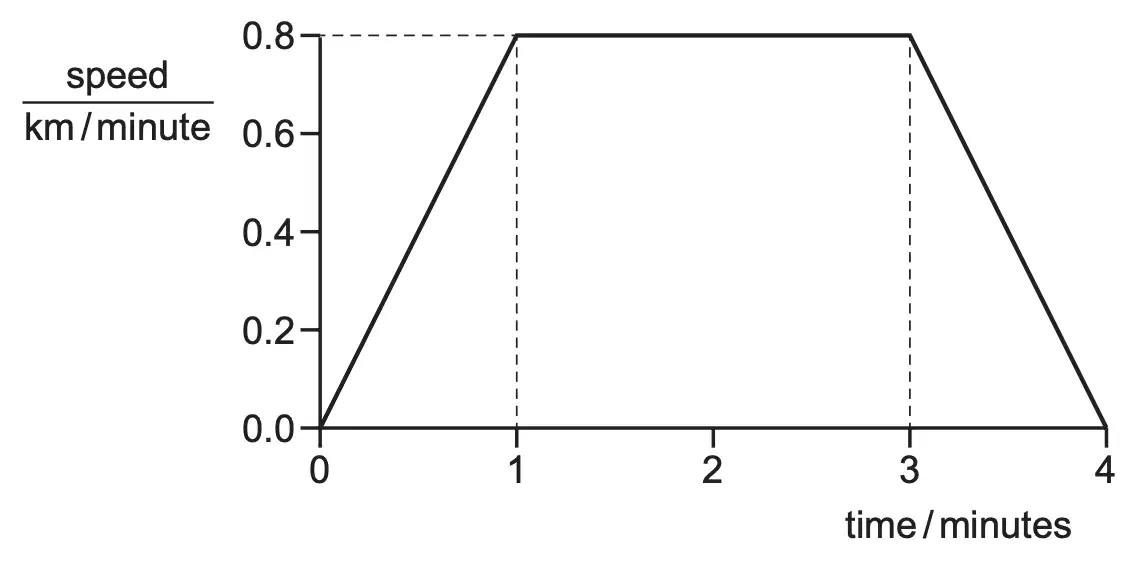
The speed-time graph represents the journey of a bicycle.
What is the total distance travelled by the bicycle?
1.6 km
2.0 km
2.4 km
3.2 km
Which energy resource does not use a turbine and generator to produce electricity?
geothermal
nuclear fission
solar cells
wind

Each of the springs shown in the diagram has the same spring constant k. One spring extends by a distance x when a force F is applied to it.
What are the total extensions of the parallel and series combinations when a force F is applied to them?
parallel - x/2; series - x
parallel - x/2; series - 2 x
parallel - x; series - x
parallel - x; series - 2 x
A rocket has a mass of 300 kg. Its motors produce a force of 12000 N vertically upwards. The acceleration of free fall g is 10 s2m . What is the resultant force on the rocket and what is the acceleration of the rocket?
resultant force (N) - 9000; acceleration ( s2m ) = 30
resultant force (N) - 9000; acceleration ( s2m ) = 2.7 × 10⁶
resultant force (N) - 9000; acceleration ( s2m ) = 50
resultant force (N) - 15000; acceleration ( s2m ) = 4.5 × 10⁶
Which form of energy is due to the motion of an object?
chemical
gravitational
kinetic
thermal
A boy carries out an experiment to demonstrate pressure and its relationship to force and area. Which experiment produces the highest pressure on the classroom floor?
standing with one foot on the floor
standing with two feet on the floor
standing with one foot on the floor, holding a 5.0 kg mass
standing with two feet on the floor, holding a 5.0 kg mass
A man does a known amount of work when he climbs up a ladder. Which other quantity must be known in order to determine the power he produces?
the acceleration of free fall
the height of the ladder
the time taken
the weight of the man
Which source of energy is non-renewable?
chemical energy in a fossil fuel
energy in tides
geothermal energy
wind energy

