wayground logo

Free Printable Worksheets

Font size

S
M
L
XL
Worksheets

ESS Semester 2 review

Total questions: 149

Worksheet time: 5hrs 48mins

Name
Class
Date
1.
Compared to other greenhouse gases, carbon dioxide is very effective in trapping heat near the surface of the Earth.
a)
true
b)
false
2.
Which of the following have been linked to climate change?  
a)
droughts
b)
flooding
c)
melting of polar ice caps
d)
all of the above
3.

The average temperature of the surface of Earth has increased approximately 1°C (1.8°F) in the past century. Which reason best explains this increase in temperature?

a)

lower levels of ozone in the atmosphere

b)

lower levels of nitrogen in the atmosphere

c)

higher levels of carbon dioxide in the atmosphere

d)

higher levels of oxygen in the atmosphere

4.
Which of the following is the best conclusion that can be made from this graph?
a)
atmospheric carbon dioxide levels have been decreasing since 1960
b)
Hawaii has a lot of carbon dioxide
c)
humans have been working hard to decrease carbon dioxide levels
d)
atmospheric carbon dioxide levels have increased steadily since 1960
5.
The main human activity that releases greenhouse gases is
a)
using bottled water
b)
burning fossil fuels
c)
texting on cellphones
d)
eating meat
6.
Some greenhouse gases are naturally present in the Earth's atmosphere
a)
True
b)
False
7.
Melting of glaciers and polar ice caps....
a)
will result in cooler temperatures in the Arctic
b)
will result in sea-levels rising
c)
Will have no effect on ecosystems
d)
None of the above
8.
Carbon is stored in
a)
Trees and other living things
b)
Oceans
c)
underground in soil and fossil fuels
d)
All are correct
9.

What is the process by which carbon is moved from storage in rocks in the earth and in oceans to being free in atmosphere and living things and back again into the rocks?

a)

carbon cycle

b)

green house gasses

c)

climate change

d)

Global warming

10.
Which of the following is NOT a natural cause of climate change?
a)
pollution
b)
meteorite collisions
c)
solar spots
d)
Volcanic eruptions
11.
All of the following are causes of Global Warming except
a)
Rotation of the Earth
b)
Deforestation
c)
Increases in Greenhouse Gases
d)
Burning Fossil Fuels
12.
What do scientists think the effect will be of having more greenhouse gases in our atmosphere?
a)
More warming of the atmosphere
b)
More cooling of the atmosphere
c)
More air in the atmosphere
d)
Less air in the atmosphere
13.

Weather occurs over _______ periods of time, while climate occurs over _______ periods of time

a)

long, short

b)

short, long

14.

Why is ozone important?

a)

It absorbs/blocks infrared radiation

b)

It absorbs/blocks UV radiation

c)

it filters pollutants out of the air

d)

it prevents climate change

15.

Select the factors that affect climate. Check all that are included

a)

Distance from the equator

b)

Wearing safety goggles

c)

The Greenhouse effect

16.
The sun's rays are least direct
a)
near the poles
b)
near the equator
c)
at high altitude
d)
far from the ocean
17.
Summers are caused by _________________________________.
a)
a combo of longer days and more direct rays from the sun
b)
less direct rays from the sun
c)
longer days and shorter nights
d)
more direct rays and shorter days
18.
As your distance from the equator increases, what happens to temperature?
a)
temperature increases
b)
temperature decreases
19.
True or False?  Warm and cold ocean currents affect the land nearby.
a)
false
b)
true
20.

Seasons are caused by

a)

tilt of Earth's axis

b)

clouds

c)

greenhouse effect

d)

warm and cold water currents

21.

The elevation of Missoula Montana is 3,209 feet above sea level.

The elevation of Great Falls, MT is 3,330 feet above sea level.

The elevation of Butte, MT is 5,538 feet above sea level.

Just based on elevation, which town should generally be cooler?

a)

Missoula, MT

b)

Great Falls, MT

c)

Butte, MT

22.

What do clouds do for temperatures during the day time?

a)

They provide shade from the sun and cool the area.

b)

They hold in heat from the sun and cool the area.

c)

Clouds don't affect the temperatures during the daytime.

23.

What do clouds do for temperatures during the nighttime?

a)

Clouds allow the heat to escaped into space.

b)

Clouds cause cooler temperatures during nighttime.

c)

Clouds hold in the terrestrial radiation and keep temperatures warmer.

24.

The energy absorbed by Earth's surface that is then transferred back into the atmosphere.

a)

terrestrial radiation

b)

greenhouse gasses

c)

ozone layer

d)

latitude

25.
In the fall, Winston noticed a small crack on a boulder where he played in his backyard. The following spring, he saw that the small crack was much larger than he remembered. What most likely caused the change?
a)
gravity had caused the rock to shift
b)
acid rain had caused the crack to erode
c)
winds had caused the rock to break down
d)
water had frozen and thawed inside the rocks
26.
Which of the following is a type of mechanical weathering?
a)
abrasion
b)
plant growth
c)
freezing and thawing
d)
all of the above
27.
This rock may chemically weather easily because is has many spaces or holes in it that allow water to seep through it, meaning it is:
a)
permeable
b)
abrasive
c)
erosion
d)
unchangable
28.
Occurs when eroded materials are dropped in another location
a)
Weathering
b)
Exfoliation
c)
Deposition
d)
Frost wedging
29.
Removal and transport of weathered materials from one location to another.
a)
Erosion
b)
Deposition
c)
Weathering
d)
Chemical weathering
30.
Chemical reaction of Oxygen with other substances. 
a)
Weathering
b)
Erosion
c)
Oxidation
d)
Transported soil
31.
Process where outer rock layers are stripped away. 
a)
Soil horizon
b)
Deposition
c)
Exfoliation
d)
Rill erosion
32.
Process that breaks down rocks and minerals into smaller pieces but doesn't change composition.
a)
Gully erosion
b)
Deposition
c)
Erosion
d)
Mechanical weathering
33.
A resource that can be easily replaced.
a)
renewable
b)
alternative
c)
nonrenewable
34.
Energy generated by the movement of air.
a)
fossil fuel
b)
wind
c)
biofuel
d)
hydroelectric
35.
Type of fossil fuel formed from ancient organisms that lived in swamps.
a)
oil
b)
fuel
c)
coal
d)
biofuel
36.
Diamonds and other minerals.
a)
alternative
b)
renewable
c)
nonrenewable
37.
Why isn't coal a renewable resource?
a)
It took millions of years to form
b)
It is under the ground
c)
We don't know how to make it
d)
We don't have a use for it
38.

What does burning fossil fuels release into the atmosphere?

a)

oxygen

b)

carbon

c)

carbon dioxide

d)

nitrogen

39.

Renewable resource

a)

resource that takes millions of years to form

b)

a resource that is virtually inexhaustible or that can be replenished over relatively short time spans.

40.

Conservation

a)

The conversion of used items into new products after collection and processing

b)

Protecting and preserving natural resources and the environment

c)

An increase in the average temperature of the earth's atmosphere as a result of increased carbon dioxide levels

d)

Partially decomposed organic plant and animal matter used as a soil conditioner or fertilizer.

41.

Which is not a characteristic of a mineral?

a)

natural

b)

organic

c)

element or compound

d)

solid

42.
How do Intrusive Igneous rocks cool?
a)
quickly
b)
slowly
c)
really fast
43.
A type of rock that forms from the cooling of molten rock at or below the surface of the earth
a)
Igneous Rock
b)
Metamorphic Rock
c)
Sedimentary Rock
d)
chemical Rock
44.
Extrusive rocks that form quickly above the Earths surface have
a)
small crystals
b)
large crystals
c)
small and large crystals
d)
no crystals
45.
What characteristic to sedimentary rocks often have?
a)
weather patterns
b)
tiny crystals
c)
striped layers
d)
glassy surfaces
46.
Sedimentary rocks are formed by
a)
Cooling of lava or magma
b)
Heat and pressure
c)
Compacting and cementing
47.

Chemical rocks are...

a)

Made from heat

b)

Made when water evaporates and minerals crystallize

c)

Made from dead animals/plants

d)

Made from pieces of other rocks

48.
Where do we usually find regional metamorphism?
a)
ocean floor
b)
mountain
c)
plate boundaries
d)
deserts
49.
During Contact Metamorphism, rocks are changed primarily by this:
a)
Subducting Plates
b)
Heat from magma
c)
Hot chemical fluids
d)
Pressure from tectonic activity
50.
True or False: Once a rock is sedimentary, it cannot become an igneous rock.
a)
True
b)
False
51.

An igneous rock has small crystals. What is its texture?

a)

fine grain

b)

course grain

c)

porporytic

d)

glassy

52.

A sedimentary rock has rounded sediment. What does that tell you?

a)

traveled a short distance

b)

traveled a long distance

c)

Traveled in a fast moving stream

d)

traveled in a slow moving stream

53.

A sedimentary rock is made of only fine sediment (clay). What does this tell you about the movement of the sediment?

a)

it traveled a long distance

b)

it traveled a short distance

c)

It traveled in a fast stream

d)

the stream was moving slow

54.

What creates the meanders (bends) in a river?

a)

sediment deposited by water flowing slower on the inside and fast current eroding the outside

b)

sediment deposited by fast moving water on the inside and slow current eroding the outside

c)

The must be present initially

d)

They do not form naturally

55.

How do rivers form?

a)

runoff from excess precipitation/snow melt erodes at the surface to form a gully

b)

mountain wind and tree roots create the gully

c)

Ground water moves up to the surface

d)

mining

56.

Which of the following is most responsible for the changing of seasons on Earth?

a)

Orbit of the Earth around the Sun

b)

Tilt of the axis of Earth

c)

Rotation of the Sun

d)

Rotation of the Earth

57.

Our Sun,planets, moons, asteroids, comets, and everything else that orbits around and is affected by the Sun's gravity.

a)

solar system

b)

Earth

c)

Milky Way Galaxy

d)

the Universe

58.

What is at the center of our solar system?

a)

Earth

b)

Milky Way Galaxy

c)

Sun

d)

Moon

59.

What is the correct order of the planets starting from the planet closest to the sun?

a)

Mercury, Venus, Earth, Mars, Jupiter, Saturn, Uranus, Neptune

b)

Venus, Mars, Jupiter, Earth, Saturn, Neptune, Uranus

c)

Mars, Venus, Earth, Saturn, Uranus, Mercury, Jupiter, Neptune

60.

Thursday will be 64 degrees

a)

Weather

b)

Climate

61.

Montana has 4 distinct seasons while Hawaii's temperature seem to stay stable.

a)

Weather

b)

Climate

62.

Early life affected the atmosphere by

a)

removing oxygen

b)

adding carbon dioxide

c)

adding oxygen

d)

removing nitrogen

63.

CFCs damaged the ozone layer when they were being used. Why is this a concern to us?

a)

Ozone layer protects us from harmful solar radiation

b)

Ozone layer converts gases into a form we can use

c)

Ozone layer removes greenhouse gases

d)

all of the above

64.

As you move higher in the troposphere

a)

pressure increases

b)

density increases

c)

temperature decreases

d)

none of the above

65.

Which relationship between fossil fuels and climate is not true?

a)

burning fossil fuels adds carbon dioxide, increasing temperatures and increasing number of storms and strength of storms

b)

creation of fossil fuels decreases carbon dioxide, increasing temperatures and increasing number and strength of storms

c)

burning fossil fuels increases global average temperature

d)

creation of fossil fuels decreases global average temperature

66.

The measure of the amount of salt dissolved in a given amount of liquid.

a)

Sea Mount

b)

Salinity

c)

Saltonomous

d)

Salty McSaltster

67.

A stream of water moving like a river through the ocean is called ___

a)

Wave

b)

Tide

c)

Current

68.

The deeper you go in the ocean, the water gets ________

a)

colder

b)

warmer

69.

The deeper you go in the ocean, the water gets ________

a)

less salty

b)

saltier

70.

What makes the surface of the ocean a different temperature from the rest?

a)

global warming

b)

the sun

c)

human activities

d)

glaciers melting

71.

______ causes deep ocean currents

a)

The Coriolis Effect

b)

gravity

c)

wind

d)

density differences

72.
T4 - Briefly describe the overall relationship between temperature and density.
a)
Lower temperature water has higher density, warmer water has lower density
b)
Lower temperature water has lower density, warmer water has higher density
73.
T4 - Which of the following is not a process that decreases the salinity of seawater?
a)
runoff from land
b)
icebergs melting
c)
precipitation
d)
evaporation
74.

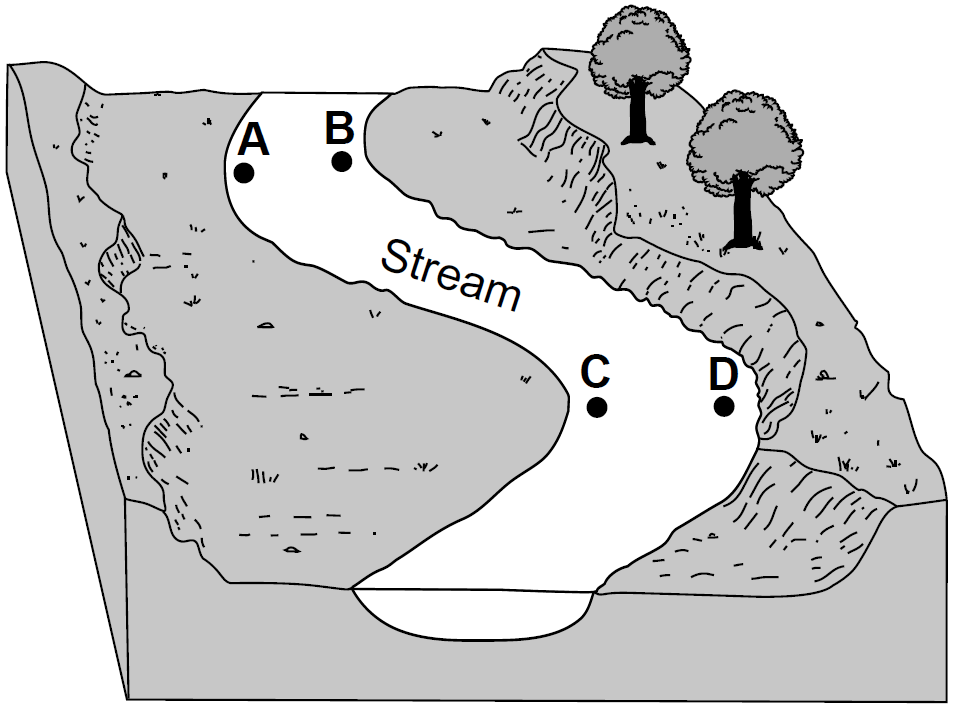
Why is erosion of the stream bank more likely at point A than at point B?

a)

Point A is located on the inside of the meander, where there is slower water velocity and more erosion

b)

Point A is located on the outside of the meander, where there is faster water velocity and more erosion

c)

Point A is located on the inside of the meander, where there is slower water velocity and less erosion

d)

Point A is located on the outside of the meander, where there is slower water velocity and less erosion

75.

Which correctly identifies the processes occurring at Point A and Point B of this river?

a)

A = erosion; B = deposition

b)

A = deposition; B = erosion

c)

A = meltin; B = foliation

d)

A = compaction; B = weathering

76.

Which correctly states the water velocity (speed) occurring at Point A and Point B of this river?

a)

A = high velocity; B = low velocity

b)

A = low velocity; B = high velocity

77.

Bends in rivers are called meanders. How do they form?

a)

The fast moving water erodes the outer bank while slower water deposits sediment on the inner bank creating a curve

b)

Humans carve out a bend in the river

c)

Wind pushes the river to one side

d)

The fast moving water near the banks will erode sediment causing the river to bend

78.

A company is likely to mine a site if the site

a)

is rich in minerals

b)

contains gold

c)

contains minerals that can be extracted economically

d)

does not contain gangue minerals

79.

Which of the following statements about minerals is FALSE?

a)

Minerals have a crystalline structure.

b)

Humans can create minerals to suit specific needs.

c)

Minerals are inorganic materials.

d)

Minerals cannot be liquids or gases.

80.

Hardness:

a)

It’s the ability of some minerals to break in geometric shapes

b)

It's the stripe colour of a mineral

c)

It's a measure of a mineral’s resistance to being scratched

d)

None of the answers is correct

81.

-The color of the powder left behind when you rub the mineral against a tile.

a)

streak

b)

color

c)

harness

d)

luster

82.
  • the way a mineral's surface reflects light.
a)

streak

b)

luster

c)

color

d)

hardness

83.

Gold, silver and copper are examples of minerals that have ______________________ luster.

a)

metallic

b)

nonmetallic

84.
  • a mineral's ability to resist being scratched
a)

streak

b)

luster

c)

color

d)

hardness

85.
Why is coal not a mineral?
a)
It's not a solid
b)
It is man-made
c)
It is not inorganic
d)
It is made of carbon
86.
Dull, silky, waxy, pearly, and earthy are terms that best describe which property of minerals?
a)
luster
b)
color
c)
streak
d)
cleavage
87.
How do you test the hardness of a mineral? 
a)
Throw it against a wall
b)
Step on it
c)
Scratch Test
d)
Kick it until it breaks
88.
Large crystals are going to form
a)
when lava erupts from a volcano
b)
when a shallow sea evaporates
c)
when magma underground cools off
d)
all of the above
89.
How are sedimentary rocks, such as shale and sandstone, formed?
a)
Particles are changed into liquids.
b)
Particles are compressed into layers.
c)
Particles are melted together by magma.
d)
Particles are heated by the Sun.
90.
Which processes must occur in order for an igneous rock to change into a metamorphic rock?
a)
heating and pressure
b)
compaction and cementation
c)
melting and cooling
d)
uplift and erosion
91.
Which processes change magma into igneous rock?
a)
weathering and erosion
b)
heat and pressure
c)
compaction and cementation
d)
cooling and crystallization
92.
Which statement is true about rocks?
a)
Magma is made of solid rock.
b)
Rocks are made of one or more minerals.
c)
Crystals are made of rocks.
d)
Minerals are made of one or more rocks.
93.
One rock was formed from rapidly cooling lava and is smooth and glassy. The other rock was formed from slow-cooling magma, so has large crystals. Which rock property is represented by these characteristics?
a)
color
b)
texture
c)
fracture
d)
hardness
94.
Which sentence BEST describes a process in the rock cycle?
a)
Sedimentary rocks can melt to become metamorphic rocks.
b)
Volcanoes can deposit sedimentary rock to form mountains.
c)
Metamorphic rocks can form by the weathering process.
d)
Igneous rocks can become metamorphic and sedimentary rocks.
95.
Which type of rock is formed when particles are compacted and cemented together?
a)
igneous
b)
metamorphic
c)
sedimentary
d)
metallic
96.
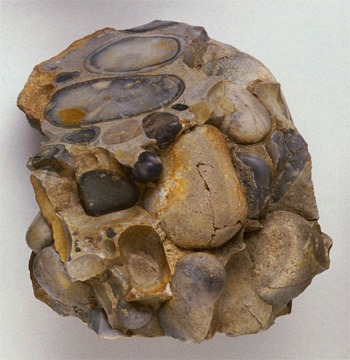
What type of rock is this?
a)
Igneous
b)
Sedimentary
c)
Metamorphic
97.
What type of rock is this?
a)
Metamorphic
b)
Igneous
c)
Sedimentary
98.
What type of texture does this show?
a)
Glassy
b)
Inter-grown Crystals
c)
Compacted Sediments
d)
Foliation
99.
What type of rock is this?
a)
Igneous
b)
Metamorphic
c)
Sedimentary
100.
What type of rock is this?
a)
Igneous
b)
Sedimentary
c)
Metamorphic
101.
Describe this texture.
a)
Interlocking Crystals
b)
Vesicular
c)
Compacted sediments
d)
Foliation
102.
How must this rock have formed?
a)
cooled quickly, at earth's surface
b)
cooled slowly, at earth's surface
c)
cooled quickly, below earth's surface
d)
cooled slowly, below earth's surface
103.
Clastic sedimentary rocks are classified based on their
a)
composition
b)
particle size
c)
density
d)
cement
104.

Which mineral property is being tested in the following diagram?

a)

density

b)

luster

c)

fracture

d)

streak

105.

Which mineral property is best illustrated by the following diagram?

a)

hardness

b)

streak

c)

cleavage

d)

density

106.

Describe the luster of the following mineral.

a)

glassy

b)

dull

c)

metallic

d)

nonmetallic

107.

Which mineral will scratch quartz but not corundum?

a)

talc

b)

topaz

c)

feldspar

d)

diamond

108.
This rock started as molten magma. What type of rock is this?
a)
Sedimentary
b)
Igneous
c)
Metamorphic
109.
This rock was another type of rock that was heated and compressed over time. What type of rock is this?
a)
Sedimentary
b)
Igneous
c)
Metamorphic
110.
The process when rocks break into smaller pieces due to exposure to natural elements is called
a)
erosion
b)
weathering
c)
sediments
111.
What are the 3 major types of rocks?
a)
Igneous, Metamorphic, Sedimentary
b)
Metamorphic, Igneous, Cementation
c)
magma, lava, crystals
112.

Which rock is formed form the cooling of volcanic ash on Earth's surface?

a)

intrusive igneous

b)

foliated metamorphic

c)

extrusive igneous

d)

organic sedimentary

113.

Rocks that form from colling magma inside Earth?

a)

Igneous intrusive

b)

Igneous extrusive

c)

Metamorphic foliated

d)

Metamorphic nonfoliated

114.
True/False: Igneous rocks can only turn into metamorphic rocks.
a)
True
b)
False
115.

Any rock that forms from another rock as a result of changes in heat or pressure (or both) is a:

a)

chemical rock

b)

igneous rock

c)

sedimentary rock

d)

metamorphic rock

116.

Which of the following lists the steps an igneous rock undergoes in order to become a sedimentary rock, in the correct order?

a)

Deposition, erosion, melting, cooling

b)

Erosion, weathering, eruption, cooling

c)

Dissolving, deposition, cooling, fracture

d)

Weathering, erosion, deposition, cementation

117.

Limestone is a sedimentary rock. During the rock cycle, limestone is changed into marble, a metamorphic rock. The processes that act on limestone and change it into marble are

a)

weather and erosion

b)

heat and pressure

c)

compacting and cementing

d)

melting, cooling, and hardening

118.
This rock was formed by smaller pieces of rock that settled at the bottom of a lake millions of years ago. What type of rock is this?
a)
Sedimentary
b)
Igneous
c)
Metamorphic
119.
This rock started as lava that cooled and then was heated and put under pressure over time. What type of rock is this?
a)
Sedimentar
b)
Igneous
c)
Metamorphic
120.

Intrusive igneous rocks

a)

are baked

b)

cool quickly

c)

cool slowly

d)

are cemented particles

121.

What type of rock can be described as being intrusive and extrusive?

a)

Igneous

b)

Sedimentary

c)

Metamorphic

122.

What type of rock can be described as being foliated or non-foliated?

a)

Igneous

b)

Sedimentary

c)

Metamorphic

123.

What type of rock can be described as being clastic , organic (biological) , or chemical?

a)

Igneous

b)

Sedimentary

c)

Metamorphic

124.
What are the two factors that affect the rate at which weathering occurs?
a)
climate and mass of rock
b)
climate and size of rock
c)
type of rock and size of rock
d)
type of rock and climate
125.
The diagrams  shows a natural process that weathers rock.
 Which statement best explains why this process results in weathering?
a)
frozen water acts as a solute
b)
water expands when it freezes
c)
the mass of water increases when it freezes
d)
frozen water dissolves most types of rock
126.
Which type of climate will have faster chemical weathering?
a)
Hot and Wet
b)
Cold and Dry
c)
Hot and Cold
d)
Cold and Wet
127.
Is the growth of vegetation a form of physical or chemical weathering?
a)
Physical
b)
Chemical
128.
Glaciers dropping rock and sand to form new landforms is an example of...
a)
weathering
b)
erosion
c)
deposition
129.
Rain washing away soil from a hillside is an example of...
a)
Weathering
b)
Erosion
c)
Deposition
130.
Which of the following is an example of chemical weathering?
a)
Acid rain dissolving limestone
b)
roots breaking into concrete
c)
paper being ripped
131.

What is the term for the wide curves whose development causes the formation of oxbow lakes?

a)

wanders

b)

bows

c)

meanders

d)

loops

132.

Which particles will be transported by a stream moving at a velocity of 5 cm/s?

a)

pebbles, sand, silt, and clay, only

b)

sand, silt, and clay, only

c)

silt and clay, only

d)

clay, only

133.

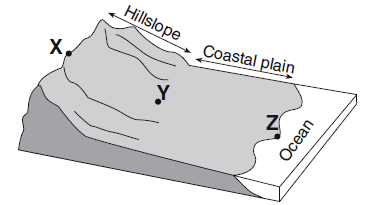
Compared to the stream velocity between point X and point Y, the stream velocity between point Y and point Z is most likely

a)

greater, since the slope of the land decreases

b)

greater, since the slope of the land increases

c)

less, since the slope of the land decreases

d)

less, since the slope of the land decreases

134.

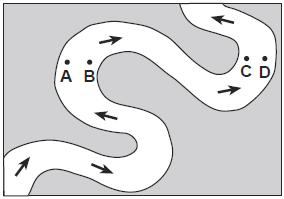
Erosion is most likely greatest at locations

a)

A and B

b)

B and C

c)

C and D

d)

D and A

135.

Which two locations have the greatest stream velocities?

a)

A and B

b)

B and C

c)

C and D

d)

D and A

136.

At which two locations would the stream most likely be the deepest?

a)

A and B

b)

B and C

c)

C and D

d)

D and A

137.

The greatest stream velocities are found closest to points

a)

A and B

b)

B and C

c)

C and D

d)

D and A

138.

The streambank on the outside of this meander is steeper than the streambank on the inside of this meander because the water on the outside of this meander is moving

a)

faster, causing erosion

b)

slower, causing erosion

c)

faster, causing deposition

d)

slower, causing deposition

139.
The biggest factor in determining climate is?
a)
elevation
b)
an ocean
c)
latitude
d)
mountain
140.
What is the difference between climate and weather?
a)
 Climate averages the weather conditions in a specific place over a long period of time, while weather describes the state of the atmosphere at a specific moment in time.
b)
 Weather averages the weather conditions in a specific place over a long period of time, while Climate describes the state of the atmosphere at a specific moment in time.
c)
Climate describes the weather conditions at night, while weather describes the conditions during the daytime.
d)
 There is not a difference between climate and weather.
141.
Which sentence best describes the relationship between elevation and air temperatures?
a)
 LOWER elevation = COLDER temperatures
b)
HIGHER elevation = COLDER temperatures
c)
HIGHER elevations = WARMER temperatures
d)
There is no relationship
142.
Earth's ozone layer is _____________________________.
a)
has been thickening over the past several years
b)
filters harmful ultraviolet radiation from the sun
c)
exists only over Antarctica
d)
traps carbon dioxide in the stratosphere
143.
Increased carbon dioxide may cause global warming by trapping more ____________ in the atmosphere.
a)
water
b)
gases
c)
heat
d)
water vapor
144.
Any amount of CO2 (Carbon Dioxide) in the atmosphere is bad for our planet.
a)
True
b)
False
145.
The conditions in an area over a long period of time?
a)
Climate
b)
Weather
146.
Winters in Minnesota frequently experience temperatures below zero.
a)
Climate
b)
Weather
147.
A tornado warning was issued for Kansas City this morning.
a)
Climate
b)
Weather
148.
Texas has long, hot summers.
a)
Climate
b)
Weather
149.
Which of the following is NOT evidence of global warming?
a)
Sea level rising
b)
Loss of Arctic Sea Ice
c)
Less Water Vapor in the Air
d)
More extreme weather events