
NEW
Font size
 Worksheets
Meiosis + Mendel
Total questions: 35
Worksheet time: 36mins
The genotype for a yellow plant is...
How many pairs of chromosomes are in your cells?
23
46
13
42
Which of the following is homozygous dominant?
A
Aa
AA
aa
Which of the following is homozygous recessive?
Tt
tt
TT
T
What is the genotype for a male human (boy)?
XX
XY
_____________________ is the appearance of an organism, or how it looks
phenotype
mutation
genotype
heredity

What are alleles?
different versions of a gene
different genes
different chromosomes
different cells
What is a genotype?
The combination of alleles in an organism
What you look like
The combination of alleles in a whole species
What your parents look like
One of Mendel's Laws states that genes for different traits can segregate without affecting each other. This is known as the
Law of Independent Assortment
Law of Probability
Law of Segregation
Law of Crossing Over and Recombination
What type of plant did Mendel study?
pea plant
cork plant
tulip flower
dandelion flower

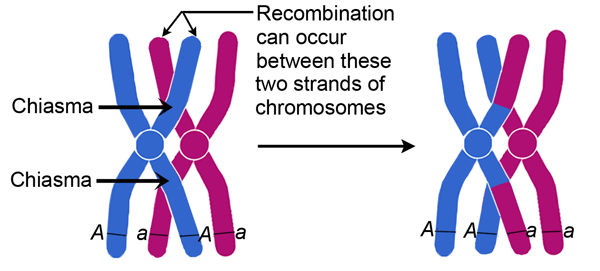
This image shows chromosomes during Prophase 1. Which of the following correctly describes the process shown?
segregation of alleles
independent assortment
mutation in which the DNA content of the gene is altered
crossing over and recombination in which alleles are exchanged


The offspring of a cross between parents that have different traits:
purebred
hybrid
dominant
homozygous
The allele that is not expressed when the dominant corresponding allele is present:
dominant
heterozygous
recessive
homozygous
Known as the father of modern genetics:
Watson
Crick
Darwin
Mendel
Which of the following is NOT a part of meiosis?
prophase
anaphase
metaphase
interphase
If a somatic cell (body cell) has 26 chromosomes, how many chromosomes would each daughter cell contain at the end of meiosis?
42
13
26
34
A Goat has 60 chromosomes in its somatic cells. What is the haploid number?
60
30
34
120
A dog has 78 chromosomes in its body cells. What is the diploid number?
78
39
156
34
One of Mendel's Laws states that alleles separate during meiosis. This is known as the
Law of Independent Assortment
Law of Probability
Law of Segregation
Law of Crossing Over and Recombination
Which is NOT something that happens during prophase?
nuclear membrane dissolves
centrioles move to opposite ends of the cell
chromatin condenses into chromosomes
spindle fibers go away
Which is NOT something that happens during telophase?
nuclear membrane goes away
centrioles go away
chromatin condenses into chromosomes
spindle fibers go away

