wayground logo

Free Printable Worksheets

Font size

S
M
L
XL
Worksheets

QUIZ 3

Total questions: 40

Worksheet time: 37mins

Name
Class
Date
1.

Which sequence of complementary DNA bases would pair with this partial strand

5' ATG TGA CAG? 3'

a)

5' TAC ACT GTC 3'

b)

3' TAC ACT GTC 5'

c)

5' UAC ACU GUC 3'

d)

3' UAC ACU GUC 5'

2.
Which of the following best describes a DNA molecule?
a)
double helix
b)
contains ribose
c)
made of amino acids
d)
contains uracil
3.
Which 2 molecules form the sides (backbone) of the DNA ladder?
a)
deoxyribose sugar and adenine
b)
deoxyribose sugar and a hydrogen bond
c)
deoxyribose sugar and the nucleus
d)
deoxyribose sugar and phosphate
4.
The two strands of nitrogenous bases in DNA are joined by which type of bond?
a)
polar bonds
b)
ionic bonds
c)
covalent bonds
d)
hydrogen bonds
5.

A process in which DNA has the unique ability to make an exact copy of itself.

a)

Replication

b)

Translation

c)

Transcription

d)

Protein Synthesis

6.

The drawing shows the structure of what molecule?

a)

A DNA molecule

b)

A RNA molecule

c)

A carbohydrate molecule

d)

A protein molecule

7.
What are the three components of a nucleotide?
a)
sugar, hydrogen, nitrogen base
b)
sugar, oxygen, nitrogen base
c)
sugar, phosphate, nitrogen base
d)
sugar, phosphate, protein
8.
Identify #2.
a)
nitrogen base
b)
phosphate group
c)
deoxyribose sugar
d)
nucleotide
9.
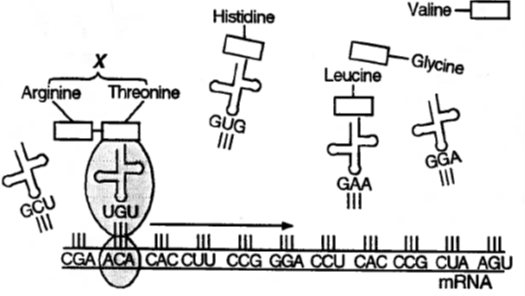
What process is shown in the diagram?
a)
replication
b)
transcription
c)
mitosis
d)
translation
10.
X outlines a(n) ___________.
a)
amino acid
b)
nitrogen base 
c)
nucleotide
d)
nitrogen base pair
11.

Which is in order from largest to smallest structure?

a)

chromosome, DNA strand, gene, nucleotide

b)

chromosome, gene, DNA strand, nucleotide

c)

gene, DNA strand, chromosome, nucleotide

d)

DNA strand, chromosome, gene, nucleotide

12.

Hydrogen bonds occur:

a)

on the ribbon (between the sugar)

b)

between the bases

c)

only between A & T

d)

only between G & C

13.

Label the picture in order from 1-3:

a)

phosphate ; sugar ; base

b)

phosphate ; base ; sugar

c)

base ; sugar ; phosphate

d)

base ; phosphate ; sugar

14.

antiparallel stands of nucleotides run in:

a)

opposite directions

b)

the same direction

c)

base pairs

d)

chromosomes

15.
the base that pairs with Thymine in DNA
a)
adenine
b)
guanine
c)
helicase
d)
nucleotide
16.
nitrogen base that pairs with guanine
a)
adenine
b)
cytosine
c)
nucloetide
d)
deoxyribose
17.
Choose the nucleotide sequence of the RNA strand that would be complementary to the following strand: 
GTAGTCA
a)
UATUAGA
b)
ACGACTG
c)
CAUCAGU
d)
CATCAGT
18.
The main function of tRNA is to...
a)
carry a message that, when translated, forms proteins
b)
form a portion of ribosomes
c)
string together complementary RNA and DNA strands
d)
bring amino acids from the cytoplasm to the ribosomes
19.
Which of the following events occurs directly after RNA polymerase recognizes a gene?
a)
The polymerase strings amino acids into a polypeptide
b)
Free-floating nucleotides pair up with exposed DNA bases
c)
A complementary RNA strand detaches itself from the DNA
d)
The DNA strand begins to unwind, separating the two strands
20.
What is the term for a three-nucleotide sequence that codes for an amino acid?
a)
base
b)
codon
c)
amine
d)
serine
21.
Which phrase best describes translation?
a)
converts mRNA into a polypeptide
b)
catalyzes bonds between amino acids
c)
produces RNA from DNA molecules
d)
recycles tRNA molecules for reuse
22.
Which of the following is the site of transcription?
a)
vacuole
b)
lysosome
c)
nucleus
d)
ribosome
23.
Which of the following is created in the nucleus and carries the genetic code to the cytoplasm?
a)
DNA
b)
tRNA
c)
mRNA
d)
rRNA
24.
The process to go from DNA to mRNA is _______
a)
translation
b)
transcription
c)
replication
25.
The process to go from mRNA to a protein is called ____
a)
transcription
b)
rRNA
c)
replication
d)
translation
26.
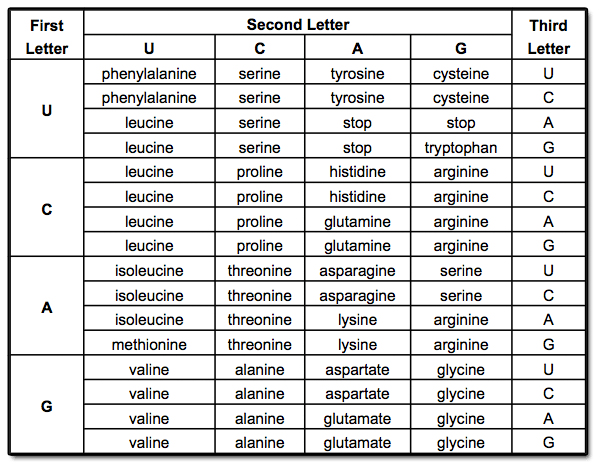
What amino acid is represented by the codon UUA?
a)
Phenylalanine
b)
Tyrosine
c)
Leucine
d)
Stop codon
27.
What process is going on in this photo? 
a)
Transcription 
b)
Translation 
c)
Replication 
d)
All the above 
28.

What is the location in the cell for translation?

a)

nucleus

b)

mitochondria in cytoplasm

c)

ribosome in cytoplasm

d)

chloroplast in cytoplasm

29.
What is the three base sequence of mRNA that codes for a single amino acid?
a)
Anticodon
b)
Codon
c)
Protein
30.

What process is happening in the diagram?

a)

transcription

b)

translation

c)

dna replication

d)

mitosis

31.
This is the triplet of bases on the end of a tRNA molecule
a)
Anticodon
b)
Codon
c)
Protein
32.

A polypeptide is a sequence of ____________________ held together by a peptide bond.

a)

amino acids

b)

fatty acids

c)

proteins

d)

fatty acids

33.

TRANSCRIBE this DNA sequence: TACGTTACT

a)

AUGCAAUGA

b)

ATGCAATGA

c)

AUGGATUGA

d)

TACGTTACT

34.

TRANSLATE this RNA sequence: AUG-GAA-UGA

a)

Met-Glu-Stop

b)

Met-His-Stop

c)

Thr-Glu-Stop

d)

Thr-Pro-Stop

35.

What does DNA stand for?

a)

Deoxyribonucleic acid

b)

Deribonucleic acid

c)

Denitrogenous acid

d)

Diribonucleic acid

36.

Why is DNA important?

a)

it is very small and very complicated

b)

it serves as the blueprint for traits of all living things

c)

it's in everything

d)

because we eat it every day for energy

37.

__________________ is a change in the nucleotide base sequence of DNA.

a)

Switch

b)

Creation

c)

Eraser

d)

mutation

38.

Why is DNA replication termed as Semi-conservative replication?

a)

because two old strands is conserved in each new molecule

b)

because one of the old strands is conserved in each new molecule

c)

because none of the two strands is conserved in each new molecule

d)

all of the above

39.

Which of the following are differences in the structure between RNA and DNA

a)

DNA uses deoxyribose sugar, RNA uses sugar ribose

b)

DNA pairs Adenine with Uracil, RNA pairs Adenine with Thymine

c)

DNA is a double helix, RNA is a single helix

d)

DNA pairs Adenine with Thymine, RNA pairs Adenine with Uracil

40.

Insertion, deletion, and substitution are all examples of a change in a genetic sequence which is also referred to as (a)

a)

Gene

b)

Amino Acid

c)

Ribose

d)

Mutation