

Wayground logo

Free Printable Worksheets

Font size

S
M
L
XL
Worksheets

Y8 Science Energy & Chemistry Revision

Total questions: 28

Worksheet time: 16mins

Name
Class
Date
1.

Which is not a type of potential energy?

a)

Gravitational

b)

Nuclear

c)

Chemical

d)

Kinetic

2.

When a spring is compressed, what type of energy is stored?

a)

Kinetic energy

b)

Chemical potential energy

c)

Elastic potential energy

d)

Sound energy

3.

What is the main type of energy transformation that occurs when a wood fire is lit?

a)

Chemical potential energy to sound energy

b)

Heat energy to light energy

c)

Chemical potential energy to heat energy

d)

Heat energy to chemical potential energy

4.

What is an energy transformation?

a)

Where a type of energy goes into an object.

b)

Where a type of energy becomes another type of energy.

c)

Where a type of energy goes into another thing and stays the same type of energy.

d)

Where a type of energy becomes more powerful.

5.

The energy efficiency equation is:

a)

EE (%) = total energy (J)useful energy (J)×100EE\ \left(\%\right)\ =\ \frac{total\ energy\ \left(J\right)}{useful\ energy\ \left(J\right)}\times100

b)

EE (%) =useful energy (J)total energy (J)×100EE\ \left(\%\right)\ =\frac{useful\ energy\ \left(J\right)}{total\ energy\ \left(J\right)}\times100

c)

EE (%) = wasted energy (J)useful energy (J)×100EE\ \left(\%\right)\ =\ \frac{wasted\ energy\ \left(J\right)}{useful\ energy\ \left(J\right)}\times100

d)

EE (%) = total energy (J)wasted energy (J) ×100EE\ \left(\%\right)\ =\ \frac{total\ energy\ \left(J\right)}{wasted\ energy\ \left(J\right)}\ \times100

6.

Examine the Sankey diagram. Which statement is incorrect?

a)

It shows three types of wasted energy.

b)

The process shown is about 35% energy efficient.

c)

The largest arrow shows the useful energy.

d)

The top-most arrow shows the useful energy.

7.
Why is water NOT on the periodic table?
a)
It is naturally occuring
b)
It is a compound, not an element
c)
It exists as a solid, a liquid, and a gas
d)
Its chemical formula doesn't fit
8.
The smallest particle of any particular type of matter is known by which of the following terms?
a)
Compound
b)
Atom
c)
Chemical
d)
Element
9.
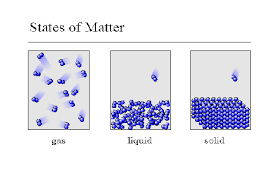
The state of matter with the molecules with the LOWEST amount of energy is....
a)
Gas
b)
Solid
c)
Liquid
10.
Which is the following is NOT a sign of a chemical change?
a)
Releasing a gas
b)
Releasing bubbles
c)
Changing state
d)
Rearranging atoms
11.

An ice cube is put into a heated pan. What will most likely

happen to the molecules in the ice as the ice is heated?

a)

The molecules will begin to move slower.

b)

The molecules will begin to move faster

c)

The molecules will begin to increase in density.

d)

The molecules will begin to condense in the air.
12.
At higher temperatures
a)
particles in an object have less energy
b)
particles in an object move faster
c)
a gas contracts
13.
What term describes a solid changing to a gas?
a)
Deposition
b)
Sublimation
c)
Evaporation
d)
Freezing
14.
What is condensation?
a)
gas to solid
b)
gas to liquid
c)
liquid to solid 
d)
solid to liquid 
15.
WHY is burning a campfire a chemical change? 
a)
It created a new substance with new properties
b)
It changes in size 
c)
There is a lot of smoke
d)
The logs get smaller 
16.

How many atoms are there in this molecule?

a)

2

b)

3

c)

4

d)

5

17.

How many different elements are there in this molecule?

a)

4

b)

5

c)

10

d)

11

18.

A molecule is

a)

a singular particle of a particular element

b)

another name for an element

c)

2 or more atoms that are combined

19.
When iron nails get rusty, heat is released.  What process is this?
a)
Exothermic
b)
Endothermic
20.
In an exothermic reaction, heat is ...
a)
taken in
b)
given out
21.

In an endothermic reaction, heat is ...

a)

taken in

b)

given out

22.
If a chemical reaction is EXOTHERMIC, the temperature would....
a)
Stay the same
b)
Increase
c)
Decrease
23.
What do atoms contain?
a)
elements, neutrons, and bonds
b)
protons, neutrons, and electrons
c)
protons, molecules, and elements
d)
electrons, protons, and bonds
24.
The molecules in the picture are tightly held together with little movement. They have shape and energy.  Therefore, the picture represents _________.
a)
solid
b)
liquid
c)
gas
d)
plasma
25.
When the temperature of matter increases the particles...
a)
speed up and move closer
b)
speed up and move farther apart
c)
slow down and move closer together
d)
slow down and move farther apart
26.
According to the law of conservation of mass...
a)
sometimes atoms are lost
b)
sometimes atoms are gained
c)
atoms are never lost nor gained
d)
atoms are lost and gained
27.
Which part of an atom is POSITIVELY charged?
a)
protons
b)
neutrons
c)
electrons
d)
atoms
28.
What part of an atom is NEGATIVELY charged?
a)
protons
b)
neutrons
c)
electrons
d)
atoms
