wayground logo

Free Printable Worksheets

Font size

S
M
L
XL
Worksheets

End of Year 6 Science assessment prep

Total questions: 81

Worksheet time: 2hrs 30mins

Name
Class
Date
1.
________ have fur o fair
a)
Mammals
b)
Animals
c)
Birds
d)
Vertebrates
2.
_____ have feathers
a)
Mammals
b)
Giraffe
c)
Dolphins
d)
Birds
3.

Breathing organ of Mammals

a)

gills

b)

lungs

c)

skin

d)

hair

4.

Animals with fur or hair and feed their young with milk

a)

penguins

b)

mammals

c)

birds

d)

amphibians

5.

All living thing such as human, animals and plants need 7 characteristics of life processes to growth. Yes or No

a)

Yes

b)

No

6.

"Living things need air to breathe". Which characteristics related to this statement

a)

Movement

b)

Growth

c)

Respiration

7.

Based on the picture, animals need _________ to stay alive

a)

Nutrition

b)

Movement

c)

Excretion

8.

Based on this picture, animals need _________ to growth

a)

Respiration

b)

Nutrition

c)

Reproduce

9.

Based on this picture, animals need ___________ to avoid from extinction

a)

Reproduce

b)

Sensitivity

c)

Nutrition

10.
An organism that is killed and eaten by another organism
a)
Predator
b)
Prey
c)
Competition
d)
Adaptation
11.
Which of the following would be considered to be prey?
a)
an animal that has to hunt for its food
b)
an animal that is eaten by another animal
c)
an organism that makes it own food
d)
an organism that feeds on the blood of another animal
12.
A consumer that hunts is called:
a)
a producer.
b)
an omnivore.
c)
a predator.
d)
a herbivore.
13.
How do consumers get their energy? 
a)
laying in the sun
b)
eating other organisms 
c)
providing food for other organisms
d)
surviving in an ecosystem 
14.
Camouflage is an example of an ______________________ that a prey might have to survive.
a)
Niche
b)
Prey
c)
Competition
d)
Adaptation
15.
If a hawk eats a snake, the snake is the...
a)
Predator
b)
Alpha
c)
Prey
d)
Mutualistic partner
16.
An animal that is hunted and eaten for food is a __________.
a)
predator
b)
prey
c)
population
17.
Maya grows and sells fruit from her farm. Maya is a ________.
a)
producer
b)
consumer
18.
A producer?
a)
Eats other plants and animals
b)
Makes its own food
c)
Eats dead plants or animals
d)
Makes toys for kids
19.
A consumer?
a)
Makes its own food
b)
Eats dead plants and animals
c)
Eats plants and other animals for energy
d)
Buys toys for kids
20.
A decomposer?
a)
Eats dead plants or animals and breaks down to put nutrients in the soil
b)
Eats plants or other animals for food
c)
Makes its own food
d)
Machine that gathers trash
21.
This organism draws its water from the ground, traps sunlight in its chlorophyll, and makes glucose (sugar) in broad green parts of its body. Is it a...
a)
Producer
b)
Consumer
c)
Decomposer
22.
Frog. Is it a....
a)
Producer
b)
Conusmer
c)
Decomposer
23.
Pine Tree. Is it a...
a)
Producer
b)
Consumer
c)
Decomposer
24.
An apple tree is a
a)
producer
b)
consumer
c)
decomposer
25.
A hawk is an example of a
a)
consumer
b)
producer
c)
decomposer
26.
A carrot is an example of a 
a)
producer
b)
consumer
c)
decomposer
27.
Which of the following is a physical adaptation for the underlined animal?
a)
A snake unhinges its jaw to eat a rabbit it just caught.
b)
A hognose snake rolls over, slows its breathing, and hangs its tongue out to pretend to be dead.
c)
A herd of buffalo encircle their young to protect them from a pack of wolves.
d)
A dung beetle rolls a piece of dung across the desert.
28.
How do adaptations help animals?
a)
to hide from predators
b)
to hunt for food
c)
to survive in their habitats
d)
All of these are correct
29.
An animal's color or pattern that helps it blend into its surroundings
a)
Environment 
b)
Mimicry
c)
Camouflage
d)
Habitat
30.
A scientist puts 100 houseflies in a sealed container; then sprays an insecticide into the container.  Ninety-six of the flies die.  Four survive.  The scientist lets the survivors mate and produce offspring, then repeats the experiment with 100 offspring.  Fifty-six of them survive the spray.  This experimental result is evidence of – 
a)
adaptive radiation 
b)
speciation
c)
natural selection
d)
extinction
31.
What genetic change allows organisms to survive natural selection in their environments? 
a)
learned behavior
b)
acquired traits
c)
analogies
d)
adaptations
32.
Which statement does not accurately describe natural selection?
a)
Individual organisms change their genes to adapt to their environment
b)
The genetic composition of a population changes from one generation to the next
c)
More advantageous traits become more common in population
d)
Beneficial and useful traits are inheritable
33.

True or False. Animals and Plants can survive anywhere.

a)

True

b)

False

34.

True or False. Many Plants and Animals share the same habitat.

a)

True

b)

False

35.

What is a habitat?

a)

A way an animal behaves.

b)

A group of the same animals living together.

c)

A specific place where an animal naturally lives.

d)

When an animal lives in a place that is not their home eg. a zoo

36.

you can kill the bacteria in water to make it safer to drink by boiling it over a fire.

a)

true

b)

false

37.

At what temperature would water on a stove gain enough energy to change to vapor?

a)

32 degrees Celsius

b)

0 degrees Celsius

c)

100 degrees Celsius

d)

212 degrees Celsius

38.
What is the boiling point of water
a)
0 C
b)
100 F
c)
50 C
d)
100 C
39.
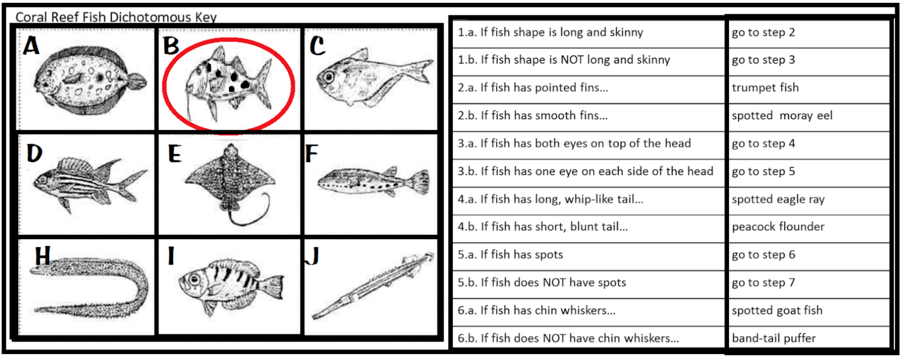
Using this dichotomous key, identity the name of the circled fish.
a)
band-tail puffer
b)
spotted goat fish
c)
peacock flounder
d)
trumpet fish
40.
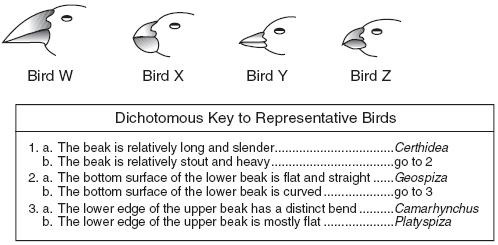
What is the name of bird W?
a)
Certhidea
b)
Geospiza
c)
Camarhynchus
d)
Platyspiza
41.

Part of the plant that absorbs water.

a)

Roots

b)

Flowers

c)

Petals

d)

Leaves

42.
What does a plant need to survive?
a)
sunshine
b)
nutrients
c)
water
d)
all of the above
43.
What keeps the plant from breaking or falling?
a)
the seeds
b)
the leaves
c)
the roots
d)
the flower
44.

What tool would use you to measure a pencil?

a)

ruler

b)

yard stick

c)

measuring tape

45.

What tool would use you to measure a cell phone?

a)

ruler

b)

yardstick

c)

measuring tape

46.

What would you use to measure the

length of a small piece of paper?

a)

Kilogram

b)

centimeter

c)

meter

d)

Litre

47.

How many centimiters is the green rectangle?

a)

3 cm

b)

4 cm

c)

5 cm

d)

6 cm

48.
In a fair test you should...
a)
only change one variable (the independent variable)
b)
change all the variables 
c)
change no variables 
49.

What is the first thing that a scientist does?

a)

Experiment

b)

Make observations

c)

Ask a question

d)

Make a prediction

50.
The independent variable...
a)
is the thing we measure
b)
is the thing we draw
c)
is the thing we keep the same
d)
is the thing we change
51.

The variable that we measure is called the...

a)

independent variable

b)

control variable

c)

dependent variable

d)

right variable

52.
In a fair test you should...
a)
only change one variable (the independent variable)
b)
change all the variables 
c)
change no variables 
53.
The control variables....
a)
are kept the same 
b)
are observed, measured and recorded
c)
are gotten rid of
54.
A testable explanation to a problem that has not yet been tested. 
a)
data
b)
theory
c)
hypothesis
d)
fact
55.
A fair test means our results are...
a)
valid
b)
repeatable 
c)
both
56.

Ms. Sosa wants to test her pet snail's favorite food, Which one should she use for a fair test?

a)
b)
57.

Amy wants to investigate which brand of batteries last longer. She want to use her MP3 player to test them.


Which of the following is the independent variable?

a)

Volume of the MP3 player

b)

Time of playing

c)

Brand of batteries

d)

Status of batteries (new/used)

e)

Size of batteries (AA, AAA, C, D...)

58.

Amy wants to investigate which brand of batteries last longer. She want to use her MP3 player to test them.


Which of the following is the dependent variable?

a)

Volume of the MP3 player

b)

Time of playing

c)

Brand of batteries

d)

Status of batteries (new/used)

e)

Size of batteries (AA, AAA, C, D...)

59.
What is a hypothesis?
a)
A hypothesis is the right answer to an experiment.
b)
A hypothesis is the wrong answer to an experiment.
c)
A hypothesis is an educated guess.
d)
I don't know.
60.
What is the part of the experiment that is left alone or “natural", and is used to compare back to?
a)
Independent Variable
b)
Dependent Variable
c)
Control Group
d)
Experimental Group 
61.
You will want your experiment to have ____ independent variable(s) in it for the experiment to be valid.
a)
1
b)
2
c)
3
d)
4
62.

What should a method have?

a)

The steps for doing the experiment so that I know what I am doing

b)

Detailed steps of everything I am going to do so it can be repeated by someone else

c)

An overview of how I conducted the experiment

d)

Detailed steps but I don't need to include values or the variables

63.

Why does our pulse get faster when we exercise?

a)

Because our hearts are beating faster

b)

Because we are tired

c)

It's telling us we need to stop and relax

64.

Who are looking after their health?

a)
b)
c)
d)
65.

Tick the healthy habits.

a)

sleep ten hours a day

b)

eat lot of sweets

c)

drink enough water

d)

drink drizzy drinks

66.

You must wash your hands only once a day

a)

True

b)

False

67.

Eating _________ are good for our health.

a)

chocolate and sausages

b)

ice cream and fries

c)

burger and chips

d)

fruits and vegetables

68.

An important part of maintaining good _______________ is washing your hands thoroughly and often.

a)

manners

b)

grades

c)

hygiene

d)

behavior

69.

I drink plenty of ___________ to be healthy.

a)

sweet juice

b)

plain water

c)

fizzy drinks

d)

coffee

70.

Which of the following could best be added...


?

Flexibility exercises

Muscular exercises

Aerobic exercises

Nutrition

a)

You must do all three types of exercises every single day.

b)

Never eat junk food, even in small amounts.

c)

Do a variety of exercises three or four times a week.

d)

Eat only fruits and vegetables.

71.
The _____ protects the brain, inner ears, and eyes.
a)
brain
b)
skull
c)
bones
d)
ribs
72.

Identify the bone.

a)

clavicle

b)

ribs

c)

humerus

d)

ulna

73.
What bones protect your heart and lungs?
a)
pelvis and spine
b)
brain and spine
c)
ribs and sternum
d)
ribs and pelvis
74.

Which of the following is NOT a type of blood vessel?

a)

Artery

b)

Capillary

c)

Vein

d)

Ventricle

75.

Which blood vessels take blood TO the heart?

a)

Veins

b)

Arteries

c)

Capillaries

76.

Which blood vessels take blood AWAY from the heart?

a)

Veins

b)

Arteries

c)

Capillaries

77.

A tool that is used to measure time.

a)

Stopwatch

b)

Spring Scale

c)

Microscope

d)

Balance Scale

78.
Name this tool: helps you measure elapsed time in minutes and/or seconds
a)
Hand Lens
b)
Thermometer
c)
Stopwatch
d)
Scale
79.
How do you find your pulse? 
 
a)
 Neck, Wrist and Chest 
b)
Count your heartbeats for 10 seconds and multiply by 6 
c)
 Is expressed as beats per minute (BPM) 
d)
  Elbow, Ankle and Ear
80.
What is Resting Heart Rate?
a)
 220 - Your Age 
b)
Karvonen Formula
c)
The number of times your heart beats per minute at rest 
d)
 The minimum number of heartbeats in a given amount of time 
81.

What is Heart Rate?

a)

The number of times your heart beats.

b)

The number of times your heart beats per minute.

c)

The maximum amount of times your heart should be.

d)

The amount of times your heart should beat while exercising.