
NEW
Font size
 Worksheets
Equilibrium
Total questions: 40
Worksheet time: 38mins
Identify the incorrect statement about achieving equilibrium.
achieved when product and reactant concentrations are equal
achieved when forward and reverse reaction rates are same
achieved when concentration of reactants is stable/constant
achieved when concentration ratio of reactants to products becomes stable, thus fixing the equilibrium constant (equilibrium position)

2SO2(g)+O2(g) ⇌ 2SO3(g)
H = -450kJ
Adding SO2(g) will
shift equilibrium right
shift equilibrium left
increase rate of reaction
have no change
2SO2(g)+O2(g) ⇌ 2SO3(g)
H = -450kJ
Increasing the temperature will...
shift equilibrium right
shift equilibrium left
increase pressure
have no change
2SO2(g) + O2(g) ⇌ 2SO3(g)
H = -450kJ
Removing O2(g) will
shift equilibrium right
shift equilibrium left
increase pressure
have no change
2SO2(g) + O2(g) ⇌ 2SO3(g)
H = -450kJ
Adding SO3(g) will
shift equilibrium right
shift equilibrium left
increase K
have no change
2SO2(g) + O2(g) ⇌ 2SO3(g)
H = -450kJ
Increasing the volume of the container will...
shift equilibrium right
shift equilibrium left
slow rate of reaction
have no change
2SO2(g)+1O2(g) ⇌ 2SO3(g) + Heat
Increasing the pressure on the system will...
shift equilibrium right
shift equilibrium left
slow rate of reaction
have no change
2SO2(g) + O2(g) ⇌ 2SO3(g)
H = -450kJ
Using a catalyst
shift equilibrium right
shift equilibrium left
have no change

CoCI42- +6H2O →Co(H2O)62+ + 4CI-.
What would happen when H2O is added?
Position of equilibrium will shift to left (and become more blue)
Position of equilibrium will shift to right (and become more pink)
Keq will increase as H2O is added
Position of equilibrium will shift to left to reduce the added H2O

1N2 + 3H2 →2NH3
When the pressure on the system is increased, the equilibrium position shifts to the right. Why?
To increase the amount of products
To reduce the pressure, as the right side has fewer molecules of gas
Keq will increase when it is shifted to the right
To increase the pressure, as the right side has more molecules of gas
CoCI42- +6H2O →Co(H2O)62+ + 4CI-
What will happen when CI- ions are added?
Position of equilibrium will shift to left and become more pink
Color of system will turn to all pink
Concentration of reactants and products remain unchanged
Position of equilibrium will shift to left to reduce the added CI- ions
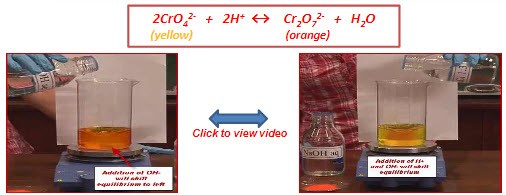
2CrO42- + 2H+ → Cr2O72- + H2O
What will happen when H+ ions are added to the system?
Position of equilibrium will shift to left and become more yellow
Color of system will turn all yellow
Color of system will turn all orange
Equilibrium will shift to right and become more orange
2CrO42- + 2H+→Cr2O72- + H2O
What will happen when OH- ions are added to the system? HINT: They remove the H+ ions.
Position of equilibrium will shift to right and become more orange
Position of equilibrium will shift to left and become more yellow
Position of equilibrium will shift to right and become more yellow
OH- ions will not react, and thus no change is seen.

CoCI42- +6H2O →Co(H2O)62+ + 4CI- + Heat
What will happen when the temperature is increased?
Position of equilibrium will shift to left and become more blue
Position of equilibrium will shift to right and become more pink
No change in position of equilibrium
Position of equilibrium will shift to left and become more pink
2SO2(g)+O2(g)⇌2SO3(g)
Removing O2(g) will
shift equilibrium right
shift equilibrium left
increase pressure
have no change
Increasing volume of container will
Decreasing volume of container will

What happens to the equilibrium if we add methane (CH4)?
It shifts left, towards the reactants
It shifts right, towards the products
It does not shift
What happens to the equilibrium if we remove water (H2O)?
It shifts left, towards the reactants
It shifts right, towards the products
It does not shift
What happens to the equilibrium if we remove heat?
It shifts left, towards the reactants
It shifts right, towards the products
It does not shift
What happens to the equilibrium if we add hydrogen (H2)?
It shifts left, towards the reactants
It shifts right, towards the products
It does not shift
What happens to the equilibrium if we remove carbon monoxide (CO)?
It shifts left, towards the reactants
It shifts right, towards the products
It does not shift

What happens when sodium ions (Na+) are added?
The reaction shifts left, towards the reactants
The reaction shifts right, towards the products
There is no shift
What happens when fluoride ions (Na+) are removed?
The reaction shifts left, towards the reactants
The reaction shifts right, towards the products
There is no shift
What happens when the system is cooled (heat is removed)?
The reaction shifts left, towards the reactants
The reaction shifts right, towards the products
There is no shift
What happens when sodium fluoride (NaF) is added?
The reaction shifts left, towards the reactants
The reaction shifts right, towards the products
There is no shift

What happens when sulfur dioxide (SO2) is added?
The reaction shifts left, towards the reactants
The reaction shifts right, towards the products
The reaction does not shift
2 NO(g) + O2(g) ⇌ 2 NO2(g)

SO2 (g) + NO2 (g) <=> SO3 (g) + NO (g)
had reached a state of equilibrium, was found to contain
0.40 mol L-1 SO3 , and 0.30 mol L-1 NO,
0.15 mol L-1NO2 , and 0.20 mol L-1 SO2.
Calculate the equilibrium constant for this reaction.
Fe3O4(s) + 4H2(g) <=> 3Fe(s) + 4H2O(g)
Kc =
What is the concentration equilibrium constant expression?
CO2(g) + H2(g) ↔ CO(g) + H2O(l)
2NOBr(g) + Cl2(g) ↔ 2NO(g) + 2BrCl(g)
if
2NOBr(g) ↔ 2NO(g) + Br2(g)
has a Kc = 0.014
Br2(g) + Cl2(g) ↔ 2BrCl(g)
has a Kc = 7.2
4Br2(g) + CH4(g) ↔ 4HBr(g) + CBr4(g)

