Wayground logo

Free Printable Worksheets

Font size

S
M
L
XL
Worksheets

6th Grade Science Wrap Up

Total questions: 40

Worksheet time: 1hrs 12mins

Name
Class
Date
1.
An example of BIOsphere connecting to ATMOsphere
a)
plants produce oxygen
b)
animals eat plants
c)
animals live in caves
d)
animals drink water
2.

In what direction do winds blow?

a)

From areas of high pressure to areas of low pressure

b)

From areas of low pressure to areas of high pressure

3.
What part of the illustration shows Evaporation? 
a)
1
b)
2
c)
3
d)
4
4.
Which statement best describes the difference between weather and climate?
a)
Weather is the conditions when you look outside while climate is the conditions you can expect for the next 6 months.
b)
Climate is the current condition outside while weather is what you can expect for the next 6 months.
5.

James plans to climb to the top of Mount Everest. Which of the following statements about his climb will be the most accurate?

a)

Air pressure will rise and the temperature on a thermometer will increase.

b)

Air pressure will fall and the temperature on a thermometer will decrease.

c)

Air pressure will rise and the temperature on a thermometer will decrease.

d)

Air pressure and temperature will not change.

6.
Which BEST describes why latitudes closest to the equator have warmer climates?
a)
they are at lower elevations
b)
they receive more solar energy
c)
they are nearer to ocean currents
d)
they get more winds that carry energy in the form of heat
7.
Which of the following does NOT have an affect on a region's climate?
a)
Large bodies of water
b)
Latitude
c)
Mountains
d)
Longitude
8.
What causes day and night on Earth?
a)
One Earth rotation
b)
One revolution around the sun
9.
What phase of the moon is pictured here?
a)
Full moon
b)
New moon
c)
Waxing gibbous
d)
Waxing crescent
10.
Why does Earth have different seasons? 
a)
because of the distance between Earth and the sun 
b)
because of the speed of Earth as it rotates on its axis 
c)
because of the amount of light blocked by the moon on its axis 
d)
because of the tilt of Earth on its axis as it moves around the sun 
11.

How long does it take the Earth to make one REVOLUTION around the Sun?

a)

12 hours

b)

24 hours

c)

365.25 days

d)

29.5 days

12.

The name given to the "Supercontinent" is

a)

Gondwanaland

b)

Pangea

c)

Eurasia

d)

Pennsylvania

13.

Which of the following statements is TRUE concerning convection?

a)

When matter heats up, it expands and becomes more dense.

b)

When matter heats up, it contracts and becomes more dense.

c)

When matter heats up, it expands and becomes less dense.

d)

When matter heats up, it contracts and becomes less dense.

14.

About 90% of the world’s earthquakes and 75% of the world’s volcanoes take place in the “Ring of Fire”. Why is this the case?

a)

It is a place where there is large amount of plate movement.

b)

It is very warm in this region of the world which allows for high levels of convection.

c)

It is the region of the world which is most affected by the weather phenomenon “El Niño”.

d)

It is the location of the largest ridge system, the Mid-Atlantic Ridge.

15.
How was a large canyon like this most likely formed based on the clues from the picture. 
a)
Weathering due to a river cutting through rock
b)
A glacier cutting through a valley
c)
A sinkhole due to water eroding the dirt away from under the rock
d)
An earthquake suddenly splitting the rock open
16.
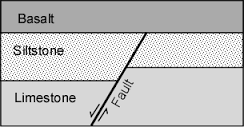
What are the relative ages of the features in order from oldest to youngest?
a)
Limestone, Basalt, Fault, Siltstone
b)
Siltstone, Fault, Basalt, Limestone
c)
Limestone, Fault, Basalt, Siltstone
d)
Limestone, Siltstone, Fault, Basalt
17.
The average temperature of the surface of Earth has increased approximately 1°C in the past century. Which reason best explains this increase in temperature?
a)
lower levels of ozone in the atmosphere
b)
lower levels of nitrogen in the atmosphere
c)
higher levels of carbon dioxide in the atmosphere
d)
higher levels of oxygen in the atmosphere
18.
Carbon is stored in
a)
Trees and other living things
b)
Oceans
c)
underground in soil and fossil fuels
d)
All are correct
19.

What is it called when CO2 is absorbed by the ocean and reacts with seawater to produce acid.

a)

water pollution

b)

ocean acidification

c)

seaweed salad vinegar

d)

hydrochloric acid

20.

What is it called when CO2 is absorbed by the ocean and reacts with seawater to produce acid.

a)

water pollution

b)

ocean acidification

c)

seaweed salad vinegar

d)

hydrochloric acid

21.

What is this a diagram of?

a)

The ozone layer being destroyed

b)

How sunlight is reflected into space

c)

The Greenhouse Effect

d)

Weather patterns

22.

The clearing of Earth's forests on a massive scale, often resulting in damage to the quality of the land.

a)

Deforestation

b)

Agriculture

c)

Rainforests

d)

Farming

23.
A Fossil Fuel is
a)
Materials that are found on Earth that people use
b)
Rock that contains metal 
c)
Fuels that formed years ago from the remains of things that lived millions of years ago.
d)
Resources that cannot be replaced quickly enough to keep from running out. 
24.

Which group includes ALL renewable resources?

a)

Coal, trees, water, oil

b)

Water, wind, sun, plants

c)

Minerals, sun, natural gas, water

d)

Coal, sun, wind, water

25.

What is the theme of the Lorax?

a)

It is important protect the Earth's natural resources.

b)

It is okay to waste the Earth's natural resources.

c)

Things change over time.

d)

Trees are the most important natural resource we have.

26.

Earth is a DYNAMIC planet

a)

True - because Earth is constantly changing

b)

True - because earth can sustain life

c)

False - because earth is stagnant

d)

False - because Earth is a system

27.
What is the source of energy for the water cycle?
a)
gravity
b)
transpiration
c)
the oceans
d)
the sun
28.
What is the correct volume of the blue liquid?
a)
5 ml
b)
15 ml
c)
20 ml
d)
25 ml
29.
a)

The cooler the temperature, the louder the crickets chirp.

b)

The crickets cannot chirp at temperatures lower than 10 degrees C.

c)

The warmer the temperature, the more often crickets chirp.

d)

The temperature and the chirping of crickets are not related.

30.

This variable in an experiment is purposefully changed.

a)

dependent variable

b)

independent variable

c)

data

d)

control group

31.
Mr. S. sets up an experiment to see how the mass of a ball affects the distance it rolls off a ramp.  Identify the independent variable.
a)
distance traveled by the ball
b)
height of the ramp
c)
mass of the ball
d)
weight of the ball
32.
If I study for my scientific method quiz, then I will have a better test score. What is the dependent variable?
a)
Scientific Method
b)
Studying
c)
Independent variable
d)
Test score
33.

Which of the following is NOT caused by the movement of plates?

a)

tsunamis

b)

earthquakes

c)

hurricanes

d)

mountain-building

34.

Which of the following terms describes a boundary formed when two plates MOVE AWAY FROM EACH OTHER or SEPARATE?

a)

divergent

b)

convergent

c)

transform

d)

strike-slip

35.
Rain, snow, sleet, and hail are all forms of _____.
a)
precipitation
b)
condensation
c)
evaporation
d)
climate
36.
Preserved remains or traces of an organism that lived in the past.
a)
vertebrate
b)
carbon film
c)
invertebrate
d)
fossil
37.

The study of space and the objects in it

a)

geology

b)

astronomy

c)

astrology

d)

meteorology

38.

Something we observe to be similar over and over again is called

a)

results

b)

model

c)

pattern

d)

theory

39.

The ability to do work or cause change is

a)

pattern

b)

system

c)

density

d)

energy

40.

A group of individual parts that work together to form a complex whole is a

a)

pattern

b)

system

c)

energy

d)

ecosystem