
 Worksheets
Unit 9J Space unit revision
Total questions: 41
Worksheet time: 1hrs 26mins
Name
Class
Date
1.
What causes day and night?
a)
The Earth is spinning.
b)
The moon's gravity.
c)
The Earths orbit.
2.
If there are long shadows outside during lunchtime, what season do you think it is? How do you know?
a)
It is probably winter time because the shadows are longer in the winter time.
b)
It is probably summer time because the shadows are longer in the summer time.
3.
How does the Earth move in space?
a)
The Earth does NOT orbit or spin.
b)
The sun orbits the earth.
c)
The Earth orbits the moon.
d)
The Earth spins and orbits the sun.
4.
The moon changes shape during the month because?
a)
different parts of the moon light up at different times.
b)
the Earth’s shadow moves across the moon.
c)
the moon orbits the Earth so the angle of the sun’s reflection changes.
d)
the moon is spinning so the sun shines on different parts.
5.
Which two factors determine the gravitational force between two objects?
a)
Time and temperature
b)
Color and Hardness
c)
Mass and Distance apart
d)
Shape and orbital speed
6.

Which object is closer to Earth?
a)
Mars
b)
Venus
c)
Jupiter
d)
Saturn
7.
The amount of matter in an object is
a)
pressure
b)
weight
c)
mass
d)
force
8.
Which of the following never changes no matter where in the universe?
a)
weight
b)
force
c)
mass
d)
pounds
9.
What is the definition of "weight"?
a)
measure of the force of gravity on your body
b)
the time it takes to get on a ride
c)
the amount of matter in an object
d)
the size of an object
10.
The weight of an object _________ as it moves away from the center of Earth.
a)
increases
b)
stays the same
c)
triples
d)
decreases
11.
As an object's mass increases, its gravitational pull will ____________.
a)
decrease
b)
increase
c)
stay the same
d)
get weaker
12.
The force of gravity acting on an object is the object's ______.
a)
mass
b)
matter
c)
weight
d)
friction
13.
True or False: My weight on Earth is different than my weight on Jupiter.
a)
True
b)
False
14.
What is the approximate value of gravitational field strength on Earth?
a)
10 N/kg
b)
20 N/kg
c)
100 N/kg
d)
1000 N/kg
15.
What is the formula for mass and weight?
a)
w = m/g
b)
w = m - g
c)
w = mg
d)
w = m + g
16.
a celestial body orbiting around a planet or star.
a)
satellite
b)
sun
c)
moon
d)
crater
17.
Fill in the blank:
Mars is the ________ planet from the sun
Mars is the ________ planet from the sun
a)
5th
b)
4th
c)
3rd
18.
Has there been water on Mars?
a)
Yes
b)
Evidence that there was
c)
Evidence that there wasn't
d)
No
19.

Why is Mars referred to as the Red Planet?
a)
high abundance of iron oxides
b)
red daytime sky
c)
light bent towards the red spectrum
d)
none of these answer choices
20.

What moon phase is this picture?
a)
This is the full moon phase.
b)
This is the waxing gibbous moon phase.
c)
This is the waning gibbous moon phase.
d)
This is the first quarter moon phase.
21.

What moon phase is this picture?
a)
This is the full moon phase.
b)
This is the waxing crescent moon phase.
c)
This is the waning gibbous moon phase.
d)
This is the waning crescent moon phase.
22.

What moon phase is this image?
a)
This is the full moon phase.
b)
This is the last quarter moon phase.
c)
This is the waxing gibbous moon.
d)
This is the new moon phase.
23.
What is illuminating the Moon?
a)
Nuclear Fusion
b)
Sunlight
c)
Mirrors
d)
Flood Lights
24.
The moon ____________ or goes around the Earth.
a)
orbits
b)
cries
c)
climbs
25.
Changes in the moon's appearance are
a)
phases
b)
eclipses
c)
stages
d)
cycle
26.
What causes the moon's phases
a)
Where you are standing on Earth
b)
the amt of sunlight reflected onto the moon from the sun
c)
The tilt of Earth
d)
how fast the moon is moving
27.
Define Full Moon
a)
None of moon is visible
b)
Half moon phase is visible
c)
Complete moon face is visible
d)
Less Than half of moon is visible
28.
A satellite is defined as something that orbits a planet. How many NATURAL satellite(s) does Earth have?
a)
Five
b)
Sixteen
c)
One
d)
Three
29.

How long does it take for the Earth to do one rotation on its axis?
a)
60 seconds
b)
24 hours
c)
365 days
d)
1 light year
30.
The Moon completes an orbit around the Earth about once a ______
a)
year
b)
day
c)
month
31.
When daylight hours are almost equal to night time hours, it is called
a)
equinox
b)
solstice
32.
On the day that the northern hemisphere has it's longest day, the southern hemisphere will have it's shortest day.
a)
True
b)
False
33.
The day with the longest night time hours is the fall equinox.
a)
True
b)
False
34.

The line up for a solar eclipse is:
a)
Sun-Earth-Moon
b)
Earth-Sun-Moon
c)
Sun-Moon-Earth
d)
Earth-Moon-Mars
35.

A lunar eclipse often has a __________ appearance
a)
Black
b)
Yellow
c)
Orange Red
d)
White
36.

The part of the sun that can only be seen during a total eclipse is:
a)
Core
b)
Chromosphere
c)
Photosphere
d)
Corona
37.
A lunar eclipse occurs when the Moon casts a shadow on Earth.
a)
True
b)
False
38.

What is the central, darker part of a shadow called?
a)
the umbra
b)
the penumbra
39.
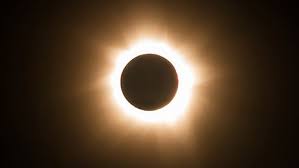
During a solar eclipse...
a)
The sun is blocked by the moon
b)
The Earth is blocked moon
c)
The moon is blocked by the sun
d)
You are blocked
40.
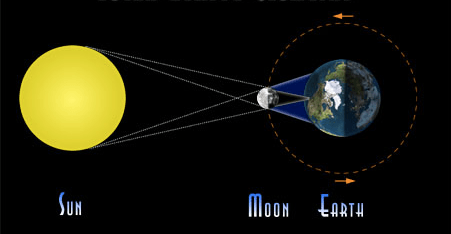
Which type of eclipse is shown in this picture?
a)
Solar Eclipse
b)
Orbit
c)
Lunar Eclipse
d)
Total Eclipse
41.
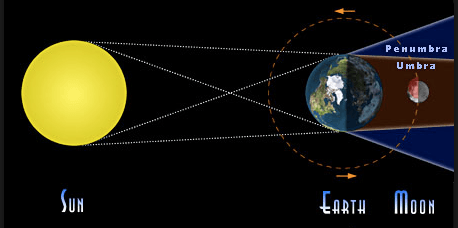
Which type of eclipse is shown in the diagram?
a)
Solar Eclipse
b)
Lunar Eclipse
c)
Total Eclipse
d)
Partial Eclipse
100 %

