wayground logo

Free Printable Worksheets

NEW

Font size

S
M
L
XL
Worksheets

Combined Science Revision Yr 11

Total questions: 43

Worksheet time: 33mins

Name
Class
Date
1.
Which of the following is NOT a function of the digestive system?
a)
Breaking down food into molecules the body can use
b)
Absorb molecules into the blood and carry them throughout the body
c)
Food allows blood cells to flow through arteries and veins
d)
Eliminate waste
2.
If food is in the esophagus, which letter represents where it will go next in the digestive system?  
a)
B
b)
C
c)
D
d)
E
3.
Consider the food chain:
grass >>> insect >>> frog >>> snake
Which is the 3rd level consumer?
a)
grass
b)
insect
c)
frog
d)
snake
4.
What two types of particles exist within an atomic nucleus?
a)
protons and neutrons
b)
Neutrons and electrons
c)
Protons and neutrinos
d)
Positrons and neutrons
5.
Carbon has an atomic number of 6. What can you conclude about carbon from this fact?
a)
It has six protons
b)
It has six neutrons 
c)
It's in group 6
d)
It's in period 6
6.
To become positively charged, an atom must:
a)
Gain a proton
b)
Lose a proton
c)
Gain an electron
d)
Lose an electron
7.
How many neutrons does the isotope of lithium have?
a)
8
b)
3
c)
4
d)
5
8.
Ions are: 
a)
atoms with a positive or negative charge
b)
atoms with no charge
c)
atoms with ONLY a positive charge
d)
atoms with ONLY a negative charge
9.
Which of the following is a REACTANT of photosynthesis?
a)
Oxygen
b)
Carbon dioxide
c)
Sugar
d)
Heat
10.
Exothermic reactions...
a)
Absorb energy
b)
Release energy
c)
Release Color
d)
Absorb Color
11.
Is photosynthesis an exothermic or endothermic reaction?
a)
Endothermic
b)
Exothermic
c)
Neither
d)
It is not a chemical reaction
12.
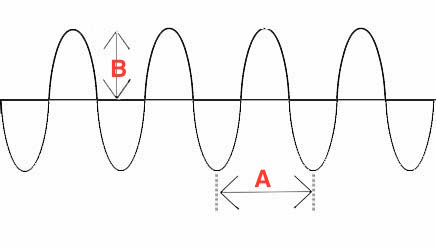
What property of this wave is represented by the letter "A"
a)
amplitude
b)
crest
c)
trough
d)
wavelength
13.
The number of wavelengths that pass a point each per second is:
a)
frequency
b)
period
c)
longitudinal 
d)
transverse wave 
14.
When the frequency of a wave increases, what happens to the wavelength?
a)
The wavelength is not directly affected by the frequency of a wave.
b)
The wavelength increases.
c)
The wavelength decreases.
d)
More specific information is needed to form a conclusion about the wavelength.
15.
When a wave bends as it passes through at an angle from one medium to another.(example: pencil in a glass of water-)
a)
medium
b)
refraction
c)
reflection
d)
interference
16.
_____ is a lens that is thicker in the middle and makes an object appear bigger.
a)
prism
b)
convex lens
c)
concave lens
d)
mirror
17.
______ is a lens that is thicker on its edges and makes an object appear smaller?
a)
mirror
b)
convex lens
c)
concave lens
d)
prism
18.
What Does a Concave Lens Do?
a)
Make things bigger
b)
Make things smaller
c)
Make things closer
d)
Make things happy
19.
In order of most to least penetrating radiation we have
a)
Alpha , Beta,  Gamma
b)
Beta , Gamma , Alpha
c)
Gamma, Beta, Alpha
d)
Gamma, Alpha, Beta
20.
What type of radiation can be stopped by a 5 mm piece of aluminium?
a)
Alpha radiation
b)
Beta radiation
c)
gamma radiation
21.
What is the major difference between static electricity and current electricity?
a)
Current electricity involves a continuous flow of neutrons; static electricity is a sudden transfer of protons
b)
Current electricity can be deadly; static electricity is almost always safe
c)
In current electricity, there's a single transfer of electrons; in static electricity, there's a steady flow of electrons
d)
Current electricity involves a flow of electrons; static electricity involves a single transfer of electrons
22.
What do atoms contain?
a)
elements, neutrons, and bonds
b)
protons, neutrons, and electrons
c)
protons, molecules, and elements
d)
electrons, protons, and bonds
23.
Why are coal, oil, and natural gas considered nonrenewable resources?
a)
There is a limited supply, and they can be replaced in a short period of time.
b)
There is not a limited supply, and they cannot be replenished in a short period of time.
c)
There is a limited supply, and they cannot be replenished in a short period of time.
d)
There is not a limited supply, and they can be replaced in a short period of time.
24.
What's a herbivore
a)
Eats meat
b)
Eats plants
c)
eats meat and plants
d)
decomposes
25.
What kinetic energy?
a)
Energy of Motion
b)
Potential Energy
c)
Food Energy
26.
What is matter?
a)
physical changes
b)
anything that takes up space
c)
chemical properties
d)
physical properties
27.
What tool is used to measure weight or force?
a)
spring scale
b)
balance
c)
hand lens
d)
tape measure
28.

In an element box, the number at top is the

a)

atomic number

b)

atomic name

c)

atomic mass

d)

atomic symbol

29.

___________________ are positively charged particles located in the nucleus of an atom.

a)

Electrons

b)

Neutrons

c)

Protons

d)

Isotopes

30.

Elements on the Periodic Table are ordered according to their

a)

element name

b)

element symbol

c)

number of atoms

d)

atomic number

31.

Rows in the Periodic Table are called

a)

Periods

b)

Groups/Families

c)

Cousins

d)

Metals

32.

Column in the Periodic Table are called

a)

Periods

b)

Groups/Families

c)

Cousins

d)

Metals

33.

The chemical symbol in this element box is

a)

26

b)

Fe

c)

Iron

d)

55.845

34.

All matter is made of

a)

electrons

b)

protons

c)

neutrons

d)

atoms

35.

A force of 20 N does 10 J of work when it moves an object through a distance d in the direction of the force.

What is distance d?

a)

0.5m

b)

2.0m

c)

10m

d)

200m

36.

What is the definition of digestion?

a)

large insoluble molecules change into feces

b)

large insoluble molecules are changed into smaller soluble molecules

c)

small soluble molecules are carried to the liver

d)

small soluble molecules pass through the wall of the intestine

37.

Which is the result of a diet lacking in iron?

a)

Osteoporosis

b)

Goiter

c)

Tooth decay

d)

Anemia

38.

What is the site of gas exchange in lungs called?

a)

Trachae

b)

Bronchi

c)

Alveoli

d)

Esophagus

39.

What is the process that moves food through the gut called?

a)

Digestion

b)

Diffusion

c)

Propulsion

d)

Peristalsis

40.

What is the deficiency of Vitamin A called?

a)

Anemia

b)

Night Blindness

c)

Tooth Decay

d)

Scurvy

41.

Which acid is produced by the stomach?

a)

Pepsin

b)

Hydrochloric Acid

c)

Gastric Juice

d)

Amino Acid

42.

What are magnets made of?

a)

iron

b)

sulfer

c)

aluminum

d)

copper

43.

Which of the following is NOT an example of a good insulator?

a)

rubber

b)

wood

c)

metal

d)

platic