wayground logo

Free Printable Worksheets

NEW

Font size

S
M
L
XL
Worksheets

Year 9 Revision

Total questions: 58

Worksheet time: 58mins

Name
Class
Date
1.

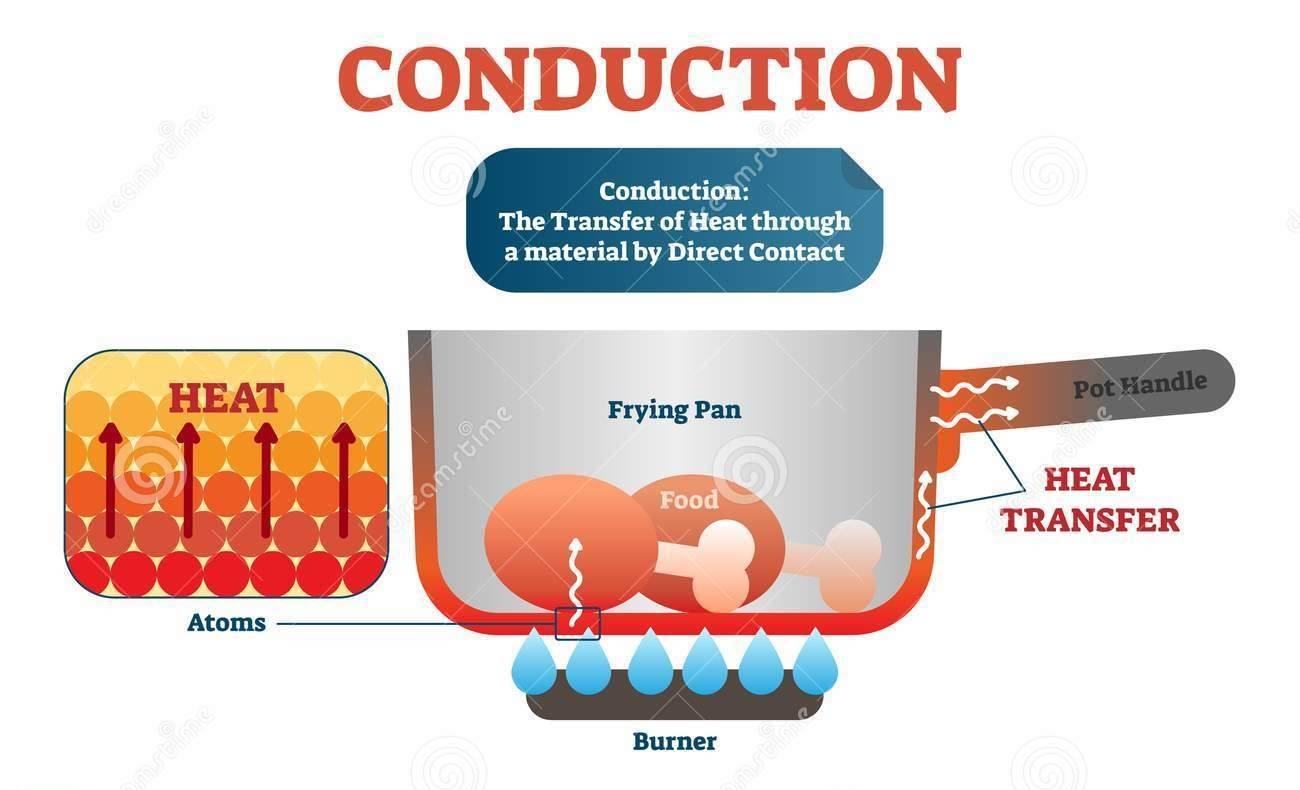
What is Conduction?

a)

When heat is passed from particle to particle through an object.

b)

When particles get heated, expand, and become less dense.

c)

When heat transfers by waves through empty space.
2.

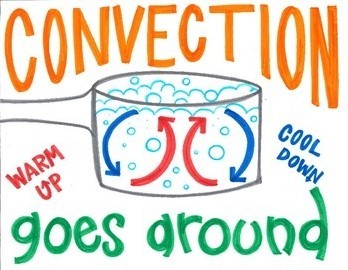
What is Convection?

a)

When heat is passed from particle to particle through an object.

b)

When particles get heated, expand, and become less dense.

c)

When heat transfers by waves through empty space.

3.

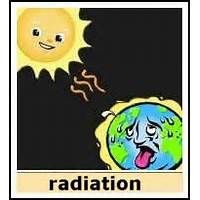
What is Radiation?

a)

When heat is passed from particle to particle through an object.

b)

When particles get heated, expand, and become less dense.

c)

When heat transfers by waves through empty space.

4.

Which of the following is an example of heat transfer by Conduction?

a)

Burning your fingers on a hot iron.

b)

Heat from a heater warming up your whole house

c)

Standing by a campfire and feeling the heat.

d)

All of the above.

5.

Which of the following is an example of heat transfer by Convection?

a)

Burning your fingers on a hot iron.

b)

Heat from a heater warming up your whole house

c)

Standing by a campfire and feeling the heat.

d)

All of the above.

6.

Which of the following is an example of heat transfer by Radiation?

a)

Burning your fingers on a hot iron.

b)

Heat from a heater warming up your whole house

c)

Standing by a campfire and feeling the heat.

d)

All of the above.

7.

What is heat?

a)

The temperature of hot objects

b)

The energy transferred between hot objects

c)

The fire hot objects give off.

d)

All of the above

8.

How does heat move?

a)

From cooler objects to warmer objects.

b)

From warmer objects to cooler objects

c)

From metal objects to nonmetal objects

d)

Very quickly in all directions

9.
No more energy can be removed from matter at:
a)
its freezing point
b)
0°C
c)
absolute zero
d)
273 K
10.
A measure of the average kinetic energy of the individual particles in an object is called:
a)
thermal energy
b)
conduction
c)
convection
d)
temperature
11.
The temperature of a substance increases as___.
a)
the substance expands
b)
the average kinetic energy of its particles increases
c)
the substance's volume increases
d)
the substance's mass increases
12.

Convert -89 oC to K

a)

184K

b)

362K

c)

-362K

d)

-184K

13.
Convert 300 K to oC
a)
27oC
b)
0oC
c)
-27oC
d)
573oC
14.

On this temperature scale, there can NEVER be negative numbers

a)

Celsius

b)

Fahrenheit

c)

Kelvin

15.
A conductor allows energy to easily pass by.  
a)
True 
b)
False
16.
A insulator does not let energy flow through easily 
a)
True 
b)
False
17.
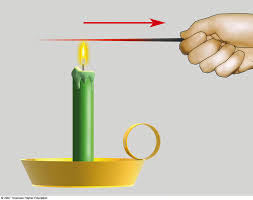
The candle will slowly heat the metal and transfer the heat directly to the mans hand.
a)
conduction
b)
convection
c)
radiation
18.

When light hits an area and bounces back it is called:

a)

echo

b)

refraction

c)

reflection

d)

absorbing

19.

When light goes from one material(medium) to another it becomes bent, what term means bent?

a)

reflected

b)

refracted

c)

absorbed

d)

turned

20.

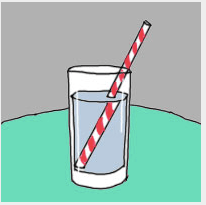
Why does the straw appear to be bent?

a)

light is reflected

b)

light is absorbed

c)

light is turned

d)

light is refracted

21.
How does light behave as it enters these mediums?
a)
continue its path as straight line.
b)
bends toward the normal
c)
bends away from the normal
d)
reflects
22.
According to the Law of reflection, a light ray striking a mirror
a)
continues moving through the mirror in the same direction
b)
moves into the mirror at a slightly different angle
c)
bounces off the mirror toward the direction it came from
d)
bounces off the mirror at the same angle it hits.
23.
Glass has a _____________ index of refraction than air.
a)
Equal
b)
Greater
c)
Less
d)
Impossible to say
24.

In the diagram, which letter represents the angle of incidence?

a)

A

b)

B

c)

C

d)

D

25.
Law of reflection state that - The angle of incidence is .................. to the angle of reflection.
a)
equal
b)
double
c)
half
26.
........... – the angle between the normal and the reflected ray.
a)
Angle of incidence
b)
Angle of reflection
c)
Angle of coincidence
d)
Angle of direction
27.
........... – the angle between the normal and the incident ray.
a)
Angle of incidence
b)
Angle of reflection
c)
Angle of coincidence
d)
Angle of direction
28.

What type of lens is wider in the middle than on the edges?

a)

Concave

b)

Convex

c)

Objective

d)

Ocular

29.

What type of lens is thinner in the middle than at the edges?

a)

Convex

b)

Concave

c)

Objective

d)

Magnifying

30.

The point at which light rays converge after passing through a convex lens is called what.

a)

The Horizon Point

b)

The Point Break

c)

The Focal Point

d)

The Perspective

31.
The point where the rays meet is known as....
a)
Fire
b)
the focal point
c)
refraction
d)
Plane of the lens
32.
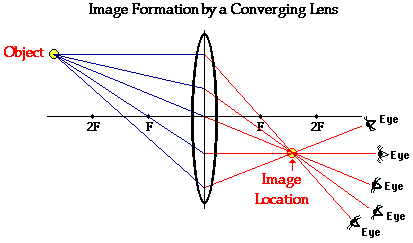
This image is.....
a)
inverted and smaller
b)
inverted and larger
c)
not inverted and smaller
d)
not inverted and larger
33.
This image is...
a)
Inverted and smaller
b)
inverted and bigger
c)
not inverted and smaller
d)
not inverted and bigger
34.
Convex Mirrors produce...
a)
only virtual images
b)
virtual or real images
c)
only real images
d)
inverted images
35.

What is myopia

a)

condition that has difficulty seeing things that are close

b)

condition that has difficulty seeing things that are far away

36.

What is hyperopia

a)

condition that has difficulty seeing things that are close

b)

condition that has difficulty seeing things that are far away

37.
What letter represents Current?
a)
A
b)
I
c)
R
d)
E
38.
What is resistance measured in?
a)
Ω (Ohms)
b)
V (Volts)
c)
A (Amps)
d)
W (Watts)
39.
What is current measured in?
a)
Ω (Ohms)
b)
V (Volts)
c)
A (Amps)
d)
W (Watts)
40.
How do you calculate current
a)
Resistance X Voltage
b)
Voltage X Resistance
c)
Resistance ÷ Voltage
d)
Voltage ÷ Resistance
41.
What is voltage measured in?
a)
Ω (Ohms)
b)
V (Volts)
c)
A (Amps)
d)
W (Watts)
42.
This circuit has more than one loop. When one light goes out, the others stay on. 
a)
closed circuit
b)
series circuit
c)
parallel circuit
d)
open circuit
43.
What kind of circuit is this?
a)
series
b)
parallel
44.
What type of circuit is show in the image?
a)
Series Circuit
b)
Parallel Circuit
45.
this circuit is .....?
a)
open
b)
parallel
c)
closed
d)
The cutest little circuit evah!
46.
When all parts of the circuit are connected it is a ______ circuit. 
a)
open
b)
closed
47.
In a parallel circuit if one light bulb goes OUT; then they ALL go out. TRUE OR FALSE?
a)
TRUE
b)
FALSE
48.
Which best describes a simple series circuit?
a)
Electricity flows along one pathway.
b)
The flow of electricity comes from the switch.
c)
Electricity flows along many pathways.
d)
The flow of electricity comes from the light bulb.
49.

This is the symbol for a...

a)

Thermistor

b)

Bulb

c)

Fixed Resistor

d)

Ammeter

50.

This is the symbol for a...

a)

Motor

b)

Ammeter

c)

Bulb

d)

Voltmeter

51.

This is the symbol for a...

a)

Bulb

b)

Voltmeter

c)

Ammeter

d)

Motor

52.

This is the symbol for a...

a)

Fuse

b)

Cell

c)

Fixed Resistor

d)

Variable Resistor

53.
This is the symbol for a _____?
a)
switch
b)
light 
c)
battery
d)
wires
54.

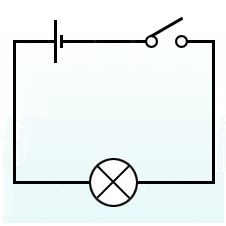
The bulb will shine in the following circuit

a)

True

b)

False

55.

If one bulb is disconnected in this circuit, will the other bulb still shine?

a)

Yes

b)

No

56.

The greater the resistance

a)

the lower the current

b)

the higher the current

c)

current stays the same

57.

Ammeters should be connected

a)

In series

b)

In parallel

58.

Voltmeters should be connected

a)

In series

b)

In parallel