Wayground logo

Free Printable Worksheets

Font size

S
M
L
XL
Worksheets

Year 11 A Level Biology Taster

Total questions: 50

Worksheet time: 3625secs

Name
Class
Date
1.
Which 4 elements make up most of all living matter?
a)
Carbon, Hydrogen, Nitrogen, Oxygen
b)
Carbon, Oxygen, Sodium, Potassium
c)
Carbon, Hydrogen, Calcium, Nitrogen
d)
Carbon, Oxygen, Nitrogen, Sulfur
2.
The image below shows a polymer of glucose molecules. What type of macromolecule is this?
a)
carbohydrate
b)
protein
c)
lipid
d)
nucleic acid
3.
An unknown molecule contains a sugar and a phosphate group. It is likely what?
a)
carbohydrate
b)
protein
c)
lipid
d)
nucleic acid
4.

Larger polymers are formed when monomers are joined together by a _______ reaction.

a)

condensation

b)

digestion

c)

hydrolysis

d)

redox

5.
What is the monomer of proteins?
a)
monosaccharides
b)
amino acids
c)
phospholipids
d)
nucleotide
6.
Which of the macromolecules contain nitrogen?
a)
proteins only
b)
nucleic acids only
c)
proteins and lipids
d)
nucleic acids and proteins
7.
What is the function of fats for living organisms?
a)
short term energy storage
b)
store hereditary information
c)
long term energy storage
d)
catalyze metabolic reactions
8.
How are the subunits of proteins linked together?
a)
ionic bonds
b)
amino acids
c)
monomers
d)
peptide bonds
9.

Which statement about polymers is not true?

a)

polymers consist of more than one type of monomer

b)

polymers are broken down through hydrolysis

c)

polymers are synthesized through condensation reactions

d)

All are untrue

10.
The image depicts which level of structure in proteins?
a)
primary
b)
secondary
c)
tertiary
d)
quaternary
11.
Which of the following is a protein (amino acid)?
a)
A
b)
B
c)
C
d)
D
12.
Identify the element found in a protein that is not present in a carbohydrate
a)
Carbon
b)
Oxygen
c)
Hydrogen
d)
Nitrogen
13.
What is a type of protein that speeds up chemical reactions?
a)
sucrose
b)
insulin
c)
enzyme
d)
antibodies
14.
Which of the following is NOT a function of a protein?
a)
Storing energy for long periods of time in a small space
b)
Building structures
c)
speeding up reactions
d)
storage 
15.

Which protein structure is matched correctly?

a)

primary structure : folded amino acid chains due to hydrogen bonds

b)

secondary structure : interactions between more than one amino acid chain in a protein

c)

tertiary structure : 3D structure due to interactions of R groups on amino acids

d)

quaternary structure : chain of amino acids

16.
The two types of folding in the secondary structure are.....
a)
alpha-helix & beta-pleated sheets
b)
polypeptide & nucleotide
c)
globular & fibrous
17.
The main bonding in the secondary structure of a protein is due to.....
a)
covalent bonding
b)
ionic bonding
c)
hydrogen bonding
d)
polar bonding
18.

The folding in proteins responsible for tertiary structure is mainly due to the interactions of....

a)

the 'R' groups

b)

the amine groups

c)

the carboxy groups

d)

the 'S' group

19.

Two or more polypeptides are attached together and work as one unit. This level of protein structure is?

a)

Primary

b)

Secondary

c)

Tertiary

d)

Quaternary

20.
How many different amino acids are there?
a)
15
b)
20
c)
25
d)
30
21.

The diagram shows a bond forming between two amino acids. What is the name of this reaction?

a)

Condensation

b)

Hydrolysis

c)

Pepysis

d)

Oxidation

22.

What type of protein is hemoglobin

a)

primary

b)

secondary

c)

tertiary

d)

quaternary

23.

A peptide bond is formed between

a)

amino acid and amine group

b)

amino group and "R" group

c)

"R" group and carboxyl group

d)

carboxyl group and amine group

24.

What type of protein is shown below?

a)

primary

b)

secondary

c)

tertiary

d)

quatenary

25.

Assume the biomolecule pictured in the illustration is normal. The entire molecule is called ____________.

a)

Hemoglobin S

b)

Heme

c)

Iron (Fe)

d)

Beta-Chains

e)

Hemoglobin

26.

Hemoglobin is made up of ___ protein chains.

a)

2

b)

4

c)

6

d)

1

e)

8

27.

Which variable is investigated and therefore changes for each set of repeats?

a)

Control

b)

Dependent

c)

Independent

d)

Hyper

28.

If you didn't keep these the same then they would also affect the results and the test would be unfair and invalid.

a)

Dependent variable

b)

Control variables

c)

Independent variables

d)

Repeat variables

29.

This variable will change in response to the variable that is changed in the investigation.

a)

Independent variable

b)

Dependent variable

c)

Control variables

d)

Infinite variables

30.

Which variable usually goes on the x axis?

a)

Independent

b)

Dependent

c)

Control

31.

Which column does the independent variable go in?

a)

The first column

b)

The 2nd column

c)

The last column

d)

It doesn't matter

32.

What type of variable must be represented in the form of a bar chart?

a)

Numerical

b)

Continuous

c)

Categoric

d)

Quantitative

33.

If both variables are numeric then the only graph type you should use is....

a)

a bar graph

b)

a line graph

c)

a pie chart

34.

What makes digital equipment more precise?

a)

Can measure to 2 decimal places

b)

Can be turned off and on

c)

Can be set to zero

d)

Can be calibrated

35.

If you do repeats then what three things does this allow you to do?

a)

calculate an average

b)

identify outliers

c)

see if there is repeatability

d)

assess accuracy

e)

assess validity

36.

The last column in a results table usually contains the...

a)

mean

b)

conclusion

c)

values for the 3rd set of repeats

d)

independent variable

37.
Attractions between water molecules are called
a)
Covalent bonds
b)
Ionic bonds
c)
Polar bonds
d)
Hydrogen bonds
38.
What happens when enzymes are heated to a high temperature?
a)
The enzymes die.
b)
The shapes of the enzyme are altered or denatured
c)
The enzymes' amino acid sequence changes.
d)
The enzymes remain the same
39.
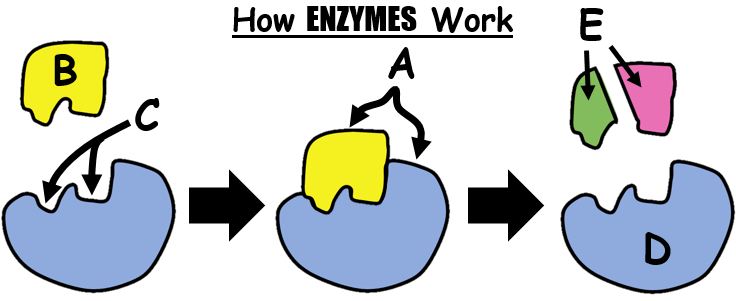
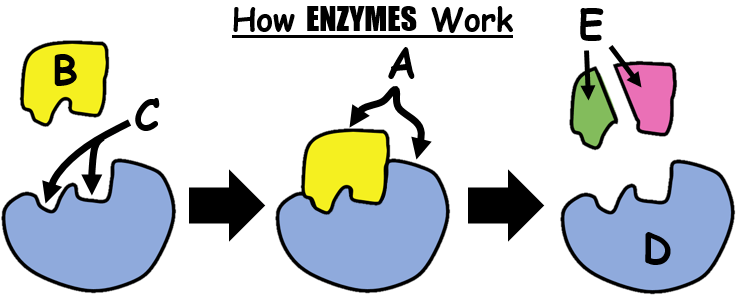
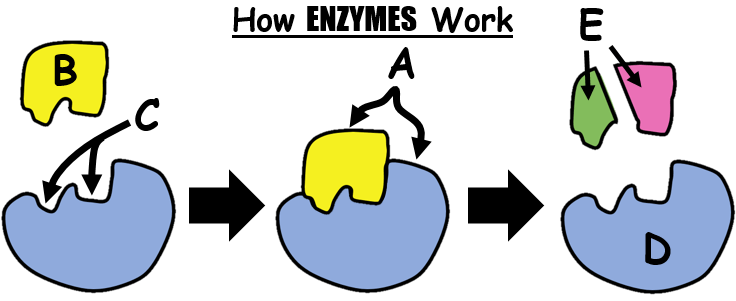
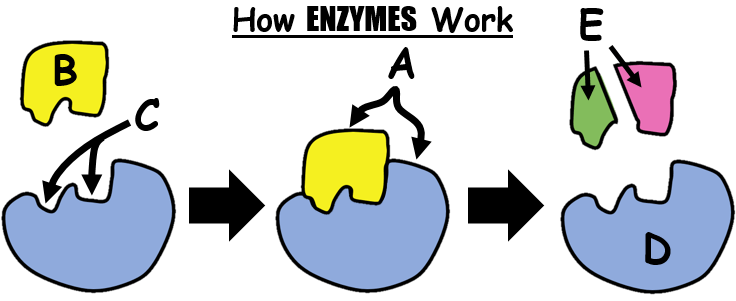
In the diagram, what is letter A? 
a)
product
b)
substrate
c)
enzyme-substrate complex
d)
active site
40.
Letter C...
a)
active site
b)
enzymes
c)
substrate
d)
products
41.
Letter D...
a)
active site
b)
enzyme
c)
substrate
d)
products
42.
Letter E...
a)
active site
b)
enzyme
c)
substrate
d)
products
43.
Letter B...
a)
active site
b)
enzyme
c)
substrate
d)
products
44.
Enzymes are _________ that __________ chemical reactions.
a)
proteins, slow down
b)
proteins, speed up
c)
lipids, slow down
d)
lipids, speed up
45.

Water is a _ molecule.

a)

nonpolar

b)

polar

46.
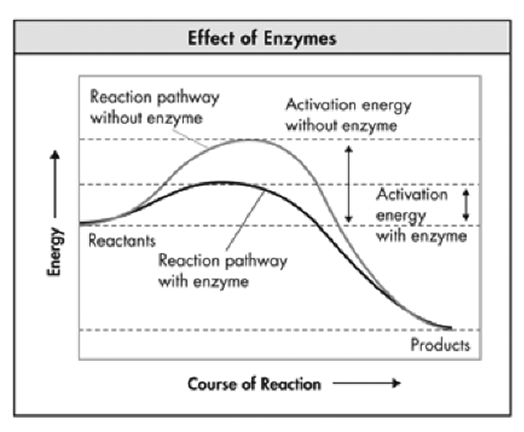
The graph shows how enzymes affect reactions in cells. Which statement best summarizes the information shown in the graph?
a)
Enzymes increase the energy of the reactants.
b)
Enzymes decrease the energy level of the products.
c)
Enzyme decrease the activation energy of the reaction.
d)
Enzymes reverse the direction of the reaction.
47.
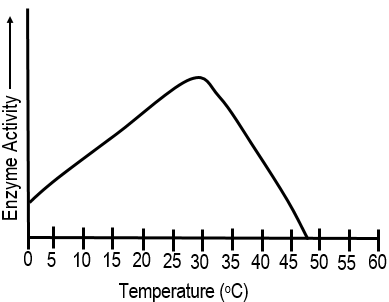
Based on the graph, what is the optimal temperature for this enzyme? 
a)
15oC
b)
40oC
c)
30oC
d)
35oC
48.

What happens when enzymes are heated to a high temperature?

a)

The enzymes die.

b)

The shapes of the enzyme are altered.

c)

The enzymes' amino acid sequence changes.

d)

The enzymes remain the same

49.
Every enzyme has a optimal temperature and pH. True or False?
a)
True 
b)
False
50.
Enzymes are composed of which of the following monomers? 
a)
amino acids
b)
carbohydrates
c)
nucleotides
d)
monosaccharides