
 Worksheets
CELL DIVISION MITOSIS & MEIOSIS
Total questions: 26
Worksheet time: 17mins
Name
Class
Date
1.
Among the following, the term that includes the others is ___.
a)
interphase
b)
nuclear division
c)
mitosis
d)
cell cycle
2.
The longest phase of the cell cycle
a)
prophase
b)
interphase
c)
metaphase
d)
mitosis
3.

Structure (b) is a ____.
a)
chromosome
b)
chromatid
c)
centromere
4.

Identify the phase of mitosis
a)
prophase
b)
metaphase
c)
anaphase
d)
telophase
5.
name the phases in mitosis
a)
prophase, metaphase
b)
234
c)
456
d)
789
6.

Fruit fly body cells have 8 chromosomes. After mitosis, you would expect a resulting fruit fly daughter cell to have -
a)
16 chromosomes.
b)
46 chromosomes.
c)
8 chromosomes.
d)
4 chromosomes.
7.
The uncontrolled division of cells...
a)
meiosis
b)
cancer
c)
nondisjunction
d)
crossing over
8.
How does cytokinesis differ in plant and animal cells?
a)
Cytokinesis only takes place in animal cells.
b)
Cytokinesis only takes place in plant cells.
c)
Plant cells form a cell plate, animal cells form a cleavage furrow.
d)
Animal cells form a cell plate, plant cells form a cleavage furrow.
9.
Which cell structure produces the spindle fibers?
a)
Centromeres
b)
Centrioles
c)
Chromatids
d)
Ribosomes
10.
G1, S, and G2 are all phases of ______________.
a)
Mitosis
b)
Cytokinesis
c)
Interphase
d)
Meiosis
11.
Mitosis results in
a)
two genetically diverse diploid cells
b)
two identical haploid cells
c)
two identical diploid cells
d)
two genetically diverse haploid cells
12.
Which of the following cell types is formed by meiosis?
a)
muscle cells
b)
skin cells
c)
sperm cells
d)
blood cells
13.
Which process is necessary for the inherited traits of an organism to be passed along by sexual reproduction?
a)
mitosis
b)
meiosis
c)
mutation
d)
fission
14.

Which best describes the process shown?
a)
nondisjunction
b)
mitosis
c)
independent assortment
d)
crossing over
15.
If an intestinal cell in a butterfly contains 24 chromosomes, a butterfly egg would contain ____ chromosomes.
a)
3
b)
6
c)
12
d)
24
16.
Body cells of fruit flies contain 8 chromosomes. Scientists used studies of flies to discover how egg and sperm are formed. What did they observe?
a)
Body cell of offspring flies have 16 chromosomes.
b)
Sperm cells have 8 chromosomes.
c)
Egg cells have 4 chromosomes.
d)
Body cells of offspring have 4 chromosomes.
17.
How many daughter cells are produced at the end of meiosis?
a)
1
b)
2
c)
3
d)
4
18.
The result of meiosis is ______.
a)
two diploid cells
b)
two haploid cells
c)
four diploid cells
d)
four haploid cells
19.
Why is meiosis important for sexual reproduction?
a)
It allows the zygote formed from fertilization to have triple the chromosome number of the organism.
b)
It allows gametes to have twice the original number of chromosomes of the organism.
c)
It allows gametes to have half the original number of chromosomes of the organism.
d)
It allows the zygote formed from fertilization to have half the original number of chromosomes of the organism.
20.

What phase is shown in the picture?
a)
anaphase 1
b)
anaphase 2
c)
metaphase 1
d)
telophase 1
21.
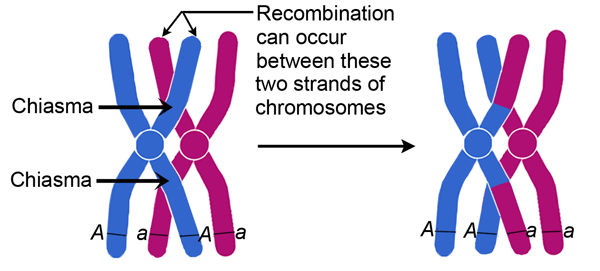
This image shows chromosomes during Prophase 1. Which of the following correctly describes the process shown?
a)
segregation of sister chromatids
b)
condensation and segregation of alleles
c)
mutationin which the DNA content of the gene is altered
d)
crossing - over in which alleles are exchanged
22.

What phase is shown here?
a)
Prophase II
b)
Metaphase I
c)
Metaphase II
d)
Anaphase I
23.

What phase is shown here?
a)
Metaphase II
b)
Telophase I
c)
Telophase II
d)
Metaphase I
24.

What phases is shown here?
a)
Prophase II
b)
Prophase I
c)
Anaphase II
d)
Interphase I
25.
The greatest amount of genetic variation occurs in offspring that reproduce —
a)
sexually through fission
b)
sexually through meiosis
c)
asexually through mitosis
d)
asexually through budding
26.
What is separated during meiosis II?
a)
sister chromatids
b)
homologous chromosomes
c)
spindle fibers
d)
crossing over
100 %

