
Font size
 Worksheets
Nuclear Physics
Total questions: 77
Worksheet time: 3hrs 21mins
Deuterium nucleus has a mass of 1.53×10⁻³ universal mass units (1.66×10⁻²⁷ kg) less than its components, this mass represents an energy of
1.37 X 10¹⁴ J
1.48 X 10⁸ J
2.12 X 10¹¹ J
3.6 X 10⁶ J
The energy equivalent of 5.0 × 10⁻³ kg is
4.5 X 10¹⁴ J
1.37 X 10¹⁴ J
2.25 X 10¹⁶ J
2.34 X 10¹⁵ J
How much energy is produced when 0.250 universal mass units (1.66×10⁻²⁷) of matter is completely converted into energy?
2.25 X 10¹⁶ J
2.34 X 10¹⁵ J
1.8 X 10¹² J
1.14 X 10⁻³⁰ J
What is the energy equivalent of a mass of 0.026 kilogram?
2.34 X 10¹⁵ J
9 X 10¹⁶ J
1.14 X 10⁻³⁰ J
1.8 X 10¹² J
The energy produced by the complete conversion of 2.0 × 10⁻⁵ kilogram of mass into energy is
1.8 X10¹² J
9 X10¹⁶ J
2.25 X 10¹⁶ J
1.37 X 10¹⁴ J
The total conversion of 1.00 kilograms of the Sun’s mass into energy yields
9 X 10¹⁶ J
1.14 X 10⁻³⁰ J
1.8 X 10¹² J
2.34 X 10¹⁵ J
As the binding energy of a nucleus increases, the
energy required to separate the nucleus into
nucleons _____.
decreases
increases
stays the same
becomes negative to positive
Which of the following statements is/are correct
regarding the binding energy of the nucleus.
I. It is equivalent to the mass defect
II. It is the energy that holds the nucleus
together
III. It is the energy required to remove a
proton from the nucleus
I only
II only
III only
I and II only
When nucleons form stable nucleus, binding
energy is _______.
created from nothing
destroyed into nothing
absorbed as high energy photons or
particles
released as high energy photons or particles

Which graph best represents the relationship
between energy and mass when matter is converted
into energy?
A
B
C
D
When protons and neutrons combine to form a nucleus , mass of the nucleus will be
Equal to the mass of protons and neutrons before combining
Greater than mass of protons and neutrons before combining
less than mass of protons and neutrons before combining
As the binding energy of a nucleus increases, the
energy required to separate the nucleus into
nucleons _____.
decreases
increases
stays the same
becomes negative to positive
Define binding energy
the energy required to break a nucleus into separate, non-interacting nucleons
the energy required to make a nucleus in a fusion reaction
the energy required to separate protons from neutrons
the energy required to separate the nucleons and electrons
What is a nucleon?
Protons & neutrons
Protons & electrons
Electrons & protons
Who knows

What does this graph show?
Binding energy per nucleon vs proton number
Mass defect vs proton number
Binding energy per nucleon vs stability
Mass defect vs stability
Which element is the most stable?
Iron
Carbon
Uranium
Hydrogen

Elements to the right of Iron will undergo
Fusion to become more stable
Fission to become more stable
The mass which is lost during the decay is called the
mass
effective mass
mass defect
mass of proton
Nuclear energy is
the energy obtained from the total mass during a radioactive decay
the energy obtained from the mass defect during an isotope making
the energy obtained from the total mass during a fusion reaction
the energy obtained from the mass defect during a radioactive decay
Which is incorrect?
E = energy released (J)
m = mass defect (kg)
m = total mass (kg)
c = speed of light
Describe the structure of an alpha particle.
a fast-moving electron
2 protons and 2 neutrons
a slow-moving neutron
a hydrogen nucleus
What is the relative charge of an alpha particle?
-1
0
1
2
An alpha particle can be stopped by (a) .
In alpha decay, the mass number...
increases by 2
decreases by 2
increases by 4
decreases by 4
In alpha decay, the atomic number...
increases by 2
decreases by 2
increases by 4
decreases by 4


85209At = ___ + 24He
Gamma rays have
no mass
a huge mass
a small mass
an average mass
614C = ___ + -10e

How is the alpha particle written in a nuclear equation?
42He
24He
0-1e
00γ
Gamma rays have
no mass
a huge mass
a small mass
an average mass

In a correctly written symbol what would be located in the "Z" position?
number of neutrons
atomic number
number of electrons
mass number
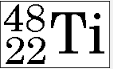


Which type of radiation releases an electron?
Alpha radiation
Beta radiation
Gamma radiation
Theta radiation


What does the graph show is needed to keep the nucleus stable?
As protons increases, more neutrons are needed.
As protons increases, less neutrons are needed.
As neutrons increase, less protons are needed.

What is likely to happen to unstable nuclei with too many, or too few, neutrons?
They will decay by emitting radiation.
They will loose all their electrons.
They will bond with other atoms.

If the nucleus has too few neutrons, it will emit two protons and two neutrons called ___________.
an alpha particle
a beta particle
a neutron
gamma radiation
Beta radiation is ____________________
an electron from an electron shell.
an electron from the nucleus.
two protons and two neutrons.
a high frequency electromagnetic wave.
What will happen if the nucleus has too many neutrons?
A neutron will turn into a proton and emit a fast-moving electron.
A proton will turn into a neutron and emit a fast-moving electron.
A neutron will break into two and emit a fast-moving alpha particle.

Which form of radioactive decay is the most ionising?
Alpha
Beta
Gamma
What type of decay is shown here
23892U ---> 23490Th + 42He.
alpha
beta
gamma
How long does it take a 180-gram of gold-198 to decay to 22.5 grams if the half -life of gold-198 is 2.68 days?
8.04 days
3 days
4 days
2.68 days
How long will it take for a 28-gram sample of radon-222 to decay to 3.5 grams? the half-life of radon-222 of 3.82 days
15.28 days
11.46 days
3 days
4 days
How long will it take for a 150-gram sample of Nitrogen-16 tp decay to 18.75 grams if the half-life for Nitrogen -16 is 7.2 seconds
7.2 seconds
14.4 seconds
18.75 seconds
21.6 seconds
How long will it for a take for a 40 gram. The half-life of cobalt-60 is 5.26 years sample ofcobalt-60 to decay to 5 grams?
17.75 days
15.78 years
15.15 years
17.17 years
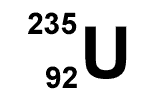
The half-life of Zn-71 is 2.4 minutes. Starting with 100.0 g, how many grams would remain after 7.2 minutes?
100.0 g
50.0 g
12.5 g
8.5 g
The half-life of strontium-90 is 25 years. How much will remain after 100 years if the initial amount is 4.0 g?
3.0 g
0.25 mg
0.3 g
6.25 g
Which force is responsible for beta decay?
Electromagnetism
Weak force
Strong force
Gravity
What happens to an atom's atomic number when it undergoes beta decay?
it always increases by 1
it always decreases by 1
depends: it could either increase by 1 or decrease by 1
it always decreases by 2
Which of the following is NOT true of beta decay?
it can mean a proton turns into a neutron
it can mean a neutron turns into a proton
it can mean a proton turns into an electron
sometimes an electron is emitted
What happens to an atom's mass when it undergoes beta decay?
increases by 2
increases by 4
decreases by 2
it does not change
When an atom undergoes gamma ray radiation, its atomic number...
increases by 1
decreases by 1
decreases by 2
does not change

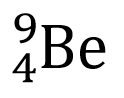
This element is also called
Beryllium-4
Beryllium-5
Beryllium-9
Beryllium-13

