Worksheets
Matter
Total questions: 75
Worksheet time: 6hrs 15mins

In which phenomena water changes into water vapour below its boiling point?
Evaporation
Condensation
Boiling
No such phenomena exist
when we put some crystals of potassium Permanganate in a beaker containing water, we observe that after sometime whole water has turned pink. This is due to:
Boiling
Melting of potassium Permanganate crystals
sublimation of crystals
Diffusion
The state of matter which has least diffusion capacity
Gas
solid
liquid
plasma
The state of matter which has maximum kinetic energy
Gas
Liquid
solid
vacumm
When heat energy is supplied,the kinetic energy of the molecules
Decreases
increases
First increases and then decreases
Remains same
Which of the following statements is NOT a characteristic of solution?
It is homogeneous
It is a mixture of one phase only
The solute can be separated from the solvent through filtration
Its components are so well mixed that all parts of the solution appear the same
What do you call the component in solutions presents in greater amount?
dispersed phase
dispersion medium
solute
solvent
Jose wants to see the different pigments or colors present in green leaves.Which of the following techniques should he use?
chromatography
filtration
fractional distillation
steam distillation
At sea level. an odorless and liquid boils at a range of 100 0C to 105 0C? What inference can be drawn from this observation?
It is a metal
It is a mixture
It is a non-metal
It is a pure substance
Gold and silver are used to make jewelries. Which of the following properties make them to be flattened into different shapes?
brittleness
good electrical conductivity
good heat conductivity
malleability
True of False? When ice melts, the number of atoms remains the same.
true
False
True or False? If you put different liquids in a jar, the most dense will sink to the bottom.
True
False
As a substance is heated up, what happens to its molecules?
they move faster
they get farther apart
they may change state
all answers are correct
Which one has the most kinetic energy?
solid
liquid
gas
Which THREE (3) are SI (Standard International) units for mass?
pounds (lb)
grams (g)
liters (L)
kilograms (kg)
milligrams (mg)

The amount of space an object takes up is its ________________.
mass
volume
density
weight

In the image, the same atoms are REARRANGED during a chemical reaction, illustrating the Law of Conservation of Matter. Which below correctly states this law?
Matter is created but not destroyed.
Matter is destroyed but not created.
Matter is never created or destroyed, just changed.
Matter cannot change form.
When the temperature of a liquid is increased a little, what happens to its particles?
They move so far apart becoming gas
They come close together
They start vibrating more
They stop vibrating
Which state of matter has no definite shape and no definite volume?
Liquid
Gas
Solid
Liquid and gas
The term "fluid" may describe more than one state of matter. Which one of the following may describe a fluid?
Solid and gas
Solid and liquid
Liquid and gas
Solid, liquid and gas
Ethanol has a melting point of -114 ºC, and a boiling point of 79 ºC. What state will it have at a temperature of 65 ºC?
Solid
Liquid
Gas
Plasma
An example of a substance that is freeze is…
Dry ice
Fog
Steam
Ice cube
All solids, liquids and gases are made up of...
Volumes
Particles
Colors
Temperature
Which describes a property of all elements?
All elements are metals.
All elements have six electrons.
All elements exist in the solid phase.
All elements are pure substances.
A student put 200 milliliters (mL) of water into a pot, sets the pot on a burner, and heats the water to boil. When the pot is taken off the burner, it contains only 180 milliliters (mL) of water. What happened to the rest of the water?
It condensed.
It turned into water vapor.
It was absorbed by the heat.
It was used up.
The ice cubes in a freezer are melting. Which change most likely is causing the ice cubes to melt?
a decrease in the mass of the ice cubes
an increase in the mass of the ice cubes
an increase in the temperature inside the freezer
a decrease in the temperature inside the freezer
Diffusion occurs only in solids
True
False
What is a solute?
A substance dissolved in another substance
the substance doing the dissolving
How do the particles move in diffusion?
From a region of low concentration to a region of high concentration
From a region of high concentration to a region of low concentration
From a region of low concentration to a region of low concentration
From a region of high concentration to a region of high concentration
The movement of particles is __________, resulting in the particles being spread throughout the container
Structured
In a straight line
Random
In curved, way motions
What happens to the coffee particles when coffee is added to hot water?
They sink to the bottom of the cup
They spread out
They clump together

Which diagram best shows the end result of diffusion?
F
G
H
J

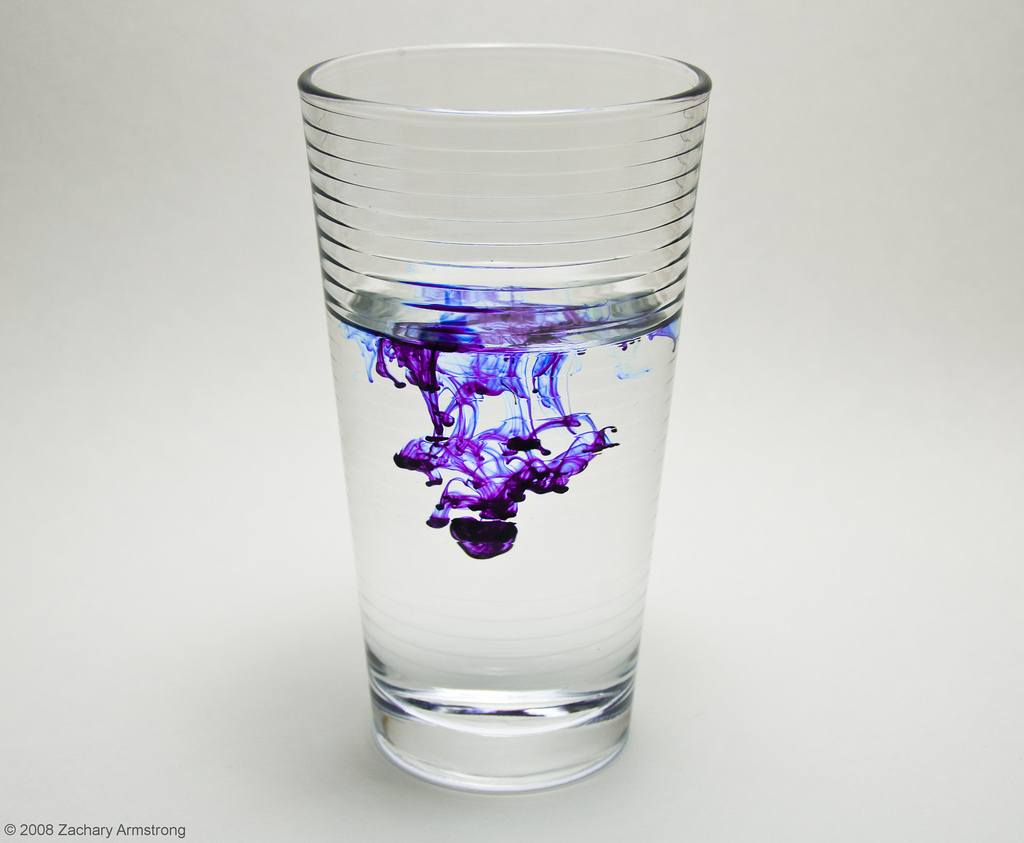
Where is there a low concentration of dye?
at the bottom of cup
in the color
at the top of cup
no concenteraion gradient
Gas pressure is caused by
Gas molecules heating up
Gas molecules reacting with other gas molecules
Gas molecules hitting the walls of a container
Gas molecules hitting other gas molecules
If a hairspray can is heated, what can be expected of the pressure of the gas inside the can?
The pressure will increase
The pressure will decrease
The pressure will remain constant
The pressure will equalize

The pressure inside the balloon will:
Decrease
Increase
Remain the same
Not enough information to formulate an answer

This is an example of the everyday application of pressure in:
Solids
Liquids
Gases
Plasma

The pressure inside the syringe will decrease if we move the plunger in:
Direction A
Direction B
We don't have to move the plunger as the pressure will change on its own.
None of the above answers.
What is Brownian motion?
The movement of water molecules in a beaker
The movement of air molecules
The movement of solid molecules
The movement of smoke particles in air
Pollen grains suspended in water exhibit Brownian motion. How does a particle undergoing Brownian motion move?
In smooth curves
Randomly
Orderly with a pattern
In straight lines with no change of direction
A student makes an observation using a microscope. He observed some particles which were moving in a zig-zag way. What particles could these NOT be?
Smoke particles in air
Dust particles in a room
Pollen grains in water
Molecules in a solid bar of steel
Which of the following does NOT describe Brownian motion?


Which of these under greater pressure?


Who first had evidence of the atom?
Bohr
Dalton
Rutherford
Thompson
What is an ion?
A Charged Atom
A Large Atom
A Small Atom
A Cute Atom


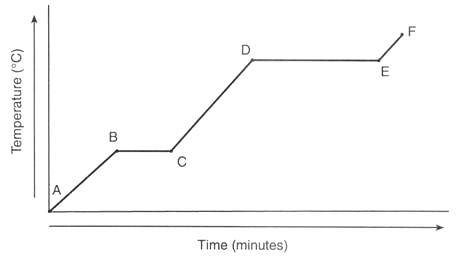


The melting point of the sample is
-60 ºC
-100 ºC
60 ºC
100 ºC
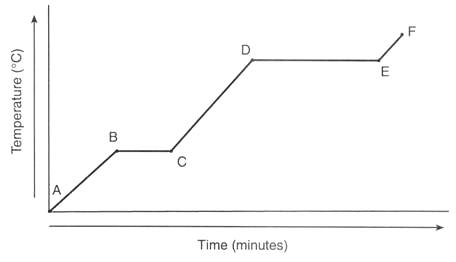
Which of the following changes of matter were made by heating?
Corn kettles into popcorn
Juice made into juice pops
water into ice cubes
oranges into orange juice
How can you make water a liquid?
It already is a liquid silly!
Heat it
Cool it
5. True or False: elements and compounds are pure substances.
True
False
9. Blood is a fluid found in the bodies of humans and other animals. It can be physically separated into plasma, red blood cells and white blood cells. Blood is a ___________________
pure substance
mixture
What process allows you to smell freshly baked bread in a supermarket, even when you are far from the bakery aisle?
Evaporation
Diffusion
Chromatography
What happens to the boiling point of water when salt is added to it?
It no longer boils at exactly 100 degrees Celsius
It boils at exactly 100 degrees Celsius
It will never boil
Instant coffee is made by dissolving a powder in hot water. Instant coffee is a ___________________ .
pure substance
mixture
Kool aid, a liquid containing water mixed evenly with kool aid powder is a
element
compound
heterogeneous mixture
solution
Which of the following is classified as a pure substance?
Lemonade
Fruit punch
ketchup
Helium