Wayground logo

Free Printable Worksheets

Font size

S
M
L
XL
Worksheets

Earth Science 7th grade

Total questions: 59

Worksheet time: 58mins

Name
Class
Date
1.
A front is
a)
where warm air is cooling at earth's surface
b)
a boundary where hot and cold air are separating
c)
a boundary where two different air masses meet
d)
where cold air is rising and forming rain clouds
2.
A cold front usually brings what kind of weather?
a)
snow  
b)
sunny and fair
c)
heavy rain and/or thunderstorms 
d)
 cool and dry 
3.
What is the purpose of a barometer?
a)
Tells you that it is going to rain.
b)
Measures the amount of wind.
c)
Measusres the amount of clouds in the sky.
d)
It measure the amount of pressure in the air.
4.
Ryan is working on his Science Fair project. He plans to measure the amount of rainfall that has fallen in his neighborhood over the past two weeks. What instrument should he use?
a)
Rain gauge
b)
Wind Vane
c)
Barometer
d)
Thermometer 
5.
Select the best answer- What is weather?
a)
Weather is what is happening in the atmosphere in a certain place at a certain time.
b)
Weather is the atmosphere.
c)
Weather is precipitation.
d)
Weather is wind.
6.
Because the earth is spinning on its axis, the global winds appear to curve. This is known as the __________ ________.
a)
Coriolis Effect
b)
Greenhouse Effect
c)
Climate Effect
d)
Atmosphere Effect
7.
What kind of weather is usually associated with a high pressure system?
a)
Sunny weather
b)
Precipitation (rain, snow, etc.)
8.

Differences in air pressure cause wind.

a)

True

b)

False

9.

As the temperature in an area increases, the air pressure ___________.

a)

increases

b)

decreases

c)

stays the same

10.
Which best explains why runoff is important?
a)
It returns water to other locations on Earth
b)
It increases the chance of flooding
c)
It makes evaporation occur faster
d)
It increases condensation
11.
What is A?
a)
Evaporation
b)
Condensation
c)
Precipitation
d)
Runoff
12.
What is B?
a)
Evaporation
b)
Condensation
c)
Precipitation
d)
Runoff
13.
What is water that flows in rivers and streams into the oceans and lakes?
a)
evaporating
b)
condensing
c)
precipitating
d)
runoff
14.
What is      D?
a)
Evaporation
b)
Condensation
c)
Precipitation
d)
Runoff
15.
The changes to water when it cycles the earth is called
a)
the moon cycle
b)
the sun cycle
c)
the water cycle
d)
the wind cycle
16.
When water is heated in the ocean by the sun and turns into water vapor
a)
condensation
b)
evaporation
c)
transpiration
d)
runoff
17.
What type of weather would you predict for Columbia, SC based on this weather map? 
a)
Cooler and potential for storms
b)
Warm and clear
c)
Consistently hot and sunny
d)
Record highs
18.

What type of weather often accompanies a cold front?

a)

fog and warmer temperatures

b)

rain and colder temperatures

c)

tornadoes and warmer temperatures

d)

hurricanes and colder temperatures

19.

The table shows the temperature and precipitation levels predicted to occur in four different cities on the same day. In only one city on this day, it is predicted to snow. Which city will most likely experience snow on this day?

a)

city A

b)

city B

c)

city C

d)

city D

20.
The movement of weathered material on the Earth's surface by wind, water, and ice is
a)
erosion
b)
deposition
c)
landslides
21.
The breakdown of rock into smaller particles from the effects of wind, water and ice is
a)
deposition
b)
delta
c)
weathering
22.
The buildup of land by depositing sediment and soil in a new location is
a)
earthquake
b)
weather
c)
deposition
23.
Identify this landform:
a)
Dune
b)
Stream
c)
Volcano
d)
Island
24.

How do glaciers change land?

a)

They can wear away mountains and leave behind valleys.

b)

They stop erosion of land by blocking rivers and streams.

c)

They warm up the area so that animals can live.

d)

They move very quickly and break everything in their path.

25.

What happens during a land slide?

a)

Magma moves up from the mantle and erupts.

b)

Large pieces of land break off and slide down.

c)

The ground freezes and melts when it gets warmer.

d)

Water in streams and rivers overflows the banks.
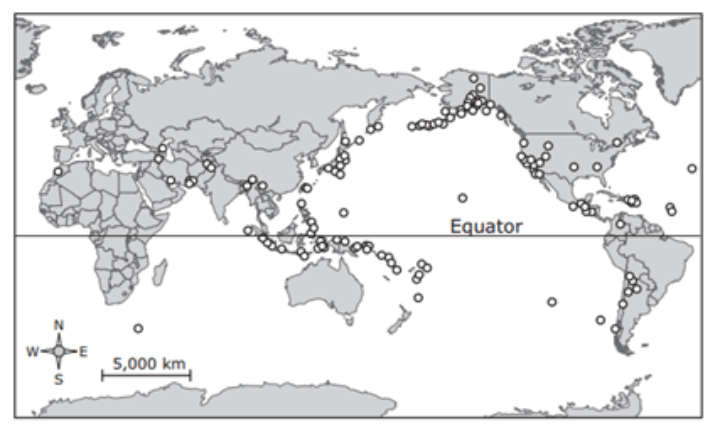
26.

A scientist was studying a type of event that occurred on Earth in various places within a 30-day period. The circles indicate where the events happened.

What type of event do the circles on the map most likely represent?

a)

Landslides, because they are all located along ocean coastlines

b)

Response Volcanoes, because they occur only near the equator

c)

Earthquakes, because they occur on land and on the ocean floor

d)

Floods, because heavy rains can make riverbeds deeper and create deltas

27.
A group of students is building a model to show how water from melting glaciers moves toward the ocean.  They put clay, water, and ice cubes into a plastic bin.  They place a heat lamp next to the bin. 
 
  Which of the following would most likely help them show how water from melting glaciers moves in their model?
a)
using colored water to represent the water in the ocean
b)
using colored water to make the ice cubes that represent the glaciers
c)
using different colors of clay to represent dry land and the bottom of the ocean
d)
using different colors of light to represent sunlight shining on the glaciers and dry  land
28.
These rocks were broken apart from the continuous freeze/thaw of water in the cracks of the rocks. This is an example of:
a)
ice wedging
b)
acid rain
c)
permeability
d)
abrasion
29.
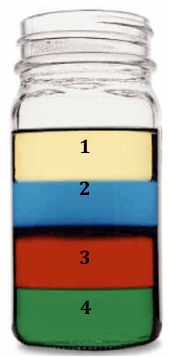
Put the liquids in order from most dense to least dense?
a)
4, 3, 2, 1
b)
1, 2, 3, 4
c)
3, 4, 2, 1, 
d)
4, 3, 1, 2
30.

______ causes deep ocean currents

a)

The Coriolis Effect

b)

gravity

c)

wind

d)

density differences

31.

______ causes surface currents.

a)

The Coriolis Effect

b)

gravity

c)

density differences

d)

wind

32.

______ causes deep ocean currents

a)

The Coriolis Effect

b)

gravity

c)

wind

d)

density differences

33.

The process by which plants release water vapor into the air through stomata.

a)

condensation

b)

evaporation

c)

transpiration

d)

cohesion

34.
Layers of rock or soil that allow water to flow through are called...
a)
aquifers
b)
lakes
c)
reservoirs
d)
watersheds
35.

The process of breaking down rocks into smaller pieces or sediments is called?

a)

Weathering

b)

Erosion

c)

Depostion

36.

The process that moves bits of rock or soil from one place to another is?

a)

Erosion

b)

Weathering

c)

Depostion

37.

The process in which sediments, soil, and rocks are added to a landform is?

a)

Erosion

b)

Deposition

c)

Weathering

38.

This process creates beaches, barrier islands, and sand bars?

a)

Erosion

b)

Chemical weathering

c)

Physcial weathering

d)

Depostion

39.

The effect of heavy rain pouring down a steep slope on bare soil is?

a)

Sediments deposited on farmland

b)

Mudslide

c)

Weathering splits and breaks the rock of a cliff

d)

Erosion occurs as rocks move downstream

40.

The provided picture shows a...

a)

Delta

b)

Oxbow

c)

Curve

41.
An area of land in which all of the water falling or flowing over it drains to the same location is a/an…
a)
watershed
b)
watertable
c)
river
d)
aquifer
42.
Water that is located in the ground in the pores within rock is called…
a)
watershed
b)
surface water
c)
groundwater
d)
water cycle
43.
What two elements make up water?
a)
Helium and oxygen
b)
Hydrogen and oxygen
c)
helium and carbon
d)
oxygen and carbon
44.
Large bodies of water do not quickly fluctuate in temperature. Why?
a)
Water is a solvent.
b)
Water has a high heat capacity.
c)
Water acts as a buffer.
d)
Water is non-polar.
45.
The fact that ice floats on liquid water is due to the fact that water's solid is ___________ than it's liquid form
a)
less polar
b)
more polar
c)
less dense
d)
more dense
46.
How much of Earth's water is salt water?
a)
50%
b)
66%
c)
75%
d)
97%
47.
How do we characterize an air mass that forms over land?
a)
Dry
b)
Wet
c)
Cold
d)
Warm
48.
How do we characterize an air mass that forms over the ocean?
a)
Dry
b)
Wet
c)
Cold
d)
Warm
49.
Air travels
a)
from high pressure to low pressure
b)
from low pressure to high pressue
50.
When two different air masses collide...
a)
A front forms
b)
They casually become one
c)
A new planet evolves
d)
Dinosaurs become extinct
51.
The amount of water vapor present in the air is called ________________.
a)
weather
b)
humidity
c)
air mass
d)
dew point
52.
Warm air rises because it is __________ dense then cold air.
a)
More
b)
Less
53.
What heats the Earth's surface?
a)
the moon
b)
the sun
c)
the ocean
d)
the sky
54.
The process the causes plate tectonics, wind, and ocean currents is known as...
a)
Radiation
b)
Conduction
c)
Nuclear Energy
d)
Convection
55.
Which of the following is most likely a cause of hurricanes?
a)
Cooler ocean temperatures
b)
Warmer ocean temperatures
c)
Large ocean waves
d)
Strong ocean currents
56.
_______ affects weather because the further north or south you go from the Equator, the less solar energy (heat).
a)
altitude
b)
latitude
c)
sunlight
d)
atmosphere
57.
______ affects weather and climate because it heats the Earth unevenly.
a)
latitude
b)
altitude
c)
atmosphere
d)
sunlight
58.
______ is the average pattern for weather over a long period of time.
a)
climate
b)
weather
c)
forecast
d)
sunlight
59.
Earth is unevenly heated due to its?
a)
oceans and moon
b)
tilt and shape
c)
gravity and clouds
d)
climate and weather